

Skin · 10 min read
Breast Reduction in London: Relief, Scars and Recovery
By Dr Hassan Soueid · MD, FRCS · Lead Surgeon, Kensington Cosmetic Clinic
Published 27 June 2026
TL;DR. Breast reduction is one of the highest patient-satisfaction procedures in cosmetic surgery, but it is still major surgery with permanent scars, a demanding recovery and real risks that deserve careful, unhurried consideration before you commit.
Why people seek breast reduction
The reasons women pursue breast reduction are rarely purely cosmetic. Chronic neck and shoulder pain, deep bra-strap grooves, recurrent intertrigo beneath the breast fold, postural problems, difficulty exercising, and the sheer psychological weight of feeling physically defined by one body part are all legitimate medical and quality-of-life concerns. Many patients who come to our clinic in Kensington have already spent years managing symptoms with physiotherapy, specialist bras and anti-inflammatory medication before they consider surgery.
It is worth being honest about what surgery can and cannot do. Reduction mammaplasty removes breast tissue, fat and skin to create a smaller, lighter and typically better-positioned breast mound. For the right patient, the relief from chronic musculoskeletal symptoms can be profound and life-changing. However, surgery cannot guarantee a specific cup size, cannot promise perfect symmetry, and cannot eliminate every source of discomfort if other contributing factors, such as core weakness or spinal pathology, are also present. A thorough consultation is the only way to establish whether your symptoms are genuinely likely to improve after surgery.
It is also important to acknowledge that breast reduction is not appropriate for everyone. If you are planning a significant weight loss, are pregnant or breastfeeding, smoke heavily, or have uncontrolled diabetes or cardiovascular disease, surgery carries substantially elevated risk and your surgeon will advise you to address those factors first. Younger patients who have not yet completed breast development are generally advised to wait.
Choosing the right surgeon and clinic
In London, the cosmetic surgery market is crowded and the variation in standards is significant. The GMC requires that any surgeon performing cosmetic procedures operates within a framework of ethical, patient-centred practice, including a mandatory reflection period between consultation and consent for elective procedures. At Kensington Cosmetic Clinic, every surgical consultation is led by a qualified doctor, not a sales coordinator, and we apply a minimum two-week reflection period as standard before any surgical consent is signed.
When you are researching surgeons, look for membership of the British Association of Aesthetic Plastic Surgeons (BAAPS) or the British Association of Plastic, Reconstructive and Aesthetic Surgeons (BAPRAS), and confirm that your surgeon holds a licence with the Care Quality Commission (CQC). Ask specifically about their complication rates, their revision policy, and what aftercare is included in your care pathway. A surgeon who is reluctant to discuss complications in detail is a surgeon worth being cautious about.
You can read more about our clinical approach on the Dr Hassan profile page, which outlines the philosophy underpinning every procedure we perform at our Kensington clinic.
Surgical techniques: what actually happens
There is no single breast reduction technique. The approach your surgeon recommends will depend on the volume of tissue to be removed, the degree of ptosis (droop), your skin quality, nipple position and your personal goals. Understanding the main options helps you have a more informed conversation at consultation.
The Wise pattern (anchor or inverted-T) technique involves incisions around the areola, vertically down to the breast fold, and horizontally along the fold itself. It allows removal of large volumes of tissue and significant reshaping, making it the most versatile option for patients with very large or heavily ptotic breasts. The trade-off is a more extensive scar pattern.
The vertical (lollipop) technique uses an incision around the areola and a vertical line down to the fold, without the horizontal component. It suits moderate reductions and tends to produce good long-term shape. The scar burden is somewhat lighter, though the vertical scar can pucker initially before settling over several months.
The periareolar (Benelli) technique is reserved for very modest reductions and mild ptosis. Scarring is limited to the border of the areola, but the technique has limitations in terms of how much tissue can safely be removed and how well shape is maintained over time.
In most techniques, the nipple-areola complex is moved upward on a pedicle of tissue that preserves its blood supply and, in many cases, sensation. In very large reductions, a free nipple graft may occasionally be required, which does sacrifice nipple sensation and the ability to breastfeed through that nipple. Your surgeon will explain which approach applies to your anatomy.
General anaesthesia is standard. The procedure typically lasts two to four hours depending on complexity. You will usually stay in the facility overnight, though some patients are discharged the same day if their recovery is straightforward and they have appropriate support at home.
Understanding your scars
This is the section many clinics gloss over, and we think that is a disservice to patients. Breast reduction always leaves permanent scars. There is no technique that avoids them entirely, and anyone who implies otherwise is not being straight with you.
In the early weeks, scars are typically pink, raised and firm. They may itch as they heal. Over the following months, most scars soften, flatten and fade to a pale silvery line, though the timeline varies considerably between individuals. Factors that influence scar quality include genetics, skin tone, smoking status, sun exposure and how carefully post-operative scar management is followed.
Some patients develop hypertrophic scars, which remain raised and red for longer than expected but stay within the original incision line. A smaller number develop keloid scars, which extend beyond the incision and can be itchy and uncomfortable. Patients with a personal or family history of keloid scarring should discuss this explicitly with their surgeon before proceeding, as it may influence the decision about whether surgery is appropriate.
Scar management typically begins around six weeks post-operatively, once wounds are fully closed. Silicone sheets or gels, gentle massage and consistent sun protection are the mainstays of evidence-based scar care. We provide a structured scar management protocol for all surgical patients and review scars at each follow-up appointment. If a scar is not settling as expected, options including steroid injections, laser resurfacing or, in some cases, scar revision can be discussed. Complementary treatments such as microneedling or CO2 laser resurfacing may also be considered at an appropriate interval after full healing to improve scar texture and tone, though these are adjuncts to good surgical technique and scar care, not substitutes for them.
Recovery: a realistic week-by-week guide
Recovery from breast reduction is more demanding than many patients anticipate, and underestimating it is one of the most common sources of post-operative frustration. The following timeline reflects typical experience, but individual variation is real and your surgeon's specific instructions always take precedence.
Days one to three: Expect significant soreness, tightness and swelling. You will be wearing a surgical support bra and may have small drains in place. Fatigue is pronounced. Most patients need help with basic tasks. Pain is manageable with prescribed analgesia in the majority of cases, though some patients find the first forty-eight hours quite uncomfortable. Sleeping slightly propped up reduces swelling and discomfort.
Days four to fourteen: Swelling peaks around day three to five before beginning to subside. Bruising may spread and look alarming before it begins to fade. You can shower once your surgeon confirms wounds are sufficiently closed, typically around day five to seven. Light activity around the house is encouraged; lifting anything heavier than a kettle is not. Most patients with desk-based jobs return to work from home around week two, though those with physically demanding roles should plan for four to six weeks off.
Weeks three to six: Energy levels begin to recover. Swelling continues to reduce, though the breasts will still look fuller and higher than the final result. The support bra remains essential. You can usually begin gentle walking. Upper body exercise, driving and carrying are still restricted. Scars are typically at their most prominent during this phase, which can be disheartening. Reassurance and patience are important here.
Weeks six to twelve: Most patients feel substantially recovered. Light exercise can usually resume around six weeks with surgical clearance. Scar management begins in earnest. The breasts start to settle into a more natural position as swelling resolves and tissues relax. Sensation in the nipple and breast skin may still be altered, ranging from numbness to hypersensitivity, and this can take many months to normalise.
Six to twelve months: The final result gradually emerges. Scars continue to mature and fade. Residual swelling resolves. Most patients feel fully recovered and are pleased with the outcome by the twelve-month mark, though scar maturation continues for up to two years.
Risks and complications you need to know about
Breast reduction is a safe and well-established procedure in experienced hands, but it is not without risk. Informed consent requires that you understand the full picture, not just the optimistic version.
Common and expected: Swelling, bruising, temporary altered sensation, asymmetry that improves as healing progresses, and visible scars in the early months.
Less common but important: Wound healing problems, particularly at the T-junction in Wise pattern techniques, are not rare and may require wound care over several weeks. Infection affects a small percentage of patients and is usually managed with antibiotics. Haematoma (blood pooling) may require a return to theatre to drain. Seroma (fluid collection) may need aspiration in clinic.
Serious but uncommon: Partial or complete nipple loss due to compromised blood supply is a rare but serious complication, more likely in very large reductions, in smokers, and in patients with diabetes or vascular disease. Changes in nipple sensation, including permanent numbness or loss of erotic sensation, affect a proportion of patients. Inability to breastfeed following surgery is a significant consideration for patients who have not yet completed their families, and should be discussed candidly before proceeding. Deep vein thrombosis and pulmonary embolism are rare but life-threatening risks of any surgery under general anaesthesia; compression stockings, early mobilisation and, where indicated, pharmacological prophylaxis are used to reduce this risk.
Smoking significantly increases the risk of wound healing complications, infection and poor scarring. We require patients to stop smoking for a minimum of six weeks before and six weeks after surgery. This is not a preference; it is a clinical requirement.
Life after breast reduction
For patients who are good candidates and have realistic expectations, breast reduction consistently ranks among the most satisfying procedures in cosmetic surgery. Studies report high rates of improvement in physical symptoms, body image and quality of life. Many patients describe feeling as though a literal and figurative weight has been lifted.
That said, breasts continue to change over time. Weight fluctuation, pregnancy and the natural ageing process will all influence the long-term result. Significant weight gain after surgery can cause the breasts to enlarge again. Pregnancy after breast reduction is not contraindicated, but patients should be aware that it may affect the result and that breastfeeding capacity may be reduced. Maintaining a stable, healthy weight gives the best chance of a durable outcome.
Some patients, once fully recovered, choose to explore complementary non-surgical treatments to address skin quality or texture concerns in the surrounding area. Treatments such as PRP therapy may be discussed at an appropriate stage in recovery, though these are never a substitute for the surgical result itself.
It is also worth acknowledging that not every patient achieves the outcome they hoped for. Revision surgery is sometimes required to address asymmetry, residual ptosis or scar concerns. Discussing the revision policy with your clinic before your primary procedure is sensible and entirely appropriate.
Booking your consultation
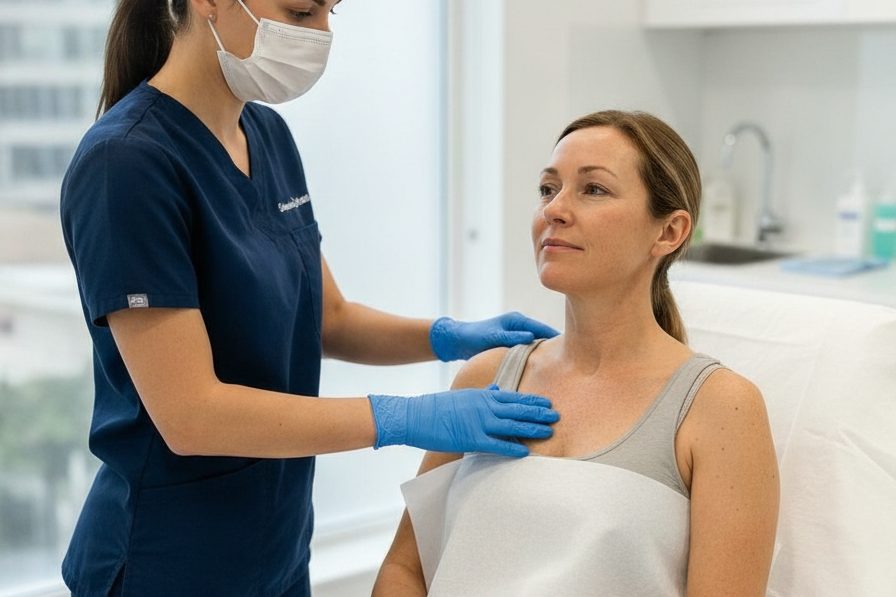
If you are considering breast reduction in London and want an honest, unhurried conversation about whether it is right for you, we would encourage you to book a consultation at our Kensington clinic. A consultation is not a commitment to surgery. It is an opportunity to discuss your symptoms, your anatomy, your expectations and your concerns with a qualified doctor who will give you a straight answer rather than a sales pitch.
Our consultations cover your medical history, a clinical assessment, a full explanation of the techniques that may be appropriate for you, a realistic discussion of scars and recovery, and clear information about risks. You will leave with written information to review at home, and we apply a mandatory reflection period before any consent is signed.
You can also explore our broader range of surgical procedures, including body contouring options such as liposuction, on the treatments section of our website. When you are ready to take the next step, book your consultation online and a member of our clinical team will be in touch to confirm your appointment at our Kensington, London clinic.
Frequently asked
Questions we get asked about EnerPeel®
- Will breast reduction affect my ability to breastfeed?
- It may do, and this is one of the most important considerations for patients who have not yet completed their families. Most breast reduction techniques preserve the nipple-areola complex on a pedicle of tissue, which maintains some ductal connections, but the surgery inevitably disrupts breast tissue and milk ducts to some degree. Some patients breastfeed successfully after reduction; others find their capacity is reduced or absent. If breastfeeding future children is a priority for you, your surgeon may recommend delaying surgery until your family is complete. This should be discussed openly at your consultation.
- How long will it be before I see the final result?
- Most patients see a result they recognise as close to final by around six months, but full scar maturation and complete resolution of swelling can take up to twelve to eighteen months. The breasts also settle and soften over time as tissues relax after surgery. It is important not to judge the outcome too early, particularly in the first three months when scars are at their most visible and swelling can still distort the shape.
- Is breast reduction available on the NHS?
- NHS funding for breast reduction is available in some clinical commissioning group areas, but criteria are strict and typically require documented evidence of significant physical symptoms, a BMI within a certain range and, in many cases, evidence that conservative treatments have already been tried. Waiting times are often long. Many patients in London choose to self-fund privately to access surgery more promptly and with a surgeon of their choosing. A GP referral can help clarify whether NHS funding is worth pursuing in your area.
- Can I combine breast reduction with other procedures?
- It is sometimes possible to combine breast reduction with other procedures under the same general anaesthetic, but this significantly increases operative time and overall surgical risk. Combining procedures also complicates recovery and makes it harder to attribute any complications to a specific intervention. Our surgeons take a conservative approach to combining procedures and will only recommend doing so when it is clinically appropriate and the overall risk profile remains acceptable. This is a conversation to have at your consultation rather than something to plan in advance.
- What should I look for when choosing a breast reduction surgeon in London?
- Look for a surgeon on the GMC Specialist Register for plastic surgery, with membership of BAAPS or BAPRAS. Confirm the facility holds CQC registration. Your consultation should be led by the operating surgeon, not a patient coordinator. Ask about the surgeon's specific experience with breast reduction, their complication rates, their revision policy and what aftercare is included. Be cautious of any clinic that pressures you to book quickly, offers very short consultation slots or is reluctant to discuss risks and downsides in detail. A reputable surgeon in London will welcome your questions and encourage you to take time to decide.