

Surgical · 11 min read
Breast Augmentation London: Choosing Implant Size, Shape & Profile
By Dr Hassan Soueid · MD, FRCS · Lead Surgeon, Kensington Cosmetic Clinic
Published 25 May 2026
TL;DR - Breast augmentation in London is one of the most requested surgical procedures we perform at Kensington Cosmetic Clinic, and the single biggest source of patient dissatisfaction is not the surgery itself but the implant selection process that precedes it. Choosing an implant is not about picking a cup size from a chart; it is a clinical decision shaped by your existing tissue, chest wall dimensions, skin laxity, and what you actually want your body to look like. This guide explains how we approach that decision, what the variables mean in practice, and, importantly, when augmentation alone is not the right answer.
Why breast augmentation in London demands more than a size conversation
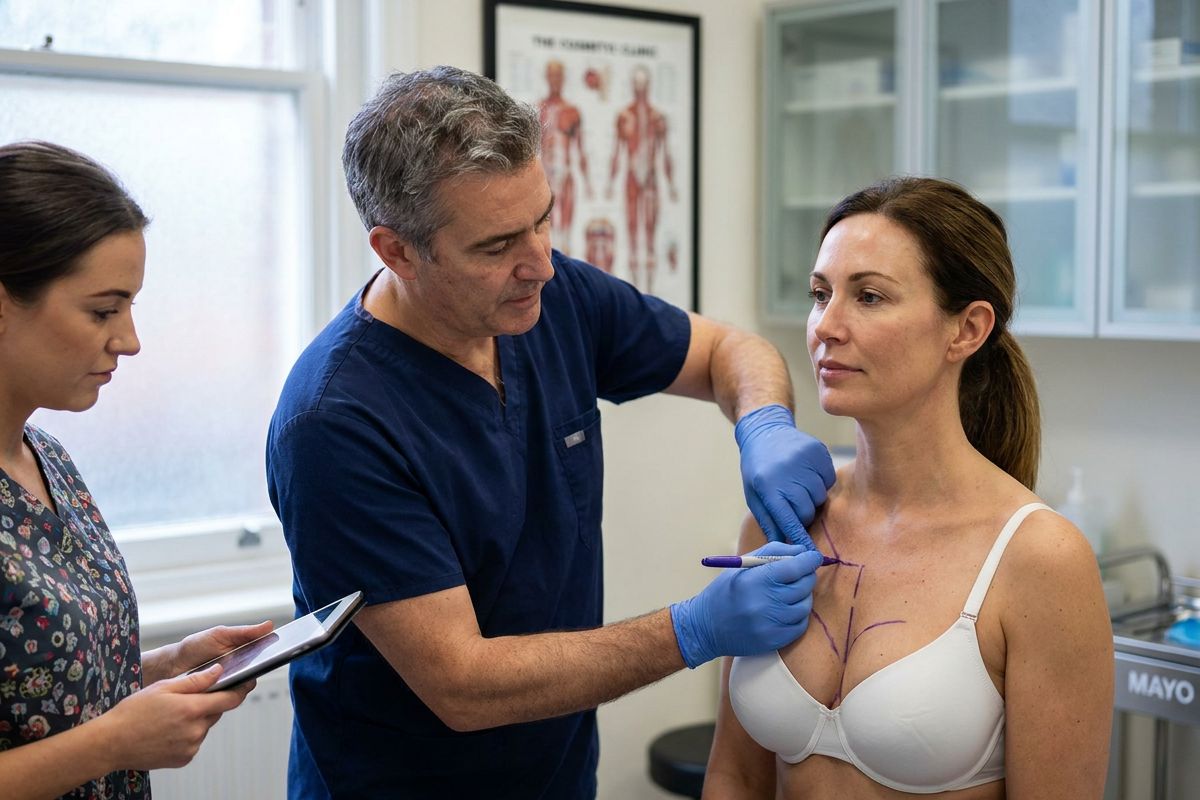
When patients come to us at our clinic on Marloes Road, just off High Street Kensington, the first thing many say is: "I want to go up two cup sizes." That is a perfectly reasonable starting point, but cup sizes are not a surgical measurement. They vary between bra manufacturers, change with weight fluctuation, and tell us nothing about the dimensions of your chest wall, which is the actual canvas we are working with. The conversation we need to have is about base width, projection, tissue thickness, and how those factors interact with the implant options available.
London has no shortage of clinics offering rapid consultations and next-week surgery dates. We do not operate that way. A proper implant selection consultation at KCC typically takes 45 to 60 minutes and involves physical measurements, a sizer trial if appropriate, and a frank discussion about what is and is not achievable with your anatomy. Dr Hassan Soueid, who leads our surgical programme, has found repeatedly that patients who feel genuinely heard and informed during this process report far higher satisfaction with their outcome, regardless of the implant ultimately chosen.
The regulatory landscape in the UK has also tightened considerably since the PIP scandal. All implants used at KCC are CE-marked or FDA-cleared cohesive silicone gel devices from manufacturers with long-term safety data. We will not use implants we cannot stand behind, and we will tell you the brand and model of what we are proposing before you sign anything.
If you are also considering body contouring alongside augmentation, it is worth reading about our full body makeover approach, which coordinates procedures for patients who want comprehensive reshaping rather than isolated changes.
Understanding implant volume: what the numbers actually mean
Implant volume is measured in cubic centimetres (cc), not cup sizes. A 300 cc implant placed in one patient may produce a very different visual result than the same implant in another, because the outcome depends on how much native breast tissue is already present, the width of the chest, and the implant's profile (how far it projects forward relative to its base diameter). This is why we measure, rather than guess.
Base width is arguably the most important starting measurement. We measure the natural footprint of your breast from the sternal border to the anterior axillary line. An implant whose base diameter exceeds this measurement will either sit too wide, creating an unnatural look, or encroach on the axilla, causing discomfort and visible lateral fullness. Conversely, an implant that is too narrow for your chest will look disproportionately projected without filling the lower pole adequately.
A rough clinical heuristic: for every centimetre of base width, you can accommodate roughly 150–200 cc before you start to compromise the soft-tissue envelope. But this is a starting point for discussion, not a formula. Skin stretch, gland volume, and the chosen pocket plane all modify the equation. During your consultation, we use anatomical sizing systems, placing sizer implants in a fitted bra, to give you a tangible sense of volume before any commitment is made.
One thing we are consistently honest about: going larger than your tissue comfortably supports accelerates long-term changes. Heavier implants exert more traction on the inferior pole over time, contributing to bottoming out, stretch marks, and the need for revision surgery earlier than you would otherwise face. We would rather you leave with a result that looks excellent at ten years than one that looks dramatic at one year and problematic at five.
Round versus anatomical implants: the shape debate
Round implants are symmetrical in all planes, which means that if they rotate inside the pocket, as all implants can, the shape does not change. They tend to produce more upper-pole fullness, which many patients actively want. Modern round implants with a cohesive gel fill behave more naturally than earlier generations; when you are upright, the gel settles slightly inferiorly, reducing the "ball on chest" appearance that gave older round implants a bad reputation.
Anatomical (teardrop) implants are shaped to mimic the natural breast, with more projection in the lower pole and a gradual slope superiorly. They are textured on the surface to resist rotation, and it is that texturing that has attracted scrutiny in recent years. There is a well-documented association between certain highly textured implants and breast implant-associated anaplastic large cell lymphoma (BIA-ALCL), a rare but serious condition. The absolute risk remains low, but it is not zero, and we discuss it with every patient considering textured devices. Smooth round implants carry no known BIA-ALCL risk.
Our current practice is to use smooth round implants for the majority of primary augmentations. We reserve anatomical implants for specific reconstructive or revision contexts where the shape advantage justifies the trade-off. If you have read elsewhere that anatomical implants always look more natural, we would gently push back on that: in the hands of a surgeon who understands pocket dissection and tissue dynamics, a well-chosen round implant in a properly created dual-plane pocket looks entirely natural.
For patients who want shape enhancement without implants, fat transfer to the breast is an option we offer, it is more limited in the volume it can reliably deliver, but it carries none of the implant-related risks and uses your own tissue.
Implant profile: low, moderate, high and extra-high explained
Profile describes the ratio of an implant's forward projection to its base diameter. Two implants can have identical volumes but very different profiles, a low-profile implant spreads wide and projects modestly; a high-profile implant has a narrower base and projects further forward. Understanding this distinction is essential to matching an implant to a chest wall.
For patients with a wider chest and naturally wider breast base, a moderate or moderate-plus profile usually produces the most proportionate result. The implant fills the footprint of the breast without over-projecting. For patients with a narrower chest, common in petite frames, a higher profile implant achieves the desired volume within a narrower base diameter, avoiding lateral spread that would look unnatural on a slim torso.
High-profile implants are sometimes requested by patients who want maximum projection relative to their frame. They can look striking, but they also concentrate stress on the inferior pole skin and may produce a more obviously augmented appearance. We will not tell you this is wrong if that is genuinely what you want, but we will make sure you understand the trade-off before you decide.
Extra-high profile implants exist and are used in specific cases, but they are not something we routinely recommend for primary aesthetic augmentation. The projection-to-base ratio becomes extreme enough that the result can look disproportionate on most frames, and the long-term tissue effects are more pronounced.
Pocket placement and the dual-plane technique
Where the implant sits relative to the chest wall muscle matters as much as the implant itself. The three main options are subglandular (above the muscle, below the gland), submuscular (below the pectoralis major), and dual-plane, a technique that places the upper portion of the implant beneath the muscle while allowing the lower portion to sit in a subglandular plane.
Subglandular placement is technically simpler and produces a faster recovery, but it offers less soft-tissue coverage over the implant, making rippling more visible in thin patients and increasing the risk of capsular contracture over time. It is appropriate for patients with adequate glandular tissue to cover the implant, but it is not our default recommendation for patients with minimal native breast tissue.
Submuscular placement provides more coverage and a lower capsular contracture rate, but the muscle exerts dynamic forces on the implant during contraction, the so-called animation deformity, where the breast distorts when the pectoralis flexes. For patients who exercise regularly or have prominent pectoral muscles, this can be noticeable and uncomfortable.
Dual-plane breast augmentation was developed to address both problems. By releasing the inferior origin of the pectoralis, the muscle covers and protects the upper pole of the implant while the lower pole sits in a more natural subglandular position. The result is better coverage where it matters most, reduced animation deformity, and a more natural lower-pole shape. It is the technique we use most frequently at KCC for primary augmentation in patients with adequate tissue, and it is the approach Mr Ali Ghanem and Dr Hassan Soueid both favour for suitable candidates.
Incision placement, inframammary fold, periareolar, or transaxillary, is a separate but related decision. Each has advantages and limitations, and the right choice depends on your anatomy, the implant size, and your scarring preferences. We discuss all three options at consultation.
Who breast augmentation is not right for
We are a surgical clinic in Kensington, and we want your business, but not at the cost of operating on patients who will not benefit or who carry risks that outweigh the likely gain. There are circumstances in which we will decline to proceed, or will recommend a different approach.
Patients with significant breast ptosis (drooping) are often disappointed by augmentation alone. Adding volume to a breast that already hangs low tends to produce a larger, lower breast rather than a lifted, fuller one. If your nipple sits at or below your inframammary fold, a breast lift (mastopexy), either alone or combined with augmentation, is likely to produce a better outcome. We will tell you this clearly at consultation, even though it means a more complex procedure.
Patients with active autoimmune conditions, significant coagulation disorders, or unrealistic expectations about what surgery can achieve are not good candidates. We also exercise caution with patients who are still in their late teens or whose weight is fluctuating significantly, implants placed in a changing body are more likely to require revision.
Body dysmorphic disorder (BDD) is a recognised contraindication for elective cosmetic surgery. We screen for it during consultation, not to gatekeep unnecessarily, but because operating on a patient with BDD rarely resolves the underlying distress and can cause significant harm. If we have concerns, we will say so directly and may recommend psychological support before any surgical discussion continues.
Patients who smoke are asked to stop at least six weeks before and six weeks after surgery. Nicotine impairs wound healing and increases capsular contracture risk. This is not a preference, it is a clinical requirement.
If you are considering augmentation as part of a broader body contouring plan, our colleague Dr Riaz Agha is available for complex cases where multiple procedures need to be sequenced and coordinated carefully. You may also find our article on what to expect from surgical recovery useful context for planning your timeline.
Recovery, risks and realistic expectations
Most patients undergoing breast augmentation in London return home the same day or after one night, depending on anaesthetic preference and how the procedure goes. The first 48 to 72 hours involve chest tightness, soreness, and restricted arm movement, this is normal and expected. Most patients are comfortable enough to resume light desk work within a week, though we ask you to avoid any upper body exercise for six weeks.
Swelling distorts the result for the first several weeks. The implants also sit high initially as the muscle and skin accommodate them, a process called "dropping and fluffing" that takes three to six months to complete. We ask patients not to judge their result until at least three months post-operatively, and to attend all follow-up appointments so we can monitor the settling process.
The principal risks of breast augmentation include capsular contracture (scar tissue hardening around the implant), implant malposition, asymmetry, changes in nipple sensation, and the need for revision surgery over a lifetime. Implants are not lifetime devices; the majority will require replacement or removal at some point, though modern cohesive gel implants have a much better durability record than earlier generations. We discuss all of this in writing before you consent to surgery.
For patients interested in how body contouring procedures interact, for example, combining augmentation with abdominal work, our article on how surgical technique choices affect long-term outcomes offers useful perspective on why technical decisions matter beyond the immediate result. And if you are considering a tummy tuck alongside augmentation, sequencing matters: we generally recommend completing any planned abdominal surgery before finalising breast implant selection, as changes in torso shape affect proportion.
Booking your consultation
If you are considering breast augmentation in London and want a consultation that is genuinely clinical rather than sales-driven, we would be glad to see you at Kensington Cosmetic Clinic, 49 Marloes Road, W8 6LA, a short walk from both Earl's Court and High Street Kensington stations. Our consultations are unhurried, and you will leave with a clear picture of what is and is not possible for your anatomy, what the procedure involves, and what recovery looks like.
To arrange a consultation with Dr Hassan Soueid or one of our other surgical team members, please book online here. You can also read more about the full range of procedures we offer on our breast surgery treatments page. There is no obligation to proceed, and a second opinion is always encouraged, we would rather you make the right decision slowly than the wrong one quickly.
Frequently asked
Questions we get asked about EnerPeel®
- How do I choose the right implant size for my frame?
- Size selection starts with measuring your chest wall base width and assessing your existing tissue thickness, not with a cup size target. During your consultation at KCC, we use physical measurements and sizer trials to identify a volume range that suits your anatomy. The goal is an implant whose base diameter matches your natural breast footprint, so the result looks proportionate rather than placed.
- Is dual-plane breast augmentation better than standard submuscular placement?
- For most patients with limited native breast tissue, dual-plane placement offers the best combination of upper-pole coverage and natural lower-pole shape, with less animation deformity than full submuscular placement. It is not universally superior, patients with good glandular coverage may do equally well with subglandular placement, but it is our most commonly used technique for primary augmentation at KCC.
- What is the risk of BIA-ALCL with textured implants?
- Breast implant-associated anaplastic large cell lymphoma (BIA-ALCL) is a rare lymphoma linked specifically to certain highly textured implant surfaces, not to smooth implants. The absolute lifetime risk is low but not negligible, and it is something we discuss with every patient. Our current practice is to use smooth round implants for primary aesthetic augmentation, which carries no known BIA-ALCL association.
- How long do breast implants last?
- Modern cohesive silicone gel implants do not have a fixed expiry date, but they are not lifetime devices. Many patients go ten to fifteen years or more without needing revision, but changes in the implant shell, capsular contracture, or shifts in your body over time may prompt earlier intervention. We recommend regular clinical review and MRI surveillance at intervals your surgeon will advise.
- Can I combine breast augmentation with a tummy tuck or liposuction?
- Combining procedures is possible and can reduce overall recovery time, but it requires careful patient selection and anaesthetic planning. We generally recommend completing any planned abdominal work before finalising implant selection, as changes in torso shape affect breast proportion. Combined procedures are discussed in detail at your consultation, and we will only recommend combining them if it is genuinely in your clinical interest.