

Surgical · 11 min read
Brow Lift vs Botox: When Forehead Lines Need Surgery
By Dr Hassan Soueid · MD, FRCS · Lead Surgeon, Kensington Cosmetic Clinic
Published 25 May 2026
TL;DR, Botox relaxes the muscles that create forehead lines; it does not lift tissue that has physically descended. If your brows sit below the orbital rim, if your upper eyelids look heavy because of brow ptosis rather than excess eyelid skin, or if repeated Botox injections have started to make your brow droop further, you are likely a surgical candidate rather than an injectable one. A brow lift in London, most commonly performed endoscopically, repositions the soft tissue and corrects the underlying anatomy in a way no toxin can replicate. This article explains how we distinguish the two problems clinically, what the endoscopic technique involves, and who is not a suitable candidate.
Why forehead lines are not always a Botox problem
The frontalis muscle runs vertically up the forehead and its job is to raise the brows. When the brows descend, through loss of soft-tissue support, bone remodelling, or simple gravitational change over decades, the frontalis contracts constantly just to keep the brows at a functional height. Those horizontal forehead lines you see are, in many patients, not the primary problem: they are a compensatory response to brow ptosis. Injecting Botox to relax the frontalis removes the lines, but it also removes the only mechanism holding the brow up. The result, which we see regularly in new patients presenting to our Kensington clinic, is a brow that sits even lower after treatment than it did before.
This is not a criticism of Botox as a treatment, used correctly, it remains one of the most evidence-based non-surgical interventions available. The problem is a diagnostic one. If the treating clinician does not assess brow position before injecting, they may be treating a symptom while worsening the cause. At KCC we always evaluate the brow-to-lid relationship, the resting brow position relative to the supraorbital rim, and the degree of upper-lid hooding before recommending any forehead treatment.
In younger patients, typically those under 40, forehead lines usually are a pure muscle-activity problem. The brows sit at a good height, the upper lids are clear, and Botox is entirely appropriate. The clinical picture changes significantly in patients over 45 to 50, where gravitational and volumetric changes mean the anatomy itself has shifted. Distinguishing between these two presentations is the first thing we do at consultation.
There is also a middle ground: patients with mild brow descent and moderate dynamic lines who are not ready for surgery. For them, a combination of conservative Botox dosing (preserving some frontalis function), a small amount of filler at the tail of the brow, or energy-based lifting treatments may buy time. We are honest about the limits of that approach, it is a deferral, not a solution.
What brow ptosis actually looks like, and how we assess it
Brow ptosis is the clinical term for a descended brow. It is graded by measuring the distance between the mid-pupil and the central brow, and by assessing the lateral brow tail relative to the lateral orbital rim. In women, the ideal brow sits just above the orbital rim with a gentle arch peaking above the lateral limbus of the iris. In men, the brow typically sits at or just above the rim with a flatter trajectory. When the brow falls below these landmarks, the upper lid is pushed downward, creating the appearance of hooded eyelids, even when the eyelid skin itself is not excessive.
This distinction matters enormously because hooded eyelids have two different causes that require two different operations. Excess upper-lid skin (dermatochalasis) is corrected with a blepharoplasty, removal of skin and sometimes fat from the upper lid. Brow ptosis causing pseudo-hooding is corrected with a brow lift. Performing a blepharoplasty on a patient whose hooding is primarily driven by brow descent can leave them with inadequate upper-lid skin and an unnatural, tight appearance. We see patients who have had this error made elsewhere, and correcting it is considerably more complex than doing the right operation first time.
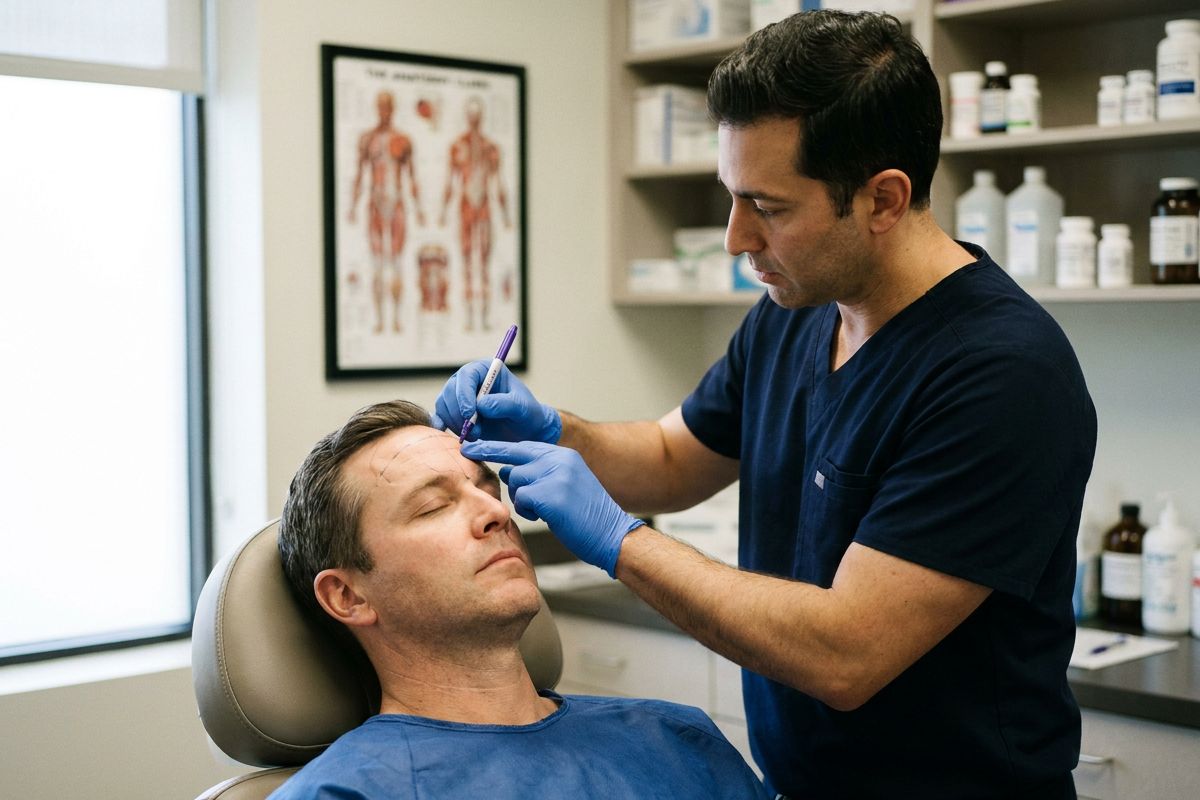
At our clinic in Kensington, Dr Hassan Soueid assesses every upper-face patient with a manual brow elevation test: the brow is gently lifted with a finger to its ideal position and the patient views the result in a mirror. If the hooding resolves substantially with brow elevation, the brow is the primary target. If significant excess lid skin remains after elevation, a combined brow lift and blepharoplasty may be appropriate. This takes about two minutes in clinic and is one of the most informative physical examination manoeuvres in facial surgery.
We also look at asymmetry. Many patients have one brow that has descended more than the other, which creates a tired or quizzical expression. Asymmetric Botox dosing can partially compensate for this, but it rarely achieves the same degree of correction as repositioning the tissue surgically, and it requires indefinite repeat treatment every three to four months.
The endoscopic brow lift: what the operation involves
The endoscopic brow lift has largely replaced the older coronal approach in most centres performing this surgery in the UK. The coronal technique involved a long incision from ear to ear across the top of the scalp, effective, but associated with significant scalp numbness, a visible scar if hair thinned later, and a longer recovery. The endoscopic approach uses three to five small incisions (typically 1–2 cm each) hidden within the hairline, through which a camera and instruments are passed to release and reposition the forehead tissue from below.
The key anatomical step is releasing the periosteum, the fibrous tissue overlying the frontal bone, and the ligamentous attachments that tether the brow in its descended position. Once released, the brow can be elevated and fixed in its new position using small absorbable or titanium fixation devices anchored to the bone. The procedure is performed under general anaesthetic and takes approximately 90 minutes. Patients go home the same day or after one night, depending on individual circumstances and how far they have travelled, we have patients attending from across London and from further afield.
Mr Ali Ghanem, who works alongside our team on complex upper-face cases, is experienced in endoscopic technique and in managing the hairline considerations that matter particularly to patients who wear their hair short or who have a naturally high forehead. In those patients, a hairline brow lift, where the incision is placed at the anterior hairline rather than within it, can correct the brow without raising the hairline further. The choice of approach is discussed at consultation based on your individual anatomy.
For patients with significant lateral brow descent but minimal central ptosis, a temporal or lateral brow lift through a single incision within the temporal hairline may achieve the correction needed with even less disruption. This is a shorter procedure but has a more limited effect on the central brow and glabellar area. There is no single correct technique, the operation is chosen to match the anatomy, not the other way around.
It is also worth noting that a brow lift is frequently combined with other procedures. Patients undergoing a facelift for mid- and lower-face rejuvenation often benefit from simultaneous brow repositioning to achieve a coherent result across the whole face. Addressing the upper and lower face in separate operations months apart can create a mismatched appearance where one zone looks refreshed and the other does not.
Recovery, realistic results, and longevity
Recovery from an endoscopic brow lift is more straightforward than many patients expect, though it is not trivial. In the first 48 to 72 hours there is swelling and bruising around the forehead and upper lids, this is normal and not a sign of complication. Most patients feel comfortable going out in public after 10 to 14 days, though residual swelling around the eyes can persist for three to four weeks. Scalp sensation may feel altered, either reduced or occasionally hypersensitive, for several weeks to months as the sensory nerves recover. Permanent sensory loss is uncommon with the endoscopic approach but should be discussed at consultation as a known risk.
The fixation devices hold the brow in its elevated position while the periosteum heals in its new location, a process that takes roughly six weeks. After that, the result is structural rather than dependent on the fixation hardware. Most patients see a stable, natural-looking result by three months, with final assessment at six months. The longevity of a brow lift is significantly greater than injectable treatments, the majority of patients maintain their correction for seven to twelve years, after which the natural ageing process continues. It is not a permanent freeze, but it is a meaningful and durable change.
We are sometimes asked whether a brow lift will make someone look surprised or over-elevated. This is a legitimate concern, because it does happen, usually when too much elevation is applied centrally, or when the medial brow is lifted as aggressively as the lateral brow. Our aim is always a rested, natural position: the brow should look as it did in your late thirties or early forties, not artificially high. Intraoperative assessment with the patient in a semi-upright position, and conservative fixation, are the technical safeguards against this outcome.
For patients interested in complementary skin quality improvements alongside surgical repositioning, we often discuss CO2 laser resurfacing of the forehead and periorbital area, which can address fine surface lines and skin texture that the lift itself does not target. These are staged, laser treatment is typically deferred until the surgical swelling has fully resolved.
Who this is not right for
A brow lift is not appropriate for everyone presenting with forehead lines or upper-face heaviness, and we will say so clearly at consultation. Patients whose brows sit at a normal height but who have significant dynamic forehead lines are better served by Botox and filler treatments, surgery would overcorrect them and produce an unnatural result. Similarly, patients with mild brow descent who are in their early forties and not yet troubled enough by the change to accept surgical recovery should not be pushed toward an operation. The threshold for surgery should be set by the patient's own assessment of their quality of life, not by a surgeon's enthusiasm for the technique.
Patients with very thin or fine hair, or those with a history of significant hair loss, require careful planning around incision placement. The endoscopic approach can still be used, but the hairline incision position and the degree of scalp mobilisation need to be adjusted to avoid creating visible scars if the hair thins further over time. We discuss this openly, and in some cases a different approach, or a staged plan that addresses hair restoration first, is the more sensible sequence. You can read more about hair considerations in our overview of hair transplant surgery, which some patients pursue before or alongside facial procedures.
Patients with unrealistic expectations, specifically those hoping a brow lift will address mid-face descent, nasolabial folds, or jowling, need to understand that the procedure has a defined anatomical territory. It lifts the brow and smooths the forehead; it does not address the cheeks, the lower face, or the neck. For patients with concerns across multiple zones, a broader surgical plan may be appropriate, and the article on SMAS versus deep-plane facelift techniques is a useful starting point for understanding what lower-face surgery can and cannot achieve.
General health considerations apply as with any procedure under general anaesthetic. Active smokers are asked to stop for at least six weeks before and after surgery, as nicotine significantly impairs wound healing and increases the risk of skin necrosis at incision sites. Patients on anticoagulant medication require careful pre-operative management. We work with our anaesthetic colleagues and, where relevant, with the patient's GP to ensure the medical picture is clear before proceeding.
How this fits into a broader facial rejuvenation plan
The upper face, brow, forehead, and upper lids, is one component of overall facial ageing, and it rarely changes in isolation. Many patients presenting for brow lift assessment also have concerns about the mid-face, the lower lids, or the neck. At KCC we approach this as a planning conversation rather than a sales process. We map out what is changing and in what order, and we advise on the sequence that produces the most coherent result with the least cumulative recovery time.
For patients with significant volume loss in the temples and lateral forehead, a common accompaniment to brow descent, fat transfer to the upper face can restore the three-dimensional fullness that repositioning alone does not address. Dr Hazim Sadideen has a particular interest in facial volume restoration and works with our surgical team on combined cases where structural lifting and volumetric enhancement are planned together. The combination can produce a result that looks genuinely refreshed rather than merely tightened.
Non-surgical adjuncts also have a role in the maintenance phase after surgery. Patients who have had a brow lift and want to preserve the result and address ongoing skin quality changes may benefit from periodic skin treatments. Our microneedling protocols, for example, support collagen remodelling in the forehead skin and can be started once the surgical wounds have fully healed, typically from three months post-operatively.
It is also worth reading our piece on surgical planning considerations if you are considering multiple procedures, as the principles around staging, recovery sequencing, and managing expectations apply broadly across facial surgery. And for patients who have been told they need a blepharoplasty elsewhere and are uncertain whether that is the right diagnosis, we would encourage a second opinion, the distinction between lid and brow pathology is one of the most commonly missed assessments in facial aesthetics.
Booking your consultation
If you are based in or around High Street Kensington, Earl's Court, or anywhere across London and are uncertain whether your forehead concerns are best addressed surgically or with injections, the most useful first step is a face-to-face assessment. A photograph or a video call cannot replicate the manual examination that determines brow position and the relative contribution of ptosis versus skin excess.
Our clinic is at 49 Marloes Road, London W8 6LA, a short walk from High Street Kensington station. Consultations for brow lift and upper-face surgery are conducted by Dr Hassan Soueid, with specialist input from colleagues as appropriate to your case. We do not operate a high-volume, quick-turnaround model; consultations are unhurried and we will tell you honestly if we do not think surgery is the right answer for you at this point.
You can read more about the procedure on our dedicated upper-face treatment pages before your appointment, and you are welcome to bring photographs from earlier in your life to help contextualise the changes you have noticed. To arrange your consultation, please book online here or call the clinic directly. We look forward to meeting you in Kensington.
Frequently asked
Questions we get asked about EnerPeel®
- Can Botox lift the brows at all, or is it purely for lines?
- Botox can produce a small degree of brow elevation, typically 1 to 2 mm, by selectively relaxing the depressor muscles (orbicularis oculi and corrugator) while preserving the frontalis elevator. This is sometimes called a 'chemical brow lift' and it is a legitimate technique in the right patient. However, it requires precise dosing and is only effective when brow descent is minimal. It cannot reposition a brow that has descended significantly below the orbital rim, and in patients with moderate to severe ptosis, injecting the frontalis without addressing the depressors can make the descent worse.
- How do I know if my hooded eyelids are caused by the brow or by the eyelid skin itself?
- The simplest self-assessment is to place your fingertips gently on your brow and lift it to what feels like a natural, rested position, then look in a mirror. If the hooding largely resolves, the brow is the primary driver and a brow lift is likely more appropriate than a blepharoplasty. If significant excess skin remains on the upper lid even with the brow elevated, you may need both procedures. This is the same manual elevation test we use in clinic, and a formal assessment by a surgeon experienced in upper-face anatomy will give you a definitive answer.
- Will a brow lift change the shape of my eyes?
- A well-planned brow lift should open the upper visual field and reduce the weight on the upper lid, which can make the eyes appear more alert and less tired. It should not change the fundamental shape of the eye itself. Over-elevation of the medial brow can create a surprised appearance, and over-elevation laterally can produce an unnatural arch, both are avoidable with conservative technique and careful intraoperative assessment. We always aim to restore the brow to a position consistent with your own earlier anatomy rather than imposing an idealised template.
- What is the difference between an endoscopic brow lift and a temporal brow lift?
- An endoscopic brow lift uses a camera and instruments through small hairline incisions to release and elevate the entire forehead and brow, including the central and medial portions. A temporal (or lateral) brow lift uses a single incision within the temporal hairline to elevate primarily the outer third of the brow. The temporal approach is a shorter, less involved procedure but has limited effect on central forehead lines or medial brow descent. The choice depends on where your descent is most pronounced, and both options will be discussed at your consultation based on your anatomy.
- How long does the result of a brow lift last compared with Botox?
- Botox for brow elevation and forehead lines typically lasts three to four months before the muscle activity returns and repeat treatment is needed. A surgical brow lift produces a structural change, the tissue is physically repositioned and heals in its new location, which is durable for most patients over a period of seven to twelve years. Ageing continues after surgery, so the result is not permanent, but the improvement achieved is maintained for considerably longer than any injectable approach. Many patients find that after a brow lift they need less Botox to maintain their forehead, or none at all for several years.