

Skin · 10 min read
Skin Tightening Without Surgery in London: What Actually Works
By Dr Hassan Soueid · MD, FRCS · Lead Surgeon, Kensington Cosmetic Clinic
Published 7 July 2026
TL;DR. Non-surgical skin tightening can produce genuine, measurable improvements in skin laxity, but results are modest compared with surgery, they take time to appear, and no single device works for every patient or every area of the face and body.
Why skin loses its tightness in the first place
Before evaluating any treatment, it helps to understand the biology you are trying to influence. Skin firmness depends on two structural proteins: collagen, which provides tensile strength, and elastin, which allows the skin to spring back after being stretched. From our mid-twenties onwards, the body produces collagen at a slower rate and the quality of existing fibres begins to decline. By the time most people notice visible laxity, they have typically lost a significant proportion of their dermal collagen density.
Compounding this, the fat compartments beneath the skin shift and deflate with age, the underlying facial bones gradually resorb, and the retaining ligaments that anchor skin to deeper structures stretch. The result is the familiar combination of jowling along the jawline, looseness in the neck, crepey texture on the cheeks, and sagging in the upper arms or abdomen. Understanding this multi-layer process is important because it explains why no single energy-based device can fully replicate what a surgical facelift achieves by physically repositioning tissue. Non-surgical treatments work primarily at the level of the dermis and superficial soft tissue; they cannot reposition a descended fat pad or tighten a lax platysma muscle in the way that surgery can.
That said, for patients with early to moderate laxity, the right combination of treatments can produce results that are genuinely worthwhile, provided expectations are calibrated correctly from the outset.
The honest case for going non-surgical
The appeal of non-surgical skin tightening is obvious: no general anaesthetic, no surgical incisions, no weeks of visible bruising, and a much lower risk profile overall. For patients who are not yet ready for surgery, or who have mild laxity that does not yet justify an operation, these treatments occupy a genuinely useful middle ground.
They are also appropriate for patients who have already had surgical procedures and want to maintain or extend their results. A well-timed course of energy-based treatment can slow the rate at which collagen continues to decline, meaning the interval before a patient might consider revision surgery is extended. In this context, non-surgical tightening is best thought of as a maintenance strategy rather than a one-off fix.
The honest caveat is that the non-surgical market is saturated with devices making extraordinary claims. Many of the before-and-after images circulating online are taken under controlled lighting conditions, at carefully chosen angles, with the subject's posture adjusted to maximise apparent improvement. At our clinic in Kensington, we do not use before-and-after imagery in our marketing precisely because we believe it sets unrealistic expectations. What we can offer instead is a frank conversation about what a given treatment is likely to achieve for your specific anatomy, skin type and degree of laxity.
Endolift: laser tightening beneath the skin surface
One of the most clinically interesting developments in non-surgical skin tightening over recent years is Endolift, a minimally invasive laser procedure that delivers energy directly into the subdermal tissue through an ultra-fine optical fibre. Unlike surface-level devices that must drive energy through the epidermis to reach the dermis, Endolift bypasses the outer layers entirely, allowing a higher concentration of thermal energy to be delivered precisely where collagen remodelling is needed.
The procedure involves the insertion of a very fine cannula, typically under local anaesthetic, through micro-entry points that are almost invisible once healed. The laser energy melts localised fat deposits, tightens the overlying skin from beneath, and stimulates a sustained collagen response over the following three to six months. It is particularly well suited to the lower face, jowl area, neck and submental region, as well as areas of the body such as the inner arms and knees.
Patients should be aware that Endolift is still a procedure with a recovery period. Swelling and mild bruising are common in the first week, and the treated area may feel firm or slightly tender for several weeks as the tissue remodels. Results continue to improve for up to six months post-treatment, so patience is required. It is not appropriate for patients with very significant skin laxity, where surgery remains the more appropriate option, and it is not suitable for all skin types or medical histories. A thorough consultation is essential before proceeding.
CO2 laser resurfacing: the gold standard for surface texture and tightening
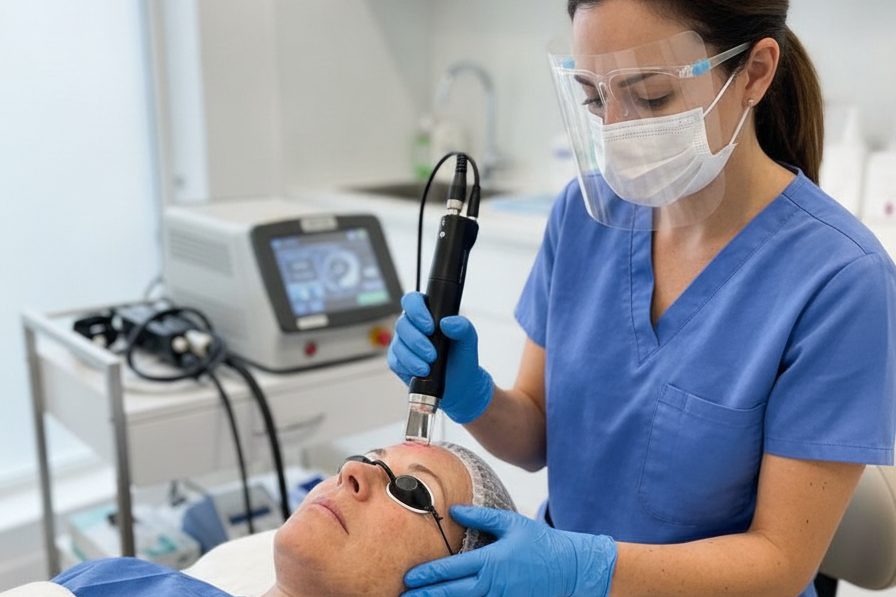
Fractional CO2 laser resurfacing has decades of clinical evidence behind it and remains one of the most effective non-surgical tools for improving both skin texture and mild to moderate laxity simultaneously. The laser creates thousands of microscopic columns of thermal injury in the skin, leaving surrounding tissue intact to accelerate healing. The controlled wound-healing response that follows drives significant new collagen production and results in measurable skin contraction.
The degree of tightening achievable with CO2 laser is greater than with most radiofrequency or ultrasound devices, particularly for fine lines, crepey texture and superficial laxity around the eyes, mouth and cheeks. It also addresses pigmentation, uneven skin tone and acne scarring simultaneously, making it a versatile option for patients with multiple concerns.
The trade-off is downtime. Fractional CO2 laser is not a lunchtime treatment. Depending on the intensity of the treatment, patients should expect redness, swelling and peeling for anywhere between five days and two weeks. Sun avoidance is mandatory for several weeks afterwards, and the skin will remain more sensitive to UV for months. Patients with darker skin tones need to be assessed very carefully, as the risk of post-inflammatory hyperpigmentation is higher, and treatment parameters must be adjusted accordingly. It is also not appropriate for patients with active skin infections, certain autoimmune conditions, or those who have recently used isotretinoin.
For patients who want meaningful improvement but are not ready for surgery, a single fractional CO2 session, or a course of two to three treatments spaced several months apart, can deliver results that hold for several years with appropriate sun protection and skincare maintenance.
Microneedling and radiofrequency microneedling: a gentler entry point
For patients with early laxity, fine lines or crepey skin texture who want a lower-downtime option, microneedling and its more advanced variant, radiofrequency (RF) microneedling, represent a well-evidenced starting point. Standard microneedling uses fine needles to create controlled micro-injuries in the dermis, stimulating collagen and elastin production through the body's natural repair response. Results are subtle and cumulative, typically requiring a course of three to six sessions to see meaningful change.
RF microneedling adds a layer of radiofrequency energy delivered directly into the dermis via insulated needles, amplifying the collagen-stimulating effect without significantly increasing surface damage or downtime. Clinical studies support its use for mild skin laxity, enlarged pores, fine lines and superficial scarring. It is generally well tolerated across a wider range of skin tones than laser-based treatments, making it a useful option for patients who are not ideal candidates for CO2 resurfacing.
The honest limitation of microneedling is that it will not produce dramatic tightening in patients with moderate or significant laxity. If you are looking at jowls that are clearly visible in photographs, or neck skin that has begun to hang, microneedling alone is unlikely to provide the degree of change you are hoping for. Managing this expectation at consultation is something our team in Kensington takes seriously, because proceeding with a treatment that cannot deliver what a patient needs is not in anyone's interest.
PRP and combination approaches: supporting the biology
Platelet-rich plasma, or PRP treatment, involves drawing a small amount of the patient's own blood, processing it to concentrate the growth factors found in platelets, and reintroducing it into the skin via injection or microneedling channels. On its own, PRP is primarily a skin quality treatment rather than a tightening treatment. It improves hydration, luminosity and fine texture, and it supports the collagen-stimulating effects of other procedures when used in combination.
Where PRP becomes particularly relevant in the context of skin tightening is as an adjunct to laser or RF microneedling treatments. Applied immediately after a resurfacing session, PRP can accelerate healing, reduce downtime and amplify the regenerative response. Some patients also use it as a standalone maintenance treatment between more intensive sessions, particularly to address the delicate skin around the eyes and neck where stronger treatments may not be appropriate.
The evidence base for PRP continues to grow, though it is worth noting that the quality of PRP preparations varies significantly depending on the processing system used and the technique of the practitioner. At KCC, all injectable and energy-based treatments are performed or directly supervised by our medical team, which matters considerably when it comes to both safety and outcome consistency.
Who is not a good candidate for non-surgical tightening
Honest patient selection is one of the most important things a responsible clinic can do, and it is an area where the aesthetics industry as a whole does not always cover itself in glory. Non-surgical skin tightening is not appropriate for everyone, and recommending it to the wrong patient does real harm, both financially and in terms of the disappointment that follows when results fall short of what was needed.
Patients with significant skin laxity, particularly those with pronounced jowling, a heavy neck, or skin that has lost substantial elasticity following major weight loss, are generally better served by a surgical consultation. A facelift or neck lift addresses the underlying anatomical changes that energy-based devices simply cannot reach. Recommending a course of RF microneedling to a patient who genuinely needs a surgical procedure is not a kindness; it delays the result they actually need and costs them money in the interim.
Patients with certain medical conditions, including active autoimmune disease, bleeding disorders, a history of keloid scarring, or those who are pregnant or breastfeeding, are not appropriate candidates for most of these treatments. Patients on blood-thinning medications, or those who have recently had certain injectable treatments in the same area, may also need to wait before proceeding. All of this is assessed thoroughly at consultation.
Age alone is not a disqualifying factor in either direction. Some patients in their forties have significant laxity that warrants surgical discussion; others in their sixties have skin quality and mild laxity that responds beautifully to non-surgical treatment. Anatomy, skin quality, lifestyle and individual healing capacity matter far more than chronological age.
Booking your consultation
If you are considering non-surgical skin tightening in London and want an honest assessment of what is likely to work for you, the most important first step is a thorough consultation with a qualified medical professional who has no commercial incentive to oversell you a treatment you do not need.
At our clinic in Kensington, all aesthetic consultations are led by our medical team. Dr Hassan and the KCC team take the time to assess your anatomy, discuss your concerns and goals, and recommend only the treatments that are genuinely appropriate for your situation. If surgery is a more appropriate option than a non-surgical treatment, we will tell you that clearly rather than taking your money for a procedure unlikely to deliver meaningful change.
We see patients from across London and beyond, and we are committed to the kind of honest, evidence-based practice that the aesthetics industry needs more of. Whether you are exploring options for the first time or have had treatments elsewhere and want a second opinion, we welcome the conversation.
To arrange your consultation, please book online or contact the clinic directly. We look forward to meeting you.
Frequently asked
Questions we get asked about EnerPeel®
- How many sessions of non-surgical skin tightening will I need?
- This depends entirely on the treatment and the degree of laxity being addressed. A single fractional CO2 laser session can produce significant improvement, though two to three sessions spaced several months apart are often recommended for optimal results. RF microneedling and standard microneedling typically require a course of three to six sessions. Endolift is usually a single procedure, with results developing over three to six months. Your practitioner will give you a realistic treatment plan at consultation based on your specific anatomy and goals.
- Are non-surgical skin tightening treatments painful?
- Most treatments involve some degree of discomfort, though this is generally manageable. Topical anaesthetic cream is applied before microneedling and laser procedures to minimise sensation. Endolift is performed under local anaesthetic, so the procedure itself is well tolerated, though there is some soreness during the recovery period. Radiofrequency treatments can produce a warming or prickling sensation. Your practitioner will discuss pain management options with you before any procedure begins.
- How long do the results of non-surgical skin tightening last?
- Results from collagen-stimulating treatments are not permanent, because the underlying ageing process continues. Fractional CO2 laser results can last two to three years with good sun protection and skincare. RF microneedling results typically last twelve to eighteen months before a maintenance session is beneficial. Endolift results are generally longer lasting, often two to three years, because of the degree of structural remodelling involved. Lifestyle factors including sun exposure, smoking and significant weight fluctuation all influence how long results are maintained.
- Can non-surgical treatments replace a facelift?
- In most cases, no. Non-surgical skin tightening works at the level of the dermis and superficial soft tissue. It cannot reposition descended fat compartments, tighten lax neck muscles, or remove excess skin. For patients with mild to moderate laxity, non-surgical treatments can produce genuinely worthwhile improvements and may delay the point at which surgery becomes appropriate. For patients with significant laxity, a surgical consultation is likely to be the more honest recommendation. At our Kensington clinic, we will always tell you clearly which category you fall into.
- Is non-surgical skin tightening safe for darker skin tones?
- Safety varies by treatment type. Fractional CO2 laser carries a higher risk of post-inflammatory hyperpigmentation in patients with darker skin tones and must be approached with significant caution, using adjusted parameters and thorough pre-treatment assessment. RF microneedling is generally considered safer across a wider range of skin tones because the energy is delivered below the surface, reducing the risk of surface pigmentation changes. PRP is suitable for all skin tones. A thorough assessment of your Fitzpatrick skin type and medical history is essential before any energy-based treatment is recommended.