

Skin · 11 min read
Laser Skin Treatments for Men in London: Options Explained
By Dr Hassan Soueid · GMC 6107783 · Medical Director, Kensington Cosmetic Clinic
Published 20 November 2026
TL;DR. Laser can help men with acne scarring, sun damage, pigmentation, redness and rough texture, but the right device depends on your skin type, how much time off work you can take and how you shave, so a careful doctor-led assessment matters more than the machine.
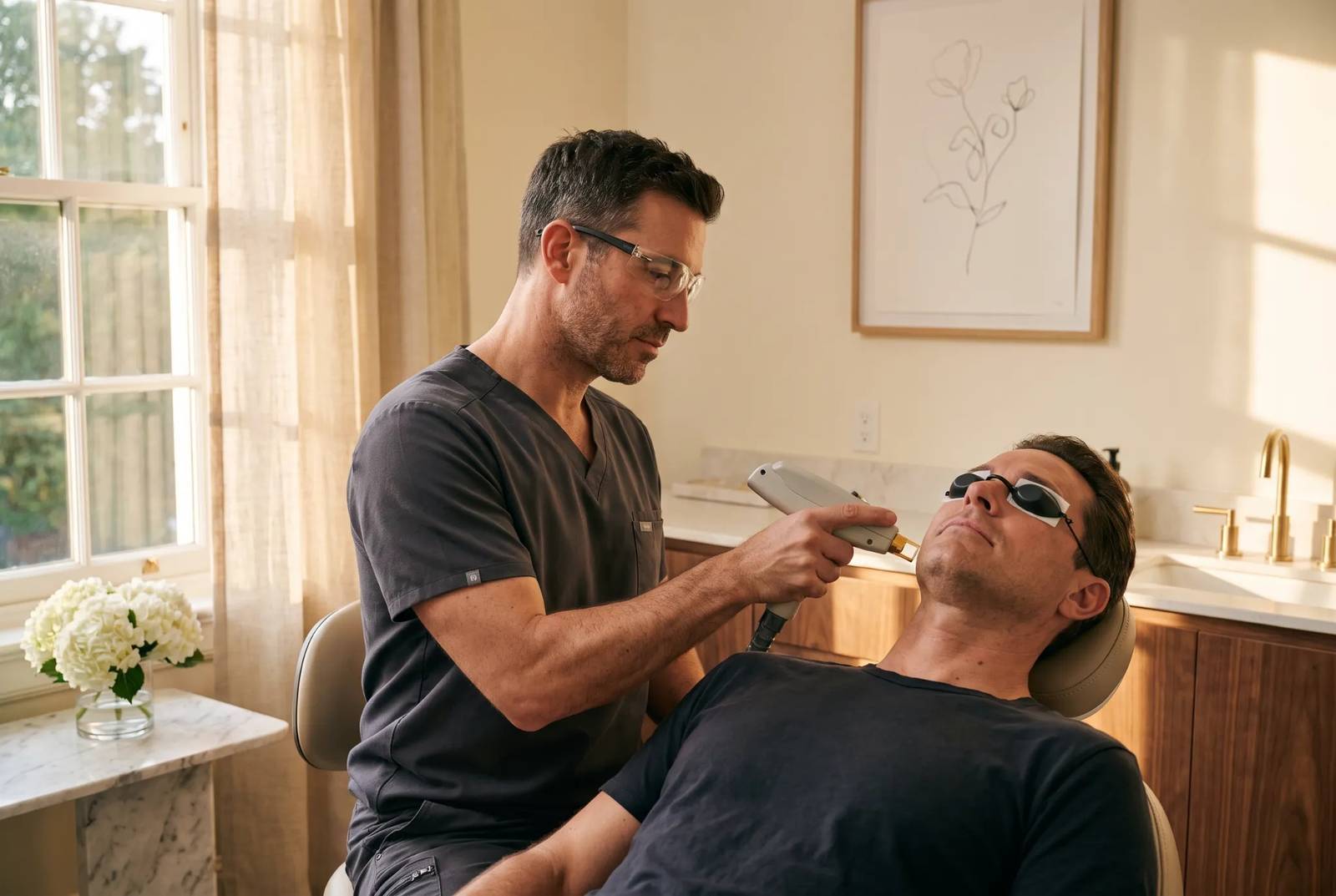
If you have never had a skin treatment, the world of lasers can look confusing and aimed at someone else. Search for laser skin treatment for men in London and most of what comes up is about hair removal. That is a useful service, but it is not what most men who come to our Kensington clinic want to discuss. They want to know whether old acne marks can be softened, whether brown spots from years of cycling or golf can be faded, or whether rough, tired-looking skin is something a laser can realistically improve.
This guide explains the main options in plain terms, how much time off you may need, how to manage shaving and the beard area, and who should wait or choose a different route. It is written to help you go into a consultation informed, not to sell you a treatment, and for some men the right answer is no laser at all.
Laser skin treatment for men in London: why men's skin needs a different plan
Men's skin is not simply women's skin with more hair on it. On average it tends to be thicker, with a denser network of collagen, and it usually produces more oil because of the effect of testosterone on the sebaceous glands. Pores are often larger, particularly across the nose and central cheeks. None of this makes laser more or less effective in itself, but it does change how a treatment is planned, the settings a clinician might consider, and how the skin behaves while it heals.
The biggest practical difference is the beard. Daily shaving is a form of regular, low-grade trauma to the skin. It removes a thin layer of surface cells, can cause small nicks and irritation, and in some men leads to ingrown hairs and dark marks along the jaw and neck. A laser plan has to account for when you shave, how you shave, and whether you want to keep facial hair in the treated area.
Many men have also had more unprotected sun exposure than they realise, from outdoor sport, running or simply years without sunscreen. Some have never used a daily skincare routine, which matters because a good deal of laser safety sits in aftercare. And many want treatment kept discreet, so downtime has to be planned around work and travel rather than left to chance.
Finally, men are sometimes less likely to mention medicines, supplements or past skin problems unless asked directly. A thorough medical history is not a formality. It is one of the main ways we reduce the chance of complications, and we will ask about things that may seem unrelated, such as gym supplements, previous acne treatment and cold sores.
Matching the laser to the concern
There is no single laser designed for men. Different devices work in different ways, and the starting point is always the problem you want to address, not the machine. Broadly, skin lasers fall into two groups. Ablative lasers remove very thin layers of the skin's surface in a controlled way and stimulate repair from below. Non-ablative lasers heat deeper layers without breaking the surface, so recovery is quicker but change is more gradual and usually needs a course of sessions.
As a general guide only:
- Acne scarring. Rolling and boxcar scars are often treated with fractional resurfacing, which works on tiny columns of skin and leaves untreated skin between them to help healing. CO2 laser is one of the more established options. Deep, narrow ice pick scars can be stubborn and may need other techniques. Realistically, scars are softened rather than erased.
- Pigmentation and sun damage. Brown spots, uneven tone and marks left by spots or ingrown hairs may suit pigmentation treatment. The cause matters: sun spots behave very differently from melasma, which can worsen with heat, and a dark mark that has recently changed needs medical assessment first.
- Dullness and early texture change. Gentler non-ablative options such as Clear Lift may suit men who want gradual improvement with very little visible recovery.
- Rough texture, enlarged pores and fine lines. Depending on severity, these might be approached with skin resurfacing, which covers a range of intensities from light to deeper.
- Redness and visible vessels. Some redness responds to light-based or vascular treatment, but rosacea is a medical condition that can flare with heat, so it needs careful assessment and sometimes treatment from your GP first.
Laser is not always the right tool. For some men, medical-grade peels, microneedling or a consistent routine with sunscreen and a retinoid is a more sensible first step. If the main concern is volume loss or deep folds, laser will not address that, and we will say so.

Non-ablative options with little downtime
For men who have never had a skin treatment, non-ablative laser is often the most comfortable place to start. Because the surface stays intact, there are no open wounds to care for, and many people return to normal activities the same day.
That does not mean there is nothing to see. Common effects include redness and a mild sunburn-like feeling for a few hours, sometimes into the next day, slight swelling, and with some devices a temporary rough texture for a few days. For most office-based jobs this is manageable, and many men book late in the day or before a weekend.
The trade-off is that change is gradual. Non-ablative treatments typically need a series of sessions several weeks apart, and collagen remodelling continues for months. They suit mild to moderate concerns, such as dullness, early fine lines, mild uneven tone or maintenance, better than deep scarring. Expecting the effect of heavy resurfacing from one lunchtime session usually leads to disappointment.
Non-ablative is still a medical treatment with risks. Burns, blistering, pigment changes and, rarely, scarring can occur with any laser if settings do not suit the skin or aftercare is not followed. Darker skin, a recent tan and certain medicines all need particular care, and a patch test may be suggested first.
CO2 resurfacing and planning the time off
Fractional CO2 is one of the more intensive laser options, often considered for acne scarring, more marked sun damage, texture and some lines. Because it creates controlled micro-injuries through the skin surface, it can produce more noticeable change than gentler options in suitable patients, but with real downtime and a higher potential for side effects. Our guide to CO2 laser resurfacing in London covers the procedure itself, so here the focus is on what it means for a working week.
As a general guide, for a fractional CO2 treatment of the face:
- The first few days: redness, swelling, heat and tightness. The skin may ooze slightly, then form fine crusts or a bronzed, sandpaper look as treated skin sheds. Swelling is often worse on waking.
- Around one week: for many people the surface has healed enough to feel socially comfortable, though the skin is usually still pink.
- The following weeks: pinkness fades gradually but can persist for several weeks, sometimes longer after deeper treatment. The skin often feels drier and more sensitive.
Deeper or more extensive treatment means longer recovery. Many men book on a Thursday or Friday and take the following week as leave or work from home. If you are client-facing or have a presentation, wedding or holiday coming up, leave at least a couple of clear weeks. Flights and hot climates soon after resurfacing are sensible to avoid, as heat, sun and limited access to aftercare all add risk.
Training needs to pause too. Sweat, heat and gym equipment against healing skin raise the risk of irritation and infection, so strenuous exercise, saunas and pools are usually avoided until the skin has fully healed, often at least a week.
Risks include prolonged redness, infection, cold sore reactivation, acne flares, pigment changes that are usually temporary but occasionally longer lasting, and, rarely, scarring. For some skin types a gentler or staged approach is safer.
Shaving, the beard area and ingrown hairs
This is often the first thing men ask about, and where generic laser advice falls short.
Before treatment. We usually suggest shaving the area the day before rather than the morning of your appointment, so small nicks have time to settle. Avoid waxing, depilatory creams and scrubs on the area beforehand. If you have a beard over the treatment area, we will discuss trimming or shaving it, because hair can absorb laser energy and affect comfort and how the treatment works.
After non-ablative treatment. Many men can shave within a day or two once redness has eased, though timing depends on the device and your skin. Use a fresh blade or electric shaver, a gentle fragrance-free gel, and skip alcohol-based aftershave for a while.
After ablative resurfacing. Shaving waits until the surface has fully healed, often around a week, sometimes longer. Shaving over healing skin can pull away fresh tissue and introduce infection. A few days of stubble is usually easier than men expect, and early regrowth can help disguise residual pinkness along the jaw. An electric shaver is often gentler for the first few shaves.
Keeping your beard. Depending on the device and settings, some pigment-targeting lasers can affect hair growth in the treated area. If you want to keep a beard, a particular line or a moustache, say so at the start.
Ingrown hairs and razor bumps. These are common, especially with curly or coarse hair, and can leave dark marks, particularly in darker skin. Pigmentation treatment may help fade the marks, but if ingrowns keep happening, so will the marks. Shaving with the grain, using a single blade or keeping a short stubble often helps, and laser hair reduction is a separate conversation. Inflamed bumps should settle before any laser goes over them.
Skin tone, tanning and safety checks
Laser safety depends heavily on skin type. Clinicians often use the Fitzpatrick scale, from type I, which always burns and never tans, to type VI, which is deeply pigmented and rarely burns. Skin with more melanin absorbs more laser energy, which raises the risk of post-inflammatory hyperpigmentation, darker patches after irritation, and hypopigmentation, lighter patches that can be slow to recover.
Laser can be suitable for darker skin, but it needs the right device, more conservative settings, sometimes skin preparation and a patch test. Some options will not be appropriate at all. A clinic offering the same treatment at the same settings to everyone is a reason for caution.
Tanning. A recent tan from holiday, outdoor sport or sunbeds makes skin behave like a darker type, raising the risk of burns and pigment change. Fake tan can also interfere. We usually ask men to avoid deliberate sun, sunbeds and self-tan for several weeks beforehand. Just back from somewhere sunny? Expect us to suggest waiting.
Mole and lesion check. The skin should be examined before any laser. Moles and dark spots should not be lasered until they have been assessed, because laser can alter their appearance and make warning signs of skin cancer harder to spot later. Any mole that is new, changing, bleeding, itchy or irregular should be checked by your GP or a dermatologist first. Our article on mole removal in London explains the medical and cosmetic distinction.
Medical history. Resurfacing can trigger cold sores, so preventive antiviral medicine may be recommended. We also ask about acne medicines such as isotretinoin, photosensitising medicines, blood thinners, keloid or raised scarring, diabetes and smoking, all of which can affect safety or healing.
Aftercare and sun protection
Aftercare is not an optional extra. Much of laser safety depends on the days and weeks afterwards, and for men without a skin routine this is often the biggest adjustment.
The basics usually include:
- Cleansing gently with lukewarm water and a mild, fragrance-free cleanser, patting dry rather than rubbing.
- Using the moisturiser or barrier ointment we recommend, often more frequently than you would expect after resurfacing.
- Leaving crusts and flaking skin alone.
- Pausing retinoids, acids and scrubs until we advise restarting.
- Sleeping with your head slightly raised for the first few nights after more intensive treatment.
- Contacting us promptly about increasing pain, spreading redness, pus, blisters or fever.
Sun protection matters most over the long term. Treated skin is more vulnerable to sun damage and pigment change, and that applies in London even on grey days, because UV passes through cloud. A broad-spectrum SPF 30 or higher every morning, reapplied outdoors, is usually advised for months after treatment and ideally for good. Many men dislike the feel of sunscreen, so a light, non-greasy formula you will actually use matters more than the brand. A cap helps on top, not instead.
Any change develops gradually and depends on your skin, the treatment and how consistently you look after it. Ageing and sun exposure continue, so maintenance is part of the conversation.
Booking your consultation
Your first visit is a consultation, not a treatment. It is doctor-led: we look closely at your skin, talk through what bothers you, take a full medical history, check moles and lesions in the area, and discuss which options are realistic, what each involves and the risks. If laser is not the right choice, or you should see your GP or a dermatologist first, we will tell you. Clinical standards are overseen by Dr Hassan Soueid, our Founder and Medical Director, and Kensington Cosmetic Clinic is registered with the Care Quality Commission.
It helps to bring a list of any medicines and supplements you take, and to arrive without a fresh tan. There is no pressure to decide on the day. Take time to weigh the downtime against your work diary and come back when the timing suits. We are introducing HonestFace, our own iPad app for digital consultation forms, consent signing and secure patient records, to keep paperwork straightforward.
If you want an honest view of whether laser suits your skin, you can book a consultation at our Kensington clinic, which is easy to reach from across west and central London.
Frequently asked
Questions we get asked
- Is laser treatment different for men?
- The lasers themselves are the same, but the plan often differs. Men's skin tends to be thicker and oilier, daily shaving affects preparation and recovery, and many men have more accumulated sun exposure. We also plan downtime around work and discuss whether you want to keep facial hair in the treated area. Your consultation is doctor-led and tailored to your skin.
- Can I shave after laser treatment?
- It depends on the treatment. After gentler non-ablative laser, many men can shave within a day or two once redness settles. After ablative resurfacing such as CO2, you should wait until the skin has fully healed, often around a week or longer. Use a fresh blade or an electric shaver and avoid alcohol-based aftershave at first. We will give you specific guidance for your treatment.
- How much downtime does laser resurfacing need?
- Non-ablative treatments usually mean redness for a few hours to a day or two. Fractional CO2 is more involved: expect swelling, crusting and redness for around a week, with pinkness that can last several weeks. Deeper treatment means longer recovery. Many men plan a week off or working from home and keep a couple of clear weeks before any important event.
- Is laser safe for darker skin?
- Laser can be used on darker skin, but the risk of pigment changes is higher, so device choice and settings matter. We may suggest skin preparation, a patch test or a gentler approach, and some options will not be suitable. A recent tan increases risk for every skin type, so avoid sun exposure, sunbeds and self-tan beforehand.
- Who should not have laser treatment?
- Laser may not be suitable, or may need to wait, if you have an active infection, cold sore or inflamed acne, a recent tan, an unassessed or changing mole, recent isotretinoin use, photosensitising medicines, a history of keloid scarring or a condition that affects healing. Smoking can slow recovery. It is also not right if you are expecting a specific result or cannot commit to aftercare.