

Skin · 10 min read
Mole Removal in London: Cosmetic vs Medical, and What to Expect With Scarring
By Dr Hassan Soueid · MD, FRCS · Lead Surgeon, Kensington Cosmetic Clinic
Published 28 June 2026
TL;DR. Mole removal can be performed for medical or cosmetic reasons, and understanding the difference matters enormously for choosing the right approach, managing your expectations around scarring, and ensuring your safety.
Why people seek mole removal
Moles are collections of pigmented cells called melanocytes, and almost everyone has at least a handful of them. The vast majority are entirely benign and require no intervention whatsoever. Yet there are two quite distinct reasons why someone might sit across from a doctor and ask for one to be removed: either they are worried about it medically, or it bothers them aesthetically. These are not the same conversation, and conflating them leads to confusion, disappointment, and occasionally genuine harm.
On the medical side, a mole may have changed in size, shape or colour, started bleeding without trauma, become itchy, or simply look irregular in a way that warrants professional assessment. In these cases, removal is not primarily about appearance. It is about obtaining a tissue sample that a histopathologist can examine under a microscope to rule out melanoma or other skin malignancies. The priority is complete excision with adequate margins, and the cosmetic outcome, while considered, is secondary to safety.
On the cosmetic side, a person may have a mole that is perfectly healthy but sits in a conspicuous position, perhaps on the face, neck, or décolletage, and causes self-consciousness. They are not worried about cancer; they simply do not want it there anymore. The clinical conversation here is entirely different. There is no urgency, no mandatory histology in every case, and the technique chosen can be weighted more heavily towards minimising visible scarring.
Understanding which category you fall into is the essential first step, and it is one reason why a proper consultation with a doctor, rather than a beauty therapist or unregulated practitioner, is non-negotiable.
The medical pathway: when a mole must come off
If a mole raises any clinical concern, the correct pathway begins with a thorough dermoscopic examination. Dermoscopy uses a handheld illuminated lens to examine the subsurface structure of a lesion in a way that is simply not possible with the naked eye. It significantly improves diagnostic accuracy and helps a clinician decide whether a lesion needs urgent removal, watchful waiting, or reassurance alone.
The ABCDE criteria are a useful starting framework: Asymmetry, Border irregularity, Colour variation, Diameter greater than 6mm, and Evolution over time. However, these are screening tools, not diagnostic conclusions. A mole can fail several of these criteria and still be benign, while a small, symmetrical lesion can occasionally harbour serious pathology. This is precisely why clinical judgement from an experienced doctor cannot be replaced by a self-assessment checklist found online.
When surgical removal is indicated on medical grounds, the technique is almost always excision with a scalpel under local anaesthetic. The mole is cut out with a margin of surrounding normal-looking skin, the wound is closed with sutures, and the entire specimen is sent to a laboratory. The histology result typically takes one to two weeks and determines whether any further treatment is needed. If margins are clear and the lesion is benign, that is the end of the matter. If the result is unexpected, the clinical team will discuss next steps with you promptly.
It is worth stating clearly: if you have a mole that concerns you, do not book a cosmetic removal session first. Have it assessed. Removing a suspicious mole without sending it for histology is not only poor practice; it could delay a diagnosis that genuinely matters.
The cosmetic pathway: techniques and their trade-offs
For moles that have been assessed and confirmed as benign, cosmetic removal is a reasonable choice if the mole is causing genuine distress or practical inconvenience, for instance, a raised mole that catches on clothing or jewellery. Several techniques are available, each with its own profile of advantages and limitations.
Shave excision is commonly used for raised, dome-shaped moles. The mole is shaved flush with the surrounding skin using a fine blade, leaving a flat wound that heals without sutures. It is quick, leaves a relatively small wound, and is well suited to facial moles where tension-free closure matters. The limitation is that it does not remove the full depth of the mole, so there is a small chance of pigment returning over time. Shave excision specimens can still be sent for histology, which is good practice.
Elliptical excision removes the mole in its entirety, including the deeper dermal component, by cutting an ellipse of skin and closing the wound in a line. It produces a linear scar, which in most cases fades well over twelve months. This technique is preferred when complete removal is important, either for medical certainty or because the mole has a flat component that shave excision would not adequately address.
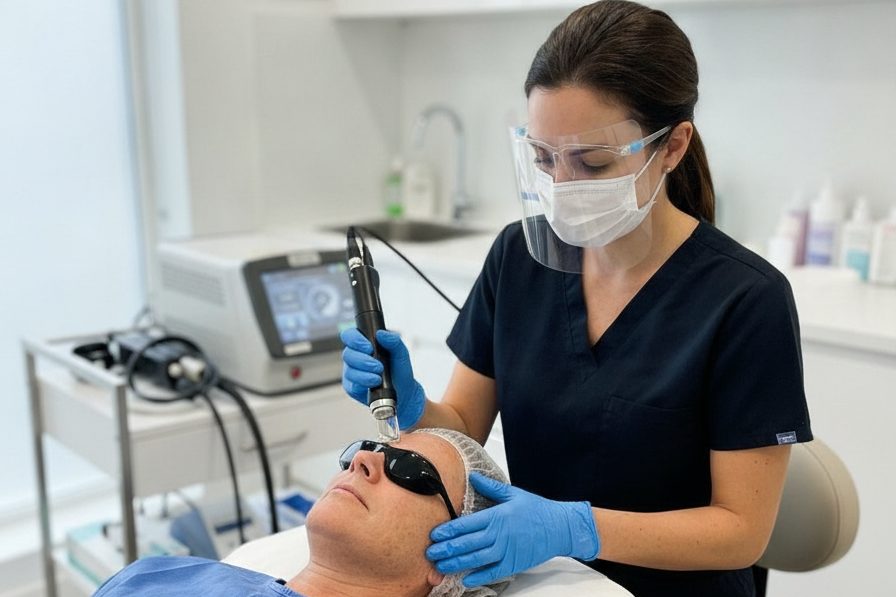
Laser removal uses targeted light energy to break down pigment within the mole. It is only appropriate for flat, superficial, and confirmed-benign lesions, and it does not produce a specimen for histology. For this reason, laser is not suitable as a first-line approach when there is any diagnostic uncertainty. Where it is appropriate, it can produce excellent cosmetic results with minimal downtime, though multiple sessions may be needed and there is still a risk of pigment returning.
Radiofrequency ablation uses a fine electrode to precisely remove tissue layer by layer. Like laser, it is best reserved for confirmed-benign, raised lesions and is popular for facial moles because the controlled nature of the technique can minimise collateral tissue damage.
No technique is universally superior. The right choice depends on the mole's characteristics, its location on the body, your skin type, and your priorities. A thorough consultation is where these variables are weighed properly.
Honest expectations around scarring
This is the section that cosmetic clinics sometimes gloss over, and we are not going to do that. Every mole removal leaves some form of mark. The question is not whether you will have a scar, but what kind of scar, how visible it will be, and how it will change over time.
Immediately after removal, you will have either a small raw area or a sutured wound, depending on the technique. In the first few weeks, the area will likely be pink, slightly raised, and noticeable. This is normal healing, not a sign that something has gone wrong. Over the following months, most scars flatten and fade considerably. By twelve months, many are barely perceptible, particularly on the face where blood supply is excellent and skin tends to heal well.
However, several factors influence scarring in ways that cannot always be predicted in advance. Skin type is significant: people with darker skin tones have a higher tendency towards post-inflammatory hyperpigmentation, where the healed area becomes darker than the surrounding skin. People of any skin tone can develop hypertrophic scars, which are raised, firm, and sometimes itchy. A small subset of people, often those with a personal or family history of keloid scarring, can develop keloids: scars that grow beyond the original wound boundary and can be challenging to treat. The chest, shoulders, and upper back are particularly prone to this type of scarring.
Location matters too. Moles on the back or chest tend to scar more visibly than those on the face, because skin tension is higher and blood supply is relatively lower. A mole on the nose or eyelid presents its own challenges because the surrounding anatomy is complex and the margin for error is small.
Post-operative care also plays a meaningful role. Keeping the wound moist during healing, protecting it from sun exposure for at least six months, and avoiding picking or stretching the area all contribute to a better outcome. Silicone gel or sheeting applied once the wound has fully closed can help flatten and fade a scar over time. Treatments such as microneedling or CO2 laser resurfacing may be considered later to improve scar texture and tone if needed, though these are separate conversations that happen well after the removal itself has healed.
Who should think carefully before proceeding
Mole removal is a minor surgical procedure, but it is still a procedure, and it is not right for everyone in every circumstance. There are situations where we would advise waiting, reconsidering, or seeking additional assessment first.
If you have a strong personal or family history of keloid scarring, cosmetic mole removal requires very careful thought. The risk of producing a scar that is more noticeable than the original mole is real, and in some locations, particularly the chest and upper arms, it is substantial. This does not mean removal is impossible, but it means the risk-benefit calculation shifts, and the conversation needs to be honest about that.
If you are pregnant, elective procedures are generally deferred until after delivery and, ideally, after breastfeeding has concluded. Hormonal changes during pregnancy can affect wound healing and pigmentation unpredictably.
If you are taking blood thinners, have a clotting disorder, or are immunocompromised, these factors need to be disclosed and managed appropriately before any skin procedure.
If your primary motivation is to look like a specific person, or you have unrealistic expectations about the outcome, a good clinician will take time to explore this with you rather than simply proceeding. Cosmetic procedures work best when expectations are grounded in reality, and the goal is improvement rather than perfection.
Finally, if a mole has not been properly assessed before you seek cosmetic removal, that assessment must happen first. No reputable clinic in London or anywhere else should remove a mole without either performing a clinical assessment themselves or reviewing documentation that confirms the lesion has been assessed as benign by a qualified clinician.
Recovery: what the first few weeks actually look like
Recovery from mole removal is generally straightforward, but it helps to know what to expect so that normal healing does not alarm you unnecessarily.
For shave excision and laser or radiofrequency techniques, you will typically have a small wound covered with a dressing for the first day or two. The area may feel tender, look red, and occasionally weep a small amount of clear or slightly blood-tinged fluid. This is normal. Keep the area clean, apply any prescribed ointment, and change the dressing as directed. Most people can return to work the following day, though you should avoid swimming, saunas, and vigorous exercise for at least a week to reduce infection risk and minimise tension on the healing skin.
For elliptical excision with sutures, the wound will be closed with either absorbable or non-absorbable stitches. Non-absorbable sutures on the face are typically removed at five to seven days; on the body, at ten to fourteen days. Until sutures are removed, keep the area dry and protected. After removal, the scar will still be pink and may feel slightly firm or itchy as collagen remodels beneath the surface. This phase can last several months.
Sun protection is critical. UV exposure to a healing scar can cause permanent darkening of the area, particularly in those with olive or darker skin tones. A high-factor SPF applied daily, or physical coverage with clothing, is essential for at least six months post-procedure.
If you notice increasing redness, swelling, warmth, pus, or fever in the days following removal, contact the clinic promptly. Infection is uncommon but possible, and it is always better to have a wound reviewed early than to wait and see.
Booking your consultation
If you are considering mole removal in London and want to understand your options properly, the starting point is always a thorough clinical consultation rather than a booking for removal itself. At our clinic in Kensington, every patient is seen by a doctor who will assess the mole, discuss your concerns honestly, and recommend the most appropriate pathway, whether that is reassurance, medical referral, or a planned cosmetic procedure.
Our approach is doctor-led throughout. We do not offer mole removal as a quick-fix service, and we will always tell you if we think removal is not in your best interest. You can learn more about our clinical team, including Dr Hassan, and the standards we hold ourselves to on our website. We also offer a range of complementary skin treatments, including chemical peels and pigmentation treatments, which may be relevant if your concerns extend beyond a single mole to broader skin tone and texture.
Kensington is home to some of London's most experienced cosmetic doctors, and choosing a clinic where medical rigour sits alongside aesthetic expertise makes a genuine difference to both your safety and your outcome. If you are ready to take the next step, you can book a consultation online, and one of our team will be in touch to confirm your appointment and answer any initial questions you may have.
Frequently asked
Questions we get asked about EnerPeel®
- Do I need a GP referral to have a mole removed at a private clinic in London?
- No, you do not need a GP referral to be seen at a private clinic. However, if your mole has any features that concern you, such as changes in size, shape or colour, it is sensible to mention this to your GP as well, since they can refer you through the NHS urgent skin cancer pathway if needed. At a private clinic, a doctor will assess the mole at your consultation and advise on the appropriate course of action.
- Will the mole grow back after removal?
- It depends on the technique used and the depth of the mole. Shave excision removes the visible portion of the mole but may leave some pigment-producing cells in the deeper dermis, which means partial regrowth or pigment return is possible in a minority of cases. Elliptical excision removes the full depth of the mole and has a much lower rate of recurrence. Your clinician will discuss the most appropriate technique for your specific mole and your priorities.
- How long does it take for a mole removal scar to fade?
- Most scars go through an active remodelling phase for up to twelve months after the procedure. During this time, the scar will typically progress from pink and slightly raised to flatter and paler. By twelve months, many scars, particularly on the face, are barely noticeable. However, individual healing varies based on skin type, location, age, and aftercare. Scars on the chest, back, and shoulders tend to take longer to settle and may remain more visible than facial scars.
- Is mole removal painful?
- The procedure itself is performed under local anaesthetic, so you should feel pressure and movement but not sharp pain during the removal. The injection of local anaesthetic can sting briefly, but this passes within seconds. After the anaesthetic wears off, the area may feel tender and sore for a day or two, which is usually well managed with standard over-the-counter pain relief such as paracetamol. Most patients find the recovery far more comfortable than they anticipated.
- Can any mole be removed for cosmetic reasons, or are there restrictions?
- Not every mole is suitable for cosmetic removal. Any mole must first be assessed clinically to confirm it is benign before cosmetic removal is considered. Moles in certain locations, such as on the eyelid margin or inside the nose, require specialist assessment and may not be suitable for straightforward removal in a cosmetic setting. Patients with a history of keloid scarring need careful counselling about the risks. A thorough consultation with a doctor is the essential first step to determine whether cosmetic removal is appropriate in your specific case.