

Surgical · 11 min read
Receding Hairline in Men: Treatment Options in London
By Dr Hassan Soueid · GMC 6107783 · Medical Director, Kensington Cosmetic Clinic
Published 22 November 2026
TL;DR. Many male hairlines simply mature with age, and when true recession is present the sensible order is a proper diagnosis first, then medication and supportive treatments, with surgery considered only once the pattern of loss is stable enough to plan around.
Noticing that your hairline looks different in photos, or that your temples seem higher than they used to, can be unsettling. It is also extremely common, and it is not a sign that you have done anything wrong. If you are researching receding hairline treatment for men in London, the most useful thing we can offer is clarity: what is actually happening, what each option can and cannot do, and why the order in which you try things matters more than many clinic websites admit. This guide sets out how we approach the male hairline at our clinic in Kensington, with an honest look at medication, PRP, hair transplant surgery and the reasons young men are often advised to slow down.
Maturing hairline or true recession?
Many men have what is often called a juvenile hairline in adolescence. It tends to sit low on the forehead, run fairly straight across and have rounded or filled-in temples. During the late teens and twenties, this hairline commonly moves back a little and settles into a more adult shape. The temples become slightly more defined, the line rises and the overall look becomes more angular. This is a maturing hairline, and it is a normal part of male development rather than a disease.
True recession, usually caused by male pattern hair loss (androgenetic alopecia), differs in a few important ways. The hairline keeps moving rather than settling. The temple corners deepen into a pronounced M or V shape. The hairs along the front often become finer, shorter and lighter before they disappear, a process called miniaturisation. Recession at the front also frequently comes with thinning elsewhere, particularly at the crown.
Doctors often use the Norwood scale to describe male pattern hair loss. Stage 1 is a full juvenile hairline. Stage 2 represents mild, often symmetrical change at the temples and is where many maturing hairlines sit. From stage 3 onwards, recession is more clearly significant, and higher stages describe increasing loss across the front and crown until only a horseshoe of hair remains at the sides and back. The scale is a helpful shorthand, but it is not a prediction. Two men at stage 2 at the age of 22 may look completely different at 40.
Signs that suggest it is worth having a doctor look properly include:
- visible change over months rather than years
- fine, wispy hairs along the front line compared with thicker hair behind
- thinning at the crown as well as the temples
- a strong family history of early hair loss on either side
- itching, redness, scaling or tenderness of the scalp, which may point to something other than pattern loss
It is very hard to judge your own hairline in a bathroom mirror, and old photos taken in different lighting can mislead. Consistent clinical photographs and a magnified look at the scalp give a far more reliable baseline.
Finding the cause before receding hairline treatment for men in London
Not every receding hairline is male pattern hair loss, and treating the wrong cause wastes time and money at best. Our hair consultations follow a doctor-led diagnostic route, described on our hair restoration page, and the service is led by Dr Mahmoud Elkhouly, a GP with a focus on hair restoration.
A proper assessment usually includes:
- A detailed history. When you first noticed change, how quickly it has progressed, family history, general health, recent illness or stress, weight change, diet, and any medicines or supplements, including testosterone or anabolic steroids, which can accelerate pattern loss in men who are predisposed.
- Examination of the scalp. Looking at the pattern and density of hair, the condition of the skin, and whether there is any scarring or inflammation.
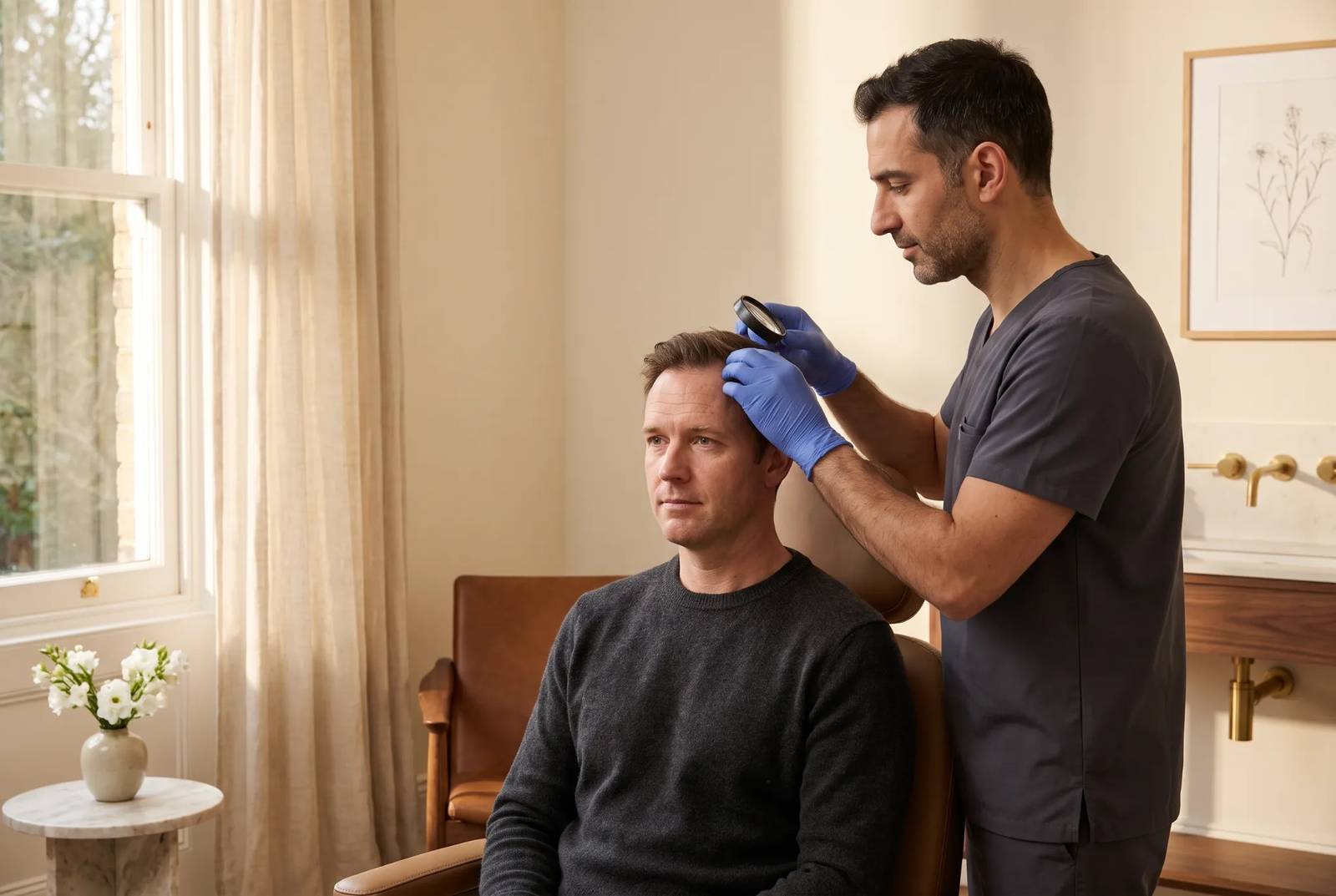
- Trichoscopy. A magnified examination of the scalp and hair shafts that helps distinguish miniaturisation from other patterns of loss.
- Blood tests where indicated. Not everyone needs them, but they may be appropriate to look for thyroid problems, low iron stores or other medical contributors, particularly if loss is diffuse or sudden.
Conditions that can mimic or complicate a receding hairline include traction alopecia from tight hairstyles, telogen effluvium (temporary shedding after illness, surgery or major stress), alopecia areata, and scarring forms of hair loss such as frontal fibrosing alopecia, which is less common in men but does occur. Scarring alopecias need medical management and often referral to a dermatologist. A transplant into an inflamed or scarring scalp can fail, so getting the diagnosis right comes before any procedure.
If the diagnosis is male pattern hair loss, the conversation turns to goals and timing. Some men decide they are comfortable with gradual change and want reassurance rather than treatment. That is a completely reasonable choice, and a good consultation should leave room for it.

Medication and how it is monitored
For male pattern hair loss, medication is usually the first line of treatment. Its main role is to slow or stabilise loss, and in some men it helps miniaturised hairs regain some thickness. It is most useful for hair that is thinning rather than hair that has already gone, so it tends to help diffuse thinning and the crown more than long-standing bare temple corners. Response varies widely, and nobody can predict in advance how an individual will respond.
Does minoxidil work for a receding hairline? Topical minoxidil, available from pharmacies as a solution or foam, has evidence for slowing hair loss and encouraging regrowth in some men. The evidence is stronger for the crown and mid-scalp than for the temples, although some men do notice benefit at the front. It needs to be used consistently, usually for several months before any change is visible, and the benefit generally fades if you stop. Common side effects include scalp irritation, dryness or itching, and an initial period of increased shedding as hair cycles reset, which can be alarming if you are not expecting it.
There are also prescription-only medicines that act on the hormonal pathway behind pattern hair loss, by reducing the conversion of testosterone to dihydrotestosterone (DHT), the hormone that shrinks susceptible follicles. These help many men, but they are not right for everyone and need a proper medical assessment before prescribing. A balanced discussion of side effects matters. A minority of men report sexual side effects such as reduced libido or erectile difficulties. Mood changes, including low mood and, rarely, suicidal thoughts, have also been reported, and the MHRA has issued safety information asking patients and prescribers to be alert to these effects. Many men take this type of medicine without significant problems, but you should know what to look for and feel able to stop and seek advice if something does not feel right.
Any prescribing decision at our clinic follows a consultation with a doctor, and monitoring is built in rather than left to chance. That typically means:
- baseline photographs taken in consistent conditions
- a review after several months, because judging progress sooner is unreliable
- a clear discussion of side effects at each review, including mood and sexual health
- an agreed plan for what happens if the medication is not helping or is not tolerated
Medication works while you take it, so it is worth deciding whether a long-term commitment suits you before you start.
Where PRP and regenerative treatments fit
Platelet-rich plasma, or PRP treatment, involves taking a small sample of your own blood, concentrating the platelets in a centrifuge and injecting the plasma into areas of thinning. The idea is that growth factors released by platelets may support follicles that are miniaturising.
The honest position is that PRP is an adjunct, not a replacement for diagnosis or medication. Some studies suggest it can help density and hair thickness in male pattern loss, but the research varies in quality, preparation methods differ between clinics and results are inconsistent from person to person. It cannot regrow follicles that have been lost completely, so it will not restore a temple corner that has been bare for years. It tends to be considered for men who still have thinning hair present, those who prefer to avoid or cannot tolerate medication, or as support around the time of a transplant.
PRP for hair is usually given as an initial course of sessions spaced several weeks apart, followed by occasional maintenance if there is a response. Side effects are generally minor, including tenderness, mild swelling, pinpoint bleeding and a headache on the day. It is not suitable for everyone, for example some people with blood disorders, those on certain medicines or anyone with an active scalp infection. We cover the practicalities in our article on PRP for hair loss in London.
You may also come across microneedling, light devices, shampoos and supplements marketed for hair loss. Some have limited supporting evidence and many have very little. Supplements are rarely useful unless a genuine deficiency has been found. A doctor should tell you plainly where each option sits on the evidence ladder rather than bundling everything into a package.
Hair transplant for the hairline
A hair transplant moves follicles from the donor area, usually the back and sides of the scalp, where hair is typically more resistant to DHT, into areas of recession. At our clinic, procedures are performed by Dr Hassan Soueid or one of our qualified surgeons, usually using follicular unit extraction (FUE), where individual follicular units are removed and implanted one by one.
For the hairline, technique matters, but planning matters more. A natural-looking hairline is not a straight line drawn across the forehead. It should be slightly irregular at the edge, use single-hair grafts at the very front, respect the natural temple angles and sit at a height that will still look appropriate as you age. A hairline that suits a 24-year-old may look out of place at 50 if the hair behind it keeps thinning.
Points we discuss at every hair transplant consultation include:
- Ongoing loss. A transplant does not stop native hair from continuing to thin. Without a plan for progression, men can end up with a transplanted hairline in front of a thinning area, which can look unnatural.
- Donor supply. The donor area is finite. Every graft used now is a graft unavailable later.
- Realistic density. A transplant redistributes hair; it cannot create more than you have. The aim is a natural frame for the face, not the density of an 18-year-old.
- Recovery. Expect redness, scabbing and some swelling in the first week or two. Transplanted hairs usually shed within weeks, new growth starts over the following months and the final appearance is generally judged at around 12 to 18 months.
- Risks. These include infection, bleeding, temporary numbness, folliculitis, prolonged redness, shock loss of existing hair near the transplanted area, poor graft growth, visible donor scarring and a hairline that does not look as natural as hoped. Some men need a second procedure.
A transplant can be a reasonable option for the right person at the right time. It is simply not the first step for most men, and it should never be presented as a cure for hair loss.
Why young men are often advised to wait
Men in their late teens and early twenties are often the most distressed by a receding hairline, and they are also the group in whom surgery carries the most uncertainty. There is no single age cut-off that applies to everyone, but there are good reasons many doctors suggest waiting until the pattern of loss is clearer and, ideally, stable for a period on medical treatment.
The first reason is unpredictability. At 21, it is difficult to know whether someone will settle at a mild stage or progress to extensive loss. If the hairline is rebuilt early and the crown and mid-scalp later thin significantly, there may not be enough donor hair to cover everything, and the result can look like an isolated strip of hair at the front.
The second reason is the finite donor area. Each man has a limited number of follicles that can be safely harvested from the back and sides. Over-harvesting, particularly in very large sessions, can leave the donor area visibly thin and limit future options. In a young man, preserving donor supply for later decades is often more valuable than using it all at once.
The third reason is hairline design. Younger patients understandably want their old hairline back, often the low, straight juvenile one. Recreating it can commit them to a look that becomes harder to maintain as surrounding hair changes. A more conservative, mature hairline usually ages better.
Waiting does not mean doing nothing. It often means starting medication if appropriate, considering supportive treatments, taking consistent photographs and coming back for review. Our article on hair transplant candidacy and the donor area explains the factors in more depth. Sometimes the most useful outcome of a consultation is a clear plan to revisit the question in a year or two.
Treatment abroad and UK aftercare
Many men in London consider travelling abroad for a hair transplant, often attracted by package deals. Some have good experiences, and it would be unfair to suggest otherwise. However, there are questions worth asking before you book anywhere, in the UK or overseas:
- Who will assess you, and is a doctor involved in diagnosis and planning, or only a sales coordinator?
- Who will actually perform each part of the procedure, including extraction and implantation, and what are their qualifications?
- How many grafts are proposed, and how was that number reached? Very high graft counts can mean over-harvesting the donor area.
- Has anyone discussed your long-term pattern of loss and medication, or only the hairline?
- What written aftercare instructions and records will you receive, including details of any medicines given?
- What happens if you develop an infection, unexpected swelling or poor growth once you are home?
Aftercare is where problems most often arise. Complications rarely appear on the day of surgery. Infection, folliculitis, persistent redness or concerns about graft survival usually show up days or weeks later, when you may be back in London and far from the team who treated you. The NHS will help with urgent problems, but revision or cosmetic follow-up is not usually available on the NHS. Before travelling, check whether the overseas clinic has any UK arrangements and what you would need to pay for yourself.
If you have already had a transplant abroad and are unsure about your healing or results, you are welcome to book a consultation at our Kensington clinic. We can assess your scalp, explain honestly what we see and discuss options, without judgement about where you were treated.
Booking your consultation
Your first appointment is about understanding your hair rather than selling you a procedure. Consultations are doctor-led and take place at our clinic in Kensington, which is registered with the Care Quality Commission. We will take a full history, examine your scalp, take baseline photographs and talk through which options, if any, make sense for you now and which are better kept for later. If surgery is discussed, we will explain the risks, recovery and alternatives, and you will always have time to think before deciding, including a cooling-off period before any procedure.
We are introducing HonestFace, our own iPad app for digital consultation forms, consent signing and secure patient records, so you may be asked to complete some paperwork that way as it is rolled out. You will still have plenty of time to talk things through face to face and ask questions.
Hair loss is common, often gradual and nothing to feel embarrassed about. Whether you want reassurance, a medical plan or a conversation about surgery in the future, you can book a consultation with our team in London and get a clear, honest view of where you stand.
Frequently asked
Questions we get asked
- Is my hairline receding or just maturing?
- A maturing hairline usually rises a little in the late teens or twenties, then settles, with slightly more defined temples and hair along the front that stays a similar thickness. True recession tends to keep progressing, deepens at the temples and often comes with finer hairs at the front or thinning at the crown. A doctor-led assessment with trichoscopy and consistent photographs is the most reliable way to tell the difference.
- Can a receding hairline grow back?
- Hair that is miniaturising may thicken with medication or supportive treatments in some men, but follicles that have been lost for a long time do not usually regrow. Response varies from person to person and no treatment can promise regrowth. Where hair has gone completely, a hair transplant can redistribute hair from the donor area for suitable candidates once the pattern of loss is stable.
- What age is too young for a hair transplant?
- There is no single cut-off. Many doctors are cautious about surgery in the late teens and early twenties because the future pattern of loss is hard to predict and the donor area is finite. Suitability depends on how stable your hair loss is, your family history, your response to medical treatment and whether your expectations for the hairline are realistic, all of which are assessed at consultation.
- Is medication for hair loss safe?
- Many men use hair loss medication without significant problems, but no medicine is free of side effects. Topical minoxidil can cause scalp irritation and temporary extra shedding. Prescription-only tablets can cause sexual side effects in a minority of men, and mood changes have been reported, which the MHRA has highlighted in safety information. That is why prescribing should only follow a doctor's consultation, with regular reviews and a clear plan if side effects occur.
- Is a hair transplant permanent?
- Follicles taken from the donor area tend to keep their resistance to pattern hair loss and often continue to grow long term after transplantation, but this cannot be guaranteed for any individual. Your native hair around the transplanted area may also keep thinning over time, which is why many men need ongoing medical management and some go on to consider further treatment.