

Surgical · 11 min read
Liposuction for Men in London: Abdomen and Flanks
By Dr Hassan Soueid · GMC 6107783 · Medical Director, Kensington Cosmetic Clinic
Published 17 November 2026
TL;DR. Liposuction for men can refine stubborn fat just beneath the skin of the abdomen and flanks once you are near a stable, healthy weight. It cannot remove the deeper visceral fat behind a firm beer belly, and it is not a weight-loss treatment.
Most men who ask us about liposuction describe the same problem. They train, they eat reasonably well, and yet a layer around the lower stomach and love handles refuses to shift. Liposuction for men in London is often sold as the quick fix for that, so it is worth being clear from the start. Liposuction is an operation that removes fat from beneath the skin to change shape. It does not make you lose weight, it does not tighten loose skin on its own, and it cannot reach the fat stored inside the abdomen. This guide covers male liposuction of the abdomen and flanks at our Kensington clinic: who it suits, what recovery really involves and what can go wrong.
Why men store fat differently
Men and women tend to store fat in different places, mainly because of hormones, genetics and age. Women more often carry fat on the hips, thighs and buttocks. Men are more likely to store it centrally: across the lower abdomen, around the waist and on the flanks, the area most people call love handles. Some men also carry fat on the chest. That can involve glandular tissue and is a separate issue, which our guide to gynaecomastia surgery covers.
This pattern has two practical consequences. First, male fat on the flanks and abdomen is often more fibrous. It sits within a denser web of connective tissue, which makes it firmer to the touch and harder to remove evenly. For the surgeon that means more deliberate work, sometimes with energy-assisted devices to loosen the tissue first. For you it can mean a little more bruising and soreness afterwards.
Second, men frequently store fat deeper, inside the abdominal cavity, as well as just beneath the skin. As men get older, testosterone tends to fall gradually, and many notice their waist expanding even when the scales barely move. Some of that change is fat beneath the skin, which liposuction can address. Some of it is not. That distinction is the most important thing to understand before you book anything.
Stubborn does not mean beyond the reach of lifestyle change. Many men find that a sustained change in alcohol, sleep, diet and training shifts central fat more than they expected. Liposuction works best as a refinement once those foundations are in place, not as a substitute for them.
Subcutaneous versus visceral fat: what liposuction cannot remove
Abdominal fat sits in two main layers. Subcutaneous fat lies between the skin and the abdominal muscles. It is the fat you can pinch, and it is the only fat liposuction can remove. Visceral fat lies deeper, behind the muscle wall, packed around the intestines, liver and other organs. No form of liposuction can safely reach it.
Many men with a prominent stomach carry a large proportion of visceral fat. The classic sign is a belly that feels firm and tight rather than soft, and that pushes forward even when you are relaxed. If you lie flat and the stomach stays high and hard, much of the volume is probably inside the abdominal wall. If you can grab a thick, soft roll with both hands, there is more subcutaneous fat to work with.
Most men have a mixture of the two. A careful examination helps the doctor estimate how much of your shape is likely to change, and may involve asking you to tense your abdominal muscles or lie down. If most of the volume is visceral, liposuction removes an outer layer but the stomach still protrudes, and the result can be disappointing.
Visceral fat is also the type more closely linked with raised blood pressure, type 2 diabetes and heart disease. Removing subcutaneous fat does not lower those risks. What does reduce visceral fat is familiar: a calorie deficit, less alcohol, regular exercise including resistance training, better sleep and, where appropriate, support from your GP. If an honest assessment suggests visceral fat is your main concern, we will tell you. For a broader look at the limits of the procedure, see our article on what liposuction can and cannot do.

Who suits liposuction for men in London, and who does not
No single checklist decides suitability, but some patterns come up again and again. Men who tend to suit liposuction usually have:
- A weight that has stayed broadly stable for several months.
- A weight at or near a healthy range for their build, with localised fat that has not responded to diet and exercise.
- Soft, pinchable fat on the abdomen and flanks rather than a mainly visceral belly.
- Reasonable skin elasticity, so the skin can adapt to a smaller contour.
- Good general health. They do not smoke, or they are willing to stop well before and after surgery.
- Realistic expectations and a willingness to follow the recovery plan.
Liposuction may not be right, or may need to wait, if:
- You are still losing weight, including on prescribed weight-loss medication. Waiting until your weight settles usually makes sense.
- Most of your abdominal volume appears to be visceral fat.
- You have significant loose or overhanging skin, for example after major weight loss. Removing fat beneath loose skin can make it look looser, and a skin-removal procedure may suit you better.
- You have a hernia, including a small umbilical hernia, that needs assessing first.
- You have uncontrolled medical conditions or a history of blood clots, or you take medicines that affect bleeding, unless these can be safely managed.
- You are hoping for visible abdominal muscles you have not built, or for surgery to resolve a deeper unhappiness with your appearance.
BMI is a rough guide rather than a rule. A muscular man can have a BMI that looks high on paper and still suit liposuction, while a man with a normal BMI and mostly visceral fat may not. Your doctor will weigh your history, examination and goals together.
Abdomen, flanks and the 360 approach
Men rarely judge their shape from the front alone. The flanks wrap from the side of the waist towards the lower back and are often the most stubborn area of all. If the abdomen is treated without the flanks, the waist can look out of proportion from the side or from behind.
That is why many men are assessed for 360 liposuction, which treats the abdomen, flanks and lower back in one procedure for a more even contour around the torso. It is a bigger operation. It involves more incision points, longer anaesthetic time, larger fluid shifts and a more demanding recovery, so it is not automatically the right choice. For some men a targeted plan is more sensible.
Shape is where male and female liposuction differ most. A typical male torso runs fairly straight through the waist and is widest at the shoulders and chest. Removing too much from the flanks can carve an inward curve at the waist, an hourglass outline that can look feminised on a man. Good male contouring generally aims to reduce the bulge above the hip bones while keeping the lines straight. Over-correction brings its own problems. Very thin fat layers can leave dents, tethering and irregularities that are hard to correct, so a slightly conservative approach usually looks more natural over time.
Some men ask about muscle definition procedures, sometimes called high-definition liposuction. Here fat is selectively removed to bring out the outline of the abdominal muscles. This depends on already having low body fat and well-developed muscles. It cannot create muscle that is not there, and it carries a higher risk of an artificial or uneven look if overdone. It can also look less natural if you later gain weight. It suits a small group of men, and its downsides deserve an open discussion.
Techniques explained without the sales pitch
Clinics often promote a named device as if it were the secret ingredient. In reality, planning, surgical judgement and aftercare matter more than the brand of machine. Here is what the common approaches involve.
Tumescent liposuction. Almost all modern liposuction begins with tumescent fluid. This is a dilute solution of saline, local anaesthetic and a medicine that narrows blood vessels, which is injected into the fat before removal. It reduces bleeding and makes the fat easier to remove through a thin cannula inserted via small incisions.
Power-assisted liposuction. A rapidly vibrating cannula helps break up fat with less force. This can be useful in fibrous areas such as the male flanks and back.
Ultrasound-assisted liposuction. Ultrasound energy loosens fat before removal, which can help with denser tissue. Because energy is involved, there is a risk of heat injury to the skin or deeper tissue.
Laser-assisted liposuction. Laser energy softens the fat, and some claim it encourages skin tightening. The evidence for meaningful tightening is mixed, and it does not replace surgical skin removal where skin is significantly loose.
No technology removes the risks of liposuction or makes recovery painless. Smaller areas can sometimes be treated under local anaesthetic, with or without sedation. Larger or combined procedures such as 360 liposuction are usually carried out under general anaesthesia. Your doctor should explain which approach is proposed for your body and why, not simply which one sounds most advanced.
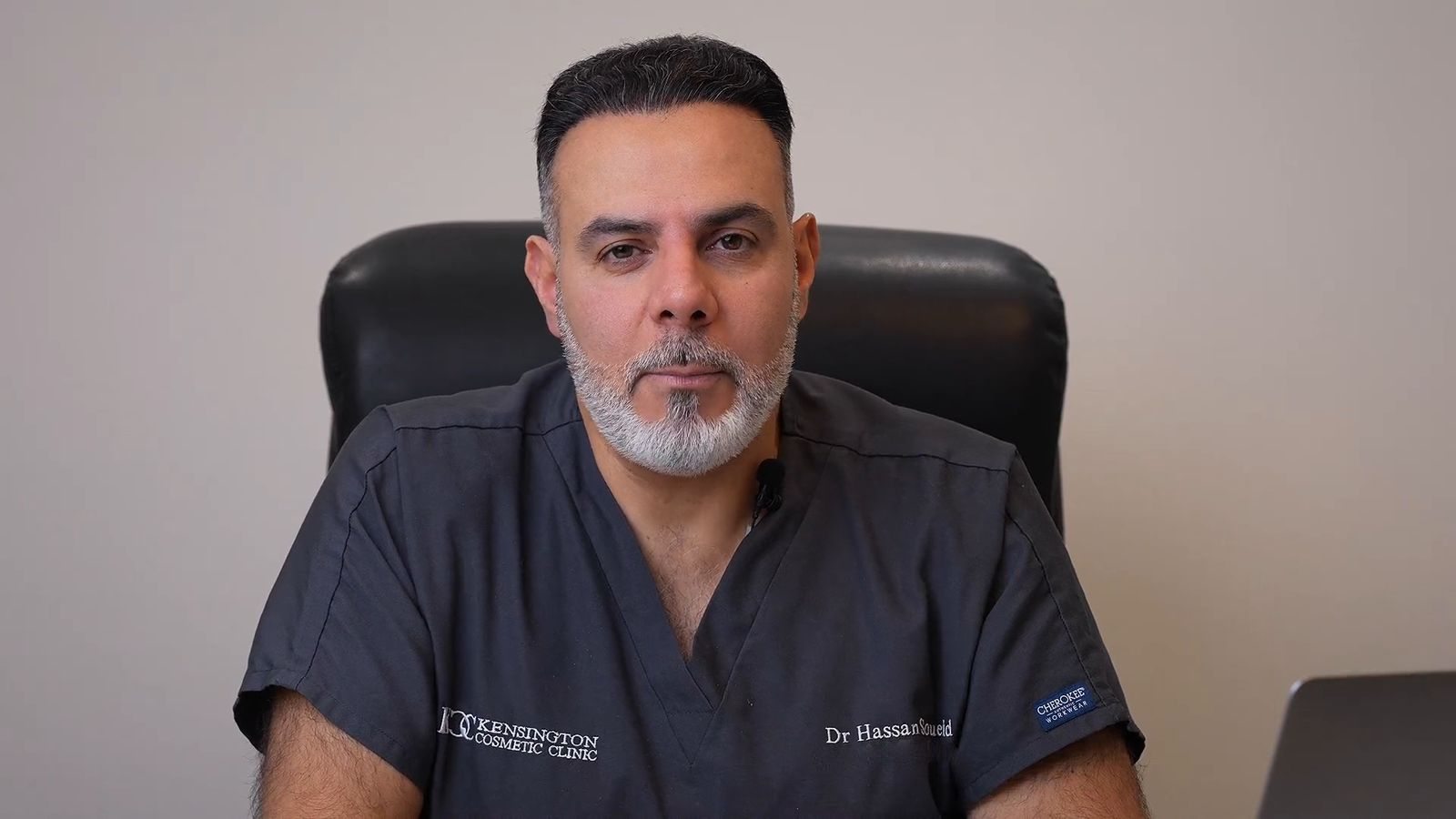
At KCC, operations are performed by Dr Hassan Soueid, our Founder and Medical Director, or one of our qualified surgeons. Consultations are doctor-led, so the person assessing you is medically trained and can talk through the risks of each option.
Recovery: garments, swelling, work and the gym
Recovery is where expectations most often fall short, so plan for it properly. Your surgeon's instructions always take priority over general guidance.
The first few days. Expect soreness, stiffness and bruising, often described as like the aftermath of a brutal training session. Some leakage of tumescent fluid from the incisions is normal for a day or two. You will need someone to take you home and, ideally, to stay with you the first night.
Compression garments. You will usually wear a compression garment for several weeks to control swelling and support the tissues as they settle. After flank and back treatment, it typically covers the whole torso. It is warm and unglamorous, but wearing it consistently matters.
Swelling. This is the part men underestimate. Treated areas can look swollen and uneven for weeks, and the final contour may take six months or longer to become clear. Firmness, patches of numbness and small lumpy areas are common in this phase and often soften with time.
Blood clot prevention. Surgery carries a risk of venous thromboembolism, especially larger procedures under general anaesthetic. This is a clot in a deep leg vein (deep vein thrombosis) that can travel to the lungs (pulmonary embolism), and it is serious and potentially life-threatening. Your individual risk will be assessed before surgery. Prevention may include compression stockings, walking little and often from the day of surgery and staying well hydrated. Some patients also need blood-thinning injections. Avoid long-haul flights and long journeys in the early weeks unless your surgeon agrees. Calf pain or swelling, chest pain or breathlessness need urgent medical attention.
Work. Men with desk jobs often return within one to two weeks, depending on the extent of surgery. Manual jobs or roles involving heavy lifting usually need longer.
The gym. Walking is encouraged from the start. Light cardio, such as a static bike, is often reintroduced after a couple of weeks if your surgeon agrees. Heavy lifting, core work and high-intensity training usually wait until around four to six weeks, then build up gradually. Coming back too early can increase swelling and the risk of fluid collections. Treat it like returning from an injury: lighter weights, controlled movement, and stop if something feels wrong.
Alcohol and nicotine. Both slow healing. Smoking and vaping reduce blood flow to the skin and raise the risk of complications, so you will be asked to stop well before and after surgery.
Risks and what happens if weight changes
Liposuction is surgery, and every operation carries risk. Most men recover without major problems, but you should understand the possibilities before giving consent. In plain terms, they include:
- Bruising, swelling and pain, which can be prolonged.
- Contour irregularities such as dents, ripples or lumps, sometimes needing further treatment.
- Asymmetry between the two sides.
- Numbness or altered skin sensation, usually temporary but occasionally longer-lasting.
- Seroma, a fluid collection under the skin that may need draining.
- Infection, bleeding or haematoma.
- Visible, darker or raised scars at incision sites.
- Skin discolouration.
- Burns or heat injury with energy-assisted devices.
- Looser or less smooth skin where elasticity is limited.
- Deep vein thrombosis and pulmonary embolism.
- Fat embolism, which is rare but serious.
- Perforation of the abdominal wall or internal organs, which is rare but serious.
- Reactions to local anaesthetic, fluid imbalance, and the risks of general anaesthesia or sedation.
- Dissatisfaction with the outcome and the possibility of revision surgery.
If your weight changes. Liposuction removes fat cells from the treated area, and those cells do not grow back. The fat cells that remain can still enlarge. If you gain weight afterwards, treated areas may fill out to some degree. Extra fat may also settle elsewhere, including the chest, upper back or, importantly for men, inside the abdomen as visceral fat. Some men find that later weight gain produces a firmer, rounder belly than before, because the outer layer is thinner while the deeper fat has grown.
That is why stable weight matters before and after surgery. Liposuction tends to suit men who see it as a refinement that supports habits they already have, not a reset button. Age, hormones, alcohol and activity levels will keep influencing your shape regardless.
Booking your consultation
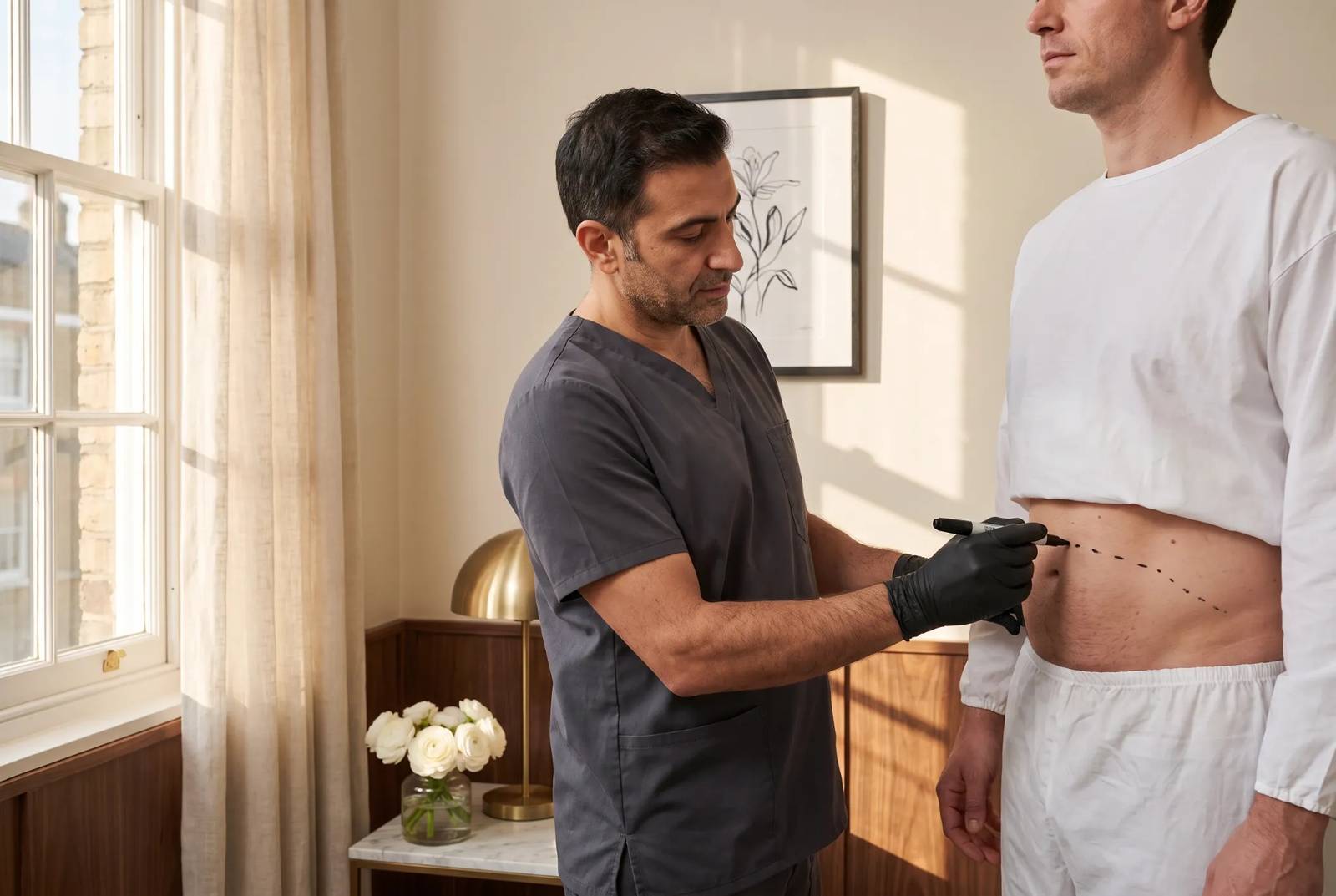
A consultation is a chance to get an honest opinion, not a commitment to surgery. At our Kensington clinic in London, consultations are doctor-led. You will be asked about your medical history, medication, weight history, training and goals. The doctor will examine your abdomen and flanks and estimate how much of your shape is subcutaneous rather than visceral fat. They will also check your skin quality and look for anything that needs attention first, such as a hernia.
You should leave knowing whether liposuction is likely to help and which areas and approach might make sense. You should also understand how recovery would affect your work and training, and which risks apply to you. If something else would serve you better, such as waiting for your weight to settle or speaking to your GP, we will say so. You will always have time to think before any procedure.
We are introducing HonestFace, our own iPad app for digital consultation forms, consent signing and secure patient records, to make the paperwork side of your visit simpler.
Kensington Cosmetic Clinic is registered with the Care Quality Commission. If you would like to discuss liposuction of the abdomen and flanks, you can book a consultation and see us in Kensington, west London.
Frequently asked
Questions we get asked
- Can liposuction remove a beer belly?
- Only partly, and often not by much. A beer belly that feels firm and pushes forward is usually caused largely by visceral fat inside the abdominal wall, which liposuction cannot reach. If there is also a soft, pinchable layer on top, liposuction can reduce that, but the stomach may still protrude. Cutting down on alcohol, improving diet and exercise, and speaking to your GP are the main ways to reduce visceral fat. A doctor-led examination can help work out which type of fat is driving your shape.
- Am I a good candidate for male liposuction?
- You may be if your weight has been stable for several months and you are at or near a healthy weight for your build. The fat should be soft and pinchable rather than mostly visceral, your skin should have reasonable elasticity, and you should be in good general health. Liposuction may not be suitable if you are still losing weight, or if you have significant loose skin, a hernia, uncontrolled medical conditions or a history of blood clots. Suitability can only be confirmed at an in-person consultation.
- When can I return to the gym after liposuction?
- Walking is encouraged from the day of surgery to help circulation and reduce the risk of clots. Light cardio is often reintroduced after around two weeks. Heavy lifting, core work and high-intensity training usually resume after about four to six weeks, building up gradually. Timings depend on how extensive the surgery was and how you are healing, so always follow your surgeon's specific advice.
- Will the fat come back after liposuction?
- Fat cells removed from the treated area do not grow back, but the fat cells that remain can enlarge if you gain weight. Extra weight may also settle in untreated areas or inside the abdomen as visceral fat. Keeping your weight stable through diet and exercise is the most reliable way to maintain the change in contour.
- Is liposuction a weight loss treatment?
- No. Liposuction is a contouring procedure that removes localised subcutaneous fat to change shape, and the difference on the scales is usually small. It does not treat obesity or reduce the health risks linked to visceral fat. It is best suited to men who are already close to a stable, healthy weight.