

Surgical · 11 min read
Gynaecomastia London: Male Chest Reduction, Step by Step
By Dr Hassan Soueid · MD, FRCS · Lead Surgeon, Kensington Cosmetic Clinic
Published 25 May 2026
TL;DR - Gynaecomastia London patients ask us about this procedure more than almost any other body-contouring operation, and it is one of the most satisfying surgeries we perform. Enlarged male breast tissue, whether caused by glandular growth, excess fat, or a combination of both, can be corrected through a targeted procedure that combines gland excision with liposuction. Results are permanent provided the underlying cause has been addressed, downtime is typically one to two weeks, and the scars are minimal. This guide explains exactly what happens at every stage so you can make a genuinely informed decision.
What gynaecomastia actually is, and why it matters clinically
Gynaecomastia is the benign enlargement of male breast tissue. It is not simply a consequence of being overweight, though excess adipose tissue can contribute. True gynaecomastia involves proliferation of the glandular ductal tissue beneath the nipple-areola complex, and it is this firm, sometimes tender disc of tissue that distinguishes it from pseudogynaecomastia, which is purely fatty. The distinction matters because fatty tissue responds to liposuction alone, whereas true glandular tissue must be excised, no amount of diet, exercise, or non-surgical treatment will dissolve it.
The condition is extraordinarily common. It appears in adolescence due to the transient oestrogen-to-testosterone imbalance of puberty, and in many cases resolves spontaneously within two years. When it persists beyond the mid-twenties, spontaneous resolution is unlikely. It also appears in middle-aged and older men as testosterone levels decline, and it is a recognised side effect of several medications including spironolactone, some antipsychotics, and anabolic steroids. Recreational cannabis use has also been associated with persistent cases, though the evidence base is still developing.
From a psychological standpoint, the impact is frequently underestimated in clinic. Men with prominent gynaecomastia often avoid swimming, the gym, and close-fitting clothing for years before seeking help. When they do come to see us at Kensington Cosmetic Clinic, many describe a significant improvement in confidence within weeks of surgery, not because we promised them that outcome, but because removing something that has caused daily self-consciousness has a measurable effect on quality of life.
Before any surgical conversation begins, we take a careful history and examine the chest to grade the severity. We use the Simon classification as a working framework: Grade I involves minor enlargement without skin redundancy; Grade IIa and IIb involve moderate enlargement with and without skin redundancy respectively; Grade III involves marked enlargement with significant ptosis. The grade influences the surgical approach, particularly whether skin excision will be needed alongside gland removal and liposuction.
Your first consultation: what we assess and why
A surgical consultation for gynaecomastia in London is not a sales meeting. Dr Hassan Soueid will spend the first part of the appointment taking a detailed medical history, specifically looking at medication use, anabolic steroid history, alcohol consumption, and any symptoms that might point to a secondary cause such as a testicular or adrenal tumour. These are rare, but they must be excluded before we proceed. If there is any clinical suspicion, we will refer you for appropriate investigations before scheduling surgery.
We will examine both breasts, assess the ratio of glandular to fatty tissue by palpation, evaluate skin quality and laxity, and note the position and size of the nipple-areola complex. Photographs are taken for your records and for surgical planning. We will also discuss your weight history: if you have lost a significant amount of weight recently, or if you are still in the process of losing weight, it is usually better to wait until your weight is stable before operating. Operating on a changing body produces less predictable results.
We will be honest about what surgery can and cannot achieve. If your skin has poor elasticity, common in older patients or those who have lost a large amount of weight, liposuction and gland excision alone may leave some skin laxity. In those cases we discuss whether a periareolar skin excision (a donut pattern around the areola) or, in more significant cases, a more extensive skin reduction is warranted. These carry more visible scarring, and we will show you examples so you can weigh the trade-off yourself.
We will also discuss the role of Mr Ali Ghanem, our consultant plastic and reconstructive surgeon, who collaborates on complex cases, particularly those involving significant skin redundancy or asymmetry that requires careful surgical planning across both sides of the chest.
The surgical technique: gland excision, liposuction, and skin management
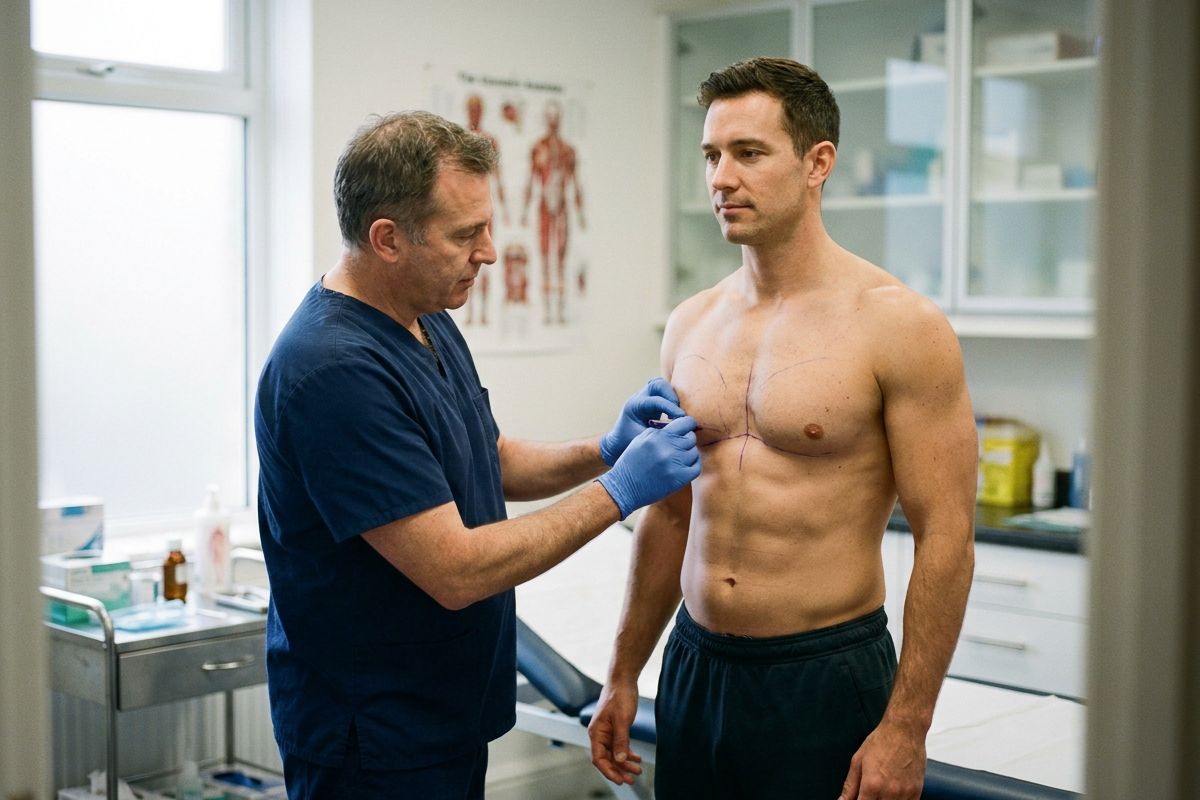
Gynaecomastia surgery is performed under general anaesthetic as a day-case procedure. You arrive at the clinic, meet the anaesthetist, and we mark the chest with you standing upright, gravity and posture affect how the tissue distributes, so markings made lying down are less accurate. The procedure typically takes between 60 and 120 minutes depending on the grade and complexity.
For the majority of patients, the approach combines two techniques. First, liposuction is used to debulk the lateral chest and any fatty component of the central breast mound. We use a fine cannula through a small incision placed in a natural skin crease at the lateral chest wall, typically no more than 4–5 mm. This incision is rarely visible once healed. For patients with a significant fatty component across the chest and flanks, we may discuss our 360 liposuction protocol, which addresses the full circumference of the torso in a single operative session for a more balanced contour.
Second, the glandular disc is excised through a periareolar incision, a curved cut placed precisely at the lower border of the areola, where the colour change in the skin provides natural camouflage. Through this incision we remove the firm glandular tissue under direct vision, taking care to leave a thin layer of tissue immediately beneath the nipple to prevent a crater deformity, which is one of the most common complications of over-aggressive excision. The specimen is routinely sent for histological analysis; this is standard practice, not an indication of concern.
Haemostasis is meticulous throughout. We close in layers, place a small drain if the dissection has been extensive, and apply a compression garment before you leave theatre. The periareolar scar typically fades to a fine, pale line within 12 months and is well concealed by the areolar border. For patients with Grade III gynaecomastia requiring skin excision, the scar pattern is larger and we discuss this in detail at consultation, there is no point proceeding if the scar trade-off is not acceptable to you.
It is worth noting that gynaecomastia surgery is distinct from the muscle definition procedures we also offer, which use high-definition liposuction to sculpt the pectoral and abdominal region in patients who are already lean. Those procedures are not a treatment for gynaecomastia; they are an aesthetic enhancement for a different patient profile.
Recovery: what the first six weeks actually look like
We will not tell you recovery is easy, but we will tell you it is manageable and predictable. The first 48 hours are the most uncomfortable. The chest feels tight and bruised, and most patients describe a burning sensation rather than sharp pain. We prescribe regular analgesia, typically paracetamol and ibuprofen alternated, and the majority of patients find this sufficient. You will go home in your compression garment the same day.
By day three to five, most men feel well enough to move around the house normally and to work from home if their job is sedentary. We ask you to avoid raising your arms above shoulder height for the first week to protect the periareolar closure. Driving is not permitted for at least a week, and longer if you are still taking any opioid analgesia.
- Week 1–2: Swelling and bruising peak around day three to five, then begin to subside. Wear the compression garment continuously, day and night, except for showering. Avoid strenuous activity.
- Week 2–4: Most patients return to office work by day ten. The chest still looks swollen, do not judge the result yet. Light walking is encouraged; gym work is not.
- Week 4–6: You may return to lower body gym work and light cardio. The compression garment is typically worn for a further two to four weeks during the day.
- Week 6 onwards: Upper body exercise resumes gradually. The chest continues to soften and settle for three to six months. Final results are assessed at the six-month mark.
Numbness around the nipple-areola complex is common in the first few months and almost always resolves. Persistent firmness beneath the scar, known as induration, is normal scar tissue remodelling and responds well to massage once the wound is fully healed, usually from week four. If you are concerned about your recovery at any point, our team is reachable directly; you are not handed to a call centre.
For patients interested in optimising their skin quality during the recovery period, our colleagues offer microneedling protocols that can support scar remodelling once the surgical wounds are fully mature, typically from three months post-operatively. This is optional, not a requirement, but some patients find it useful.
Gynaecomastia cost in Kensington: what you should expect to pay
We do not publish fixed prices online because the cost of gynaecomastia surgery in Kensington varies meaningfully depending on the grade of the condition, whether liposuction alone is sufficient or gland excision is also required, whether skin excision adds operative time, and the anaesthetic fees involved. What we can tell you is that quoting a single number without examining you is not honest surgical practice.
As a general orientation: straightforward cases involving liposuction and small-volume gland excision sit at the lower end of the range for body-contouring procedures in London. More complex cases, bilateral asymmetry, significant skin redundancy, or combined procedures, cost more. We will give you a written, itemised quote at your consultation that covers the surgeon's fee, anaesthetist's fee, facility fee, garment, and follow-up appointments. There are no hidden costs added later.
We are based at 49 Marloes Road, W8 6LA, a short walk from High Street Kensington station, and we see patients from across London and from outside the UK. For international patients, we can arrange a video consultation before you travel and coordinate your care so that your in-person visits are efficient. We do not offer finance arrangements ourselves, but we can signpost you to regulated third-party providers if that is relevant to your planning.
It is also worth comparing the cost of surgery against the cost of doing nothing. Men who have lived with gynaecomastia for a decade or more frequently describe the psychological toll in terms that make the surgical investment feel straightforward in retrospect. We are not using that to sell you an operation, we are noting it because it is what patients tell us, and it is clinically relevant to the decision.
Who this surgery is not right for
We will not recommend gynaecomastia surgery to every man who presents with chest concerns, and it is important to be clear about this. If you are significantly overweight, the first recommendation is weight loss, not because we are being dismissive, but because liposuction on a substantially enlarged chest in a patient with a high BMI produces less predictable contour results, carries higher anaesthetic risk, and may leave you with more skin redundancy than you anticipated. We would rather have an honest conversation now than a disappointed patient later.
If your gynaecomastia is medication-induced and you are still taking the causative drug, or if you are still using anabolic steroids, surgery before cessation is unlikely to produce a lasting result. The tissue will recur. We will ask you to stop the causative agent and allow a period of stabilisation before proceeding.
Adolescent patients present a particular consideration. Puffy nipple surgery in teenagers is something we approach cautiously. If the gynaecomastia is recent in onset and the patient is still in puberty, we recommend a period of watchful waiting, typically until at least 18, and ideally until growth has fully completed. Operating too early risks the tissue recurring as hormonal fluctuations continue. There are exceptions, severe, persistent, psychologically distressing cases in older adolescents, but these are assessed individually.
Finally, if your expectations are not aligned with what surgery can deliver, for example, if you are hoping surgery will produce a highly defined, muscular chest contour when your underlying muscle mass is modest, we will address that directly at consultation. Surgery removes the abnormal tissue; it does not sculpt muscle. For patients whose primary goal is athletic chest definition rather than correction of a pathological process, the conversation is a different one.
For a useful comparison of how we approach patient selection in body-contouring surgery more broadly, our post on tummy tuck surgery in London covers similar principles around timing, weight stability, and realistic expectations, many of the same rules apply.
Booking your consultation
If you are considering gynaecomastia surgery in London and want a straightforward clinical assessment rather than a high-pressure sales consultation, we would be glad to see you. Our clinic is at 49 Marloes Road, Kensington, W8 6LA, accessible from High Street Kensington and Earl's Court stations. Consultations are conducted by Dr Hassan Soueid or, for complex cases, in collaboration with Mr Ali Ghanem. We will examine you, grade the condition, explain the most appropriate technique, give you a written quote, and answer every question you have, without obligation to proceed.
You can read more about the procedure itself on our liposuction treatment page, which covers the techniques we use for body contouring including the chest. For patients considering a broader body-contouring approach, our guide to surgical planning illustrates how we think about combining procedures safely. And if you would like to understand how we approach surgical consultations in general, our post on rhinoplasty cost and recovery in London gives a useful sense of our clinical approach, even though the anatomy is entirely different.
Book your consultation here, we typically offer appointments within two weeks, and the consultation fee is offset against your surgical fee if you proceed.
Frequently asked
Questions we get asked about EnerPeel®
- Will gynaecomastia come back after surgery?
- In the vast majority of cases, results are permanent. The glandular tissue that is excised does not regenerate. However, if the original cause, such as anabolic steroid use, a specific medication, or significant weight gain, is reintroduced after surgery, new tissue can develop. We discuss this at consultation so you can make an informed decision about timing.
- How visible are the scars after male breast reduction?
- For most patients, the periareolar incision heals to a fine line at the border of the areola that is difficult to detect within 12 months. The liposuction entry point is typically a 4–5 mm nick in a skin crease. Patients requiring skin excision will have a larger scar, which we discuss and show examples of before any decision is made.
- Can I have gynaecomastia surgery if I am still losing weight?
- We generally advise waiting until your weight has been stable for at least three to six months. Operating on a body that is still changing makes it harder to predict the final contour, and significant further weight loss after surgery could alter the result. If you are close to your target weight, we will discuss the timing with you at consultation.
- Is gynaecomastia surgery available on the NHS?
- NHS funding for gynaecomastia surgery is extremely limited and typically restricted to severe cases with documented psychological impact that have failed conservative management. In practice, most men in London pursue treatment privately. We can provide documentation to support an NHS referral if appropriate, but we will be honest with you about the likelihood of funding being approved.
- What is the difference between gynaecomastia and puffy nipples, do they need different treatment?
- Puffy nipples are usually caused by a small, localised disc of subareolar glandular tissue rather than diffuse breast enlargement. They are a mild form of gynaecomastia and are typically corrected through a small periareolar excision, sometimes combined with minimal liposuction. The procedure is less extensive than surgery for higher-grade gynaecomastia, and recovery is correspondingly quicker.