


Skin · 6 min read
PRP and the 'Vampire Facial': What It Actually Does
By Dr Hassan Soueid · MD, FRCS · Lead Surgeon, Kensington Cosmetic Clinic
Published 21 June 2026
TL;DR. PRP concentrates the growth factors in your own blood and applies them to the skin or scalp to encourage repair and collagen. It is a genuine, evidence-supported treatment for skin quality and early hair thinning, but it is a gradual booster, not a dramatic one-off fix.
What PRP is, and why it is called a "vampire facial"
Platelet-rich plasma (PRP) is a concentrated preparation made from a small sample of your own blood. Blood is broadly made up of red cells, white cells, plasma, and platelets. Platelets are best known for clotting, but they also carry a rich store of growth factors, the signalling proteins your body releases at a site of injury to trigger repair, new blood vessel formation, and collagen production. PRP is simply a way of concentrating those platelets and the growth factors they hold, then placing them where you want the skin or scalp to behave as though it is in active repair.
The "vampire facial" name is a piece of media branding rather than a clinical term. It attached itself to the treatment because the procedure involves drawing your own blood and, when the plasma is applied to the face alongside microneedling, the skin can look flushed afterwards. The image is memorable, which is precisely why it spread, but it can give a misleading impression of something exotic or extreme. In reality this is a measured, autologous procedure: nothing synthetic is introduced, and the material applied to your skin came from your own arm minutes earlier. We mention the name because patients search for it, but we would gently encourage you to look past the marketing and focus on the mechanism and the evidence, which is what actually determines whether the treatment is worth your time.
At Kensington Cosmetic Clinic we treat PRP as one tool within a wider skin and hair programme rather than a headline act. It does specific things well, and it does not do other things at all, and being clear about that distinction is the whole point of this article.
How it is done
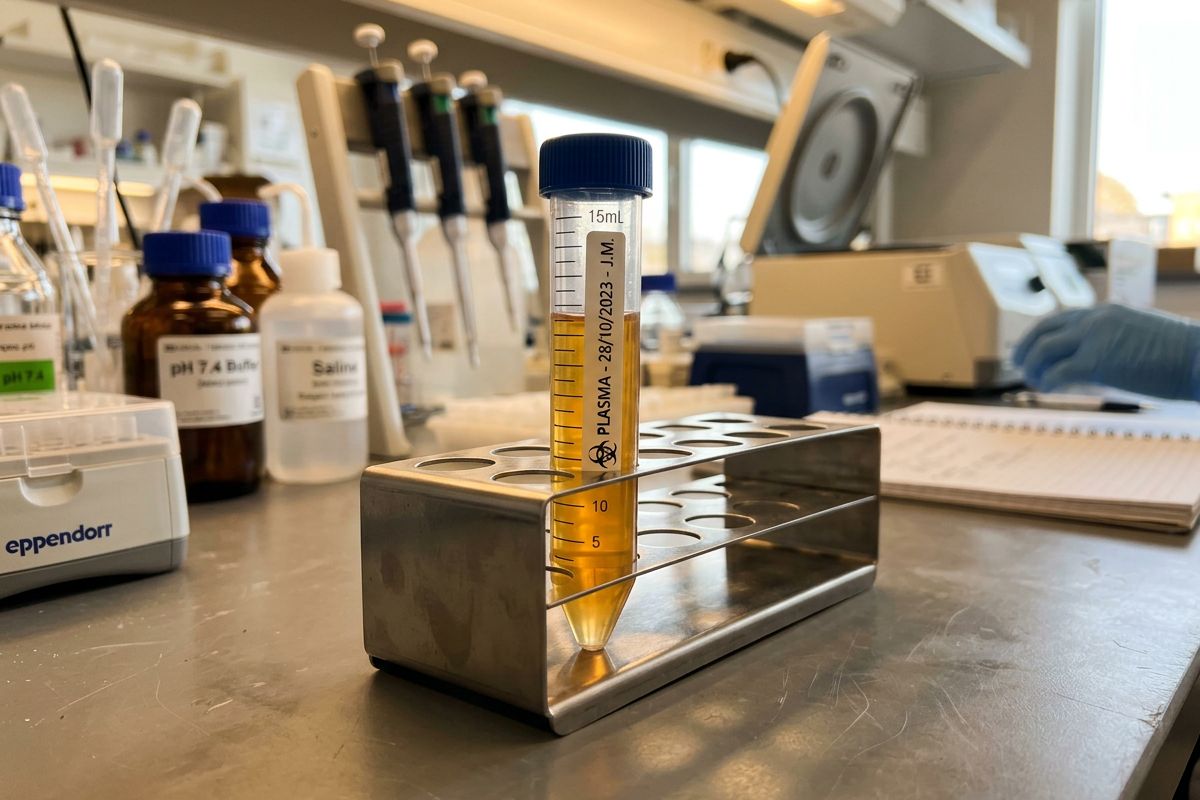
We take a small blood sample, spin it in a centrifuge to separate the platelet-rich plasma, then deliver it into the skin, often with microneedling, or into the scalp for hair. There is no foreign material, it is entirely your own.
To explain that in a little more detail: the draw is comparable to a routine blood test, a single small tube from the arm. That tube is placed in a centrifuge, which spins at speed so that the heavier red cells settle to the bottom and the plasma, with its concentrated platelets, rises to the top as a golden-amber layer. That platelet-rich fraction is carefully drawn off and prepared for application. The whole separation step takes only a matter of minutes, which is why the appointment is reasonably short.
How the PRP is then delivered depends on the target. For skin, we most commonly pair it with microneedling: fine needles create thousands of controlled micro-channels in the skin, and the plasma is applied to the surface so that the growth factors reach the dermis through those channels while the needling itself stimulates a collagen response. PRP can also be injected directly into specific areas. For hair, the plasma is injected into the scalp at the level of the follicles across the thinning region. A topical anaesthetic cream is typically used to keep the scalp comfortable.
The mechanism, in plain terms
The logic of PRP rests on a single biological idea: growth factors drive repair. When you concentrate platelets and release their contents into tissue, you are presenting that tissue with a strong signal to rebuild. In skin, the relevant outcome is fibroblast activity, the cells that produce collagen and elastin, alongside improved local blood supply. Over weeks, that can translate into firmer, better-quality skin with improved texture and tone rather than a sudden cosmetic change.
In the scalp, the proposed mechanism is that growth factors prolong the active growth phase of the hair cycle, improve the blood supply to the follicle, and support follicles that are miniaturising but not yet lost. This is why PRP is discussed in the context of early-stage thinning rather than established baldness. A follicle that is struggling can sometimes be encouraged; a follicle that has already gone cannot be conjured back.
It is worth being honest that the underlying biology, while well established in principle, does not translate into a guaranteed clinical result in every individual. Platelet concentrations vary between people and between preparation methods, and the response to growth factor signalling is not identical from one patient to the next. That variability is part of why we describe PRP as a booster with a realistic ceiling rather than a predictable, dose-for-dose transformation.
What the evidence supports, and what it does not
- Skin: gradual improvement in texture, fine lines and glow over a short course.
- Hair: useful for early-stage thinning, slowing loss and improving density in suitable patients.
Taking those two areas in turn, and looking honestly at where the published evidence sits: for skin, the research base most consistently supports modest improvements in texture, fine lines, and overall radiance, particularly when PRP is combined with microneedling rather than used alone. These are real but incremental gains. They accumulate over a course and are best understood as an improvement in skin quality, not a structural change to the face.
For hair, several studies report measurable improvements in hair density and a slowing of loss in patients with early androgenetic thinning. The evidence here is genuinely encouraging but also genuinely mixed: trial protocols differ, preparation methods differ, and outcomes are not uniform across the literature. The honest summary is that PRP appears to help a meaningful proportion of suitable patients with early thinning, that it works best as part of a broader hair plan rather than in isolation, and that it is not a cure for hair loss.
What the evidence does not support is equally important. PRP is not a volumiser and will not replace lost facial volume the way a dermal filler does. It will not lift sagging skin or jowls; that is a structural concern. And it will not regrow hair in areas where the follicles are no longer present. Any clinic implying otherwise is overstating the case. We would rather you arrive with calibrated expectations than leave disappointed by a treatment that was always going to behave as a gradual booster.
Where we use it, skin, hair and the under-eye area
In practice we use PRP across three main areas. For skin quality, it suits patients whose concern is dullness, mild textural irregularity, and early fine lines rather than deep wrinkles or laxity. Combined with microneedling, it forms a sensible collagen-supporting programme for the face, and it can be used on the neck and the backs of the hands as well.
For hair, PRP is a reasonable first step for early-stage thinning. Many patients want to do something before considering surgery, and PRP fits that brief: it is minimally invasive, uses your own blood, and can be tried as a course before any larger decision is made. For patients whose hair loss is more advanced, we will be candid that PRP is unlikely to be sufficient on its own, and a conversation about a hair transplant may be the more honest route.
The under-eye area deserves a careful note. PRP is sometimes promoted for under-eye rejuvenation, and it can offer a modest improvement in skin quality and fine crepiness in the right patient. However, the most common under-eye complaints, hollowing and dark shadowing caused by volume loss or anatomy, are not problems that growth factors can solve. For those, a different approach is appropriate, and we would assess the underlying cause rather than defaulting to PRP because it is the treatment a patient has heard of. Setting that boundary clearly is part of treating the under-eye area responsibly.
Realistic expectations and the course of treatment
We usually recommend a short course spaced a few weeks apart, then maintenance. It pairs well with microneedling for skin and is a sensible first step for early hair concerns before considering a transplant.
To put numbers around that without overpromising: a typical plan involves a small series of sessions a few weeks apart, after which the effect is reassessed and maintenance sessions are scheduled periodically to sustain the result. PRP works with your own biology, which takes time, so the meaningful changes tend to appear over weeks and months rather than overnight. A patient expecting an immediate, dramatic difference after a single session has been mis-sold the treatment.
It is also worth understanding that PRP is not permanent. Because it nudges your tissue to behave better rather than installing anything that stays in place, the benefit gradually tapers without maintenance. That is not a flaw; it reflects what the treatment actually is. Patients who appreciate this from the outset tend to be the ones who are genuinely satisfied, because their expectations match the mechanism. You can read more about the standalone procedure on our PRP treatment page, which sits alongside this article.
Safety, hygiene and why sterile autologous handling matters
PRP has an inherently favourable safety profile for one simple reason: the material applied to you is your own. There is no synthetic substance and therefore no risk of the kind of allergic reaction associated with foreign material. The most common after-effects are short-lived: redness, mild swelling, or minor bruising at the treated sites, settling over a few days.
That said, the safety of PRP depends entirely on how rigorously it is handled, and this is a point we want to make frankly rather than gloss over. The "vampire facial" label has, in a small number of widely reported cases internationally, been attached to settings where blood was drawn and handled without proper sterile technique or single-use equipment, and the consequences of getting that wrong, including the transmission of blood-borne infection, are serious. The risk does not come from PRP as a concept; it comes from poor practice. Because the procedure involves drawing, processing, and reapplying blood, every step has to follow strict sterile, single-patient protocols, with equipment that is never shared between patients and a clinical environment held to medical standards. This is exactly why PRP belongs in a properly run, doctor-led clinic and not in an informal or unregulated setting, however appealing the price or convenience might seem. When you are choosing where to have any blood-based treatment, the standard of the clinic is not a detail; it is the single most important factor in keeping the procedure safe.
Who PRP is not right for, and booking your consultation
PRP will not replace lost volume, lift sagging skin or regrow hair where follicles are already gone. If your expectation is dramatic and immediate, we will be honest that this is not the right treatment.
Beyond expectation, there are clinical situations where PRP is not appropriate. It is generally unsuitable for patients with certain blood, platelet, or clotting disorders, for those on particular blood-thinning medication, or where there is an active infection or skin condition in the area to be treated. Certain other medical conditions may also make it inadvisable. We would also not proceed where a patient's underlying concern is structural, such as significant skin laxity or volume loss, because PRP simply does not address those problems and proceeding anyway would not be in your interest. These are matters to discuss properly at consultation, where your medical history can be reviewed in full.
If you would like to understand whether PRP is a sensible option for your skin or your hair, the right next step is an honest assessment. One of our clinicians will examine the area, talk through your history and your goals, and tell you plainly whether PRP is likely to help, whether a different treatment would serve you better, or whether the most truthful answer is that no minimally invasive option will achieve what you are hoping for. You can book a consultation at our Kensington clinic, and we will give you a realistic appraisal rather than steer you towards a treatment that is not right for you.
Frequently asked
Questions we get asked about EnerPeel®
- Is the 'vampire facial' just PRP?
- Yes. The name refers to PRP applied with microneedling. The plasma comes from your own blood.
- How many sessions do I need?
- Usually three sessions a few weeks apart, then occasional maintenance. Hair protocols are similar.
- Does PRP work for hair loss?
- It helps early thinning by improving density and slowing loss. It cannot regrow hair where follicles are already lost.