

Surgical · 11 min read
Buttock Implants or Fat Transfer: Comparing Contouring Options in London
By Dr Hassan Soueid · GMC 6107783 · Medical Director, Kensington Cosmetic Clinic
Published 7 November 2026
TL;DR. Buttock implants and fat transfer can both add volume and change buttock shape, but they work in very different ways, carry different risks and suit different bodies, so the honest answer to which is better depends on your anatomy, your available fat and what you are prepared to accept in recovery and long-term maintenance.
Most people who come to see us in Kensington about buttock shape have already read a great deal online. Much of it is either enthusiastic marketing or alarming headlines, and very little of it helps someone work out which approach, if any, is right for their own body. This guide sets out the two main surgical approaches to buttock contouring that add volume, solid silicone implants and fat transfer. It compares them as plainly as we can: what each involves, where each tends to work well, where each falls short, and who should probably not have either.
It is not a substitute for an examination. Buttock surgery is major surgery whichever route you take, and the right choice is made in a consultation room in London, not on a blog. If your main concern is the safety of fat transfer specifically, our guide on what to ask before a BBL in the UK covers that in depth.
Two very different ways to change buttock shape
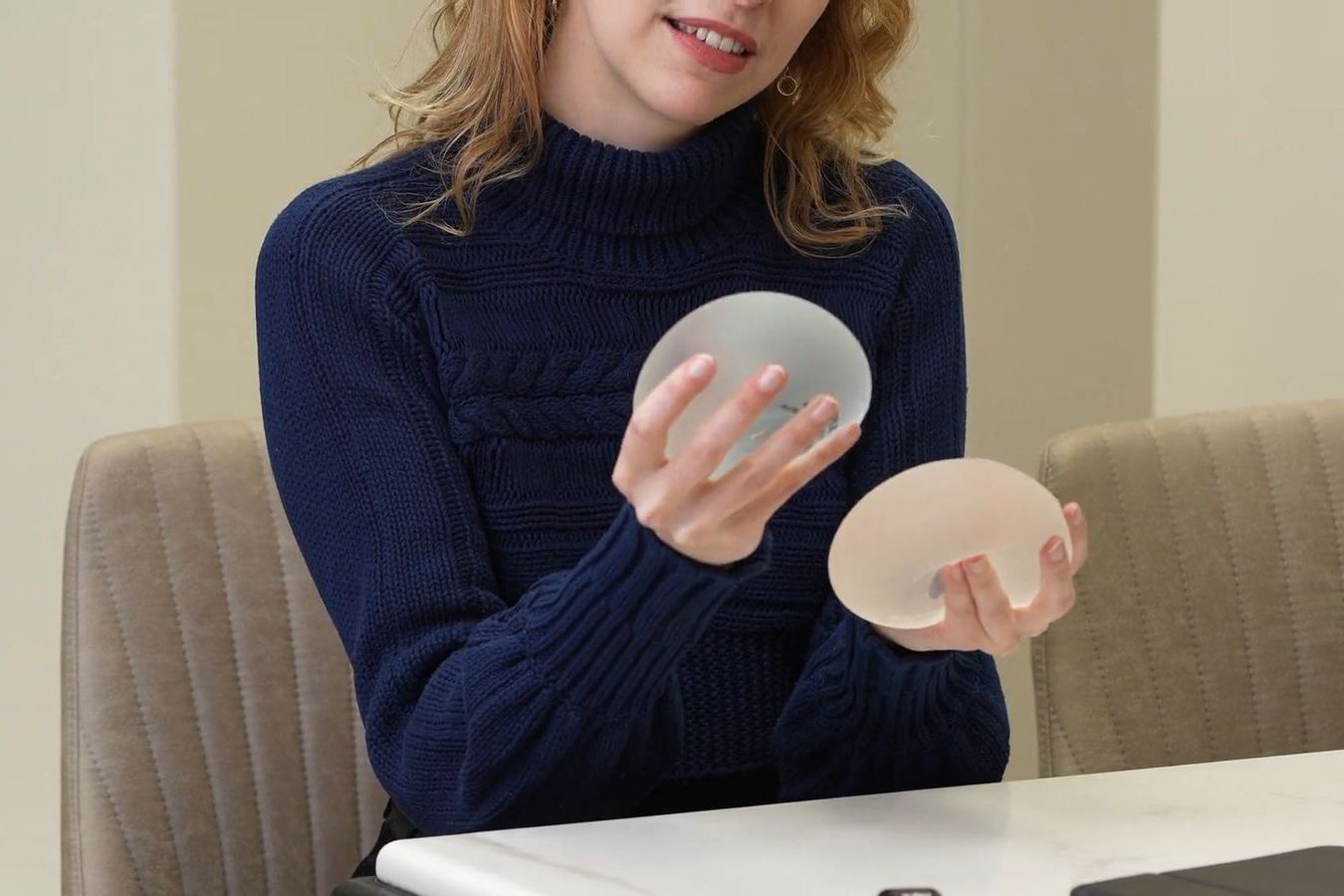
At the simplest level, both procedures aim to increase buttock volume and alter contour. The difference lies in what is added and where it goes. A buttock implant is a manufactured device made of soft but solid silicone, placed into a pocket created within or beneath the tissues of the buttock. Fat transfer, often called a Brazilian butt lift or BBL, uses liposuction to remove fat from one part of your body, processes it, and then injects it into the fatty layer of the buttocks and, where appropriate, the hips. Our fat transfer page explains the general principles, which are shared with fat grafting to other areas.
That distinction affects almost everything else: the shape that can be created, how the buttocks feel to the touch, how the outcome changes over time, what can go wrong and how problems are managed if they do. It also means the two procedures compete for the same patient less often than people assume. Someone with very little spare body fat may simply not have enough for a meaningful transfer. Someone whose main wish is to reshape the hips and the curve from waist to buttock may find that an implant cannot address what they actually want changed.
There is also a third option that is easy to overlook: deciding that neither procedure is appropriate. Sometimes a concern is better addressed with liposuction alone to refine the surrounding areas, with a structured strength programme to build the gluteal muscles, or with no treatment at all. A good consultation should leave every one of those possibilities on the table, and we would rather talk someone out of surgery than into the wrong operation.
How buttock implants work
Buttock implants differ from breast implants in an important way. Because they have to tolerate the pressure of sitting, they are generally made of a firm but flexible solid silicone rather than a gel-filled shell. They come in a range of shapes and sizes, and selection is based on your frame, the width and height of your buttock, and how much tissue is available to cover the device.
The implant is usually inserted through an incision placed in or near the natural crease between the buttocks, although other incision positions are sometimes used. The surgeon then creates a pocket for it. The main options are:
- Intramuscular: the implant sits within the gluteus maximus muscle itself. This gives more tissue cover over the device, which can help reduce visibility, but limits the size of implant that can be placed safely.
- Subfascial: the implant sits beneath the tough fascia that covers the muscle, but above the muscle fibres. This can allow a different shape but provides less coverage, which matters more in slim patients.
- Submuscular: the implant sits beneath the muscle. This is used less often because it brings the device closer to deeper structures, including the sciatic nerve.
Each plane has its own balance of benefits and risks, and the choice is driven by your anatomy rather than by preference alone.
The main strength of an implant is that it provides a defined volume that does not depend on how much fat you have or how much of it survives. For a very slim person who wants more projection in the upper and central buttock, that predictability can matter a great deal. The limitations are just as real. An implant adds volume where it sits; it does not reshape the hips, smooth the outer thigh or narrow the waist. It is a foreign body, so it can become infected, shift position, develop a tightening capsule of scar tissue around it, or become visible or palpable, particularly in thinner patients. Implants are not lifetime devices, and anyone choosing one should expect the possibility of further surgery to revise, replace or remove it at some point in the future.
How fat transfer to the buttocks works
Fat transfer is really two procedures in one. First, liposuction is used to harvest fat from donor areas such as the abdomen, flanks, back or thighs. This changes body shape in its own right, and many patients value the slimming of those areas as much as the added buttock volume. If you are curious about what liposuction can and cannot do on its own, it is worth reading about separately. The harvested fat is then processed to separate usable fat cells from fluid and oil, and injected carefully into the buttocks and, where suitable, the hips.
The central safety principle, now reflected in UK professional guidance, is that fat should be placed only in the subcutaneous layer, the fatty tissue between the skin and the muscle, and never into or beneath the gluteal muscle. Injecting into the muscle risks fat entering large veins and travelling to the heart and lungs, which is the main reason this procedure acquired such a serious reputation. Surgical technique, patient positioning, careful judgement and, increasingly, ultrasound guidance all form part of reducing that risk. The risk cannot be removed entirely, and nobody should tell you otherwise.
The strengths of fat transfer are that it uses your own tissue, it can shape areas an implant cannot reach, such as the upper hip and the outer contour, and it combines buttock volume with reduction elsewhere. The limitations are that not all of the transferred fat survives. Some is reabsorbed by the body over the first few months, and how much varies from person to person in a way that cannot be precisely predicted beforehand. Some patients later choose a second session. Fat that does establish a blood supply behaves like fat elsewhere in your body, so it can change with significant weight gain or loss. And there has to be enough donor fat to begin with, because there is a limit to how much can be safely harvested and transferred in a single operation.
Shape, feel and longevity compared
Shape
An implant mainly increases projection in the central and upper buttock. In patients with enough soft tissue cover it can look smooth, but in thinner patients the edges of the device can sometimes be seen or felt. Fat transfer offers more freedom to distribute volume across the buttock and into the hips, which suits people whose priority is overall contour rather than projection alone, although the amount of change is limited by donor fat and by how much the tissues can safely accept.
Feel
Solid implants are firmer than natural tissue, and many patients remain aware of them, particularly when sitting on hard surfaces or contracting the gluteal muscles. Once healed, transferred fat generally feels like the rest of your body fat, although some patients develop firm lumps where fat has not survived, known as fat necrosis, or small oil cysts. These are usually harmless but can be noticeable and occasionally need treatment.
How long it lasts
An implant does not lose volume, but the tissues around it continue to age, and the device itself may need attention in the future. Transferred fat goes through an early period of reabsorption and then tends to settle, after which it follows your weight and the natural ageing of your body. Neither approach stops time, and we avoid describing either as permanent.
If something needs changing
Problems with an implant, such as infection or malposition, often mean removing or replacing it, and the tissues may not return to exactly how they were before. With fat transfer, additional volume can be added at a later session, but removing fat that has already taken is harder and can leave irregularities. In practice, neither route is easily reversible, which is one reason we encourage people to take time over the decision.

Risks: different profiles, not one safe and one dangerous
It is tempting to frame this as a choice between a safe option and a risky one. That is not accurate. Both are major operations performed under general anaesthesia, and both carry risks that every patient must understand before consenting.
Risks shared by both procedures include bleeding, infection, blood clots in the legs or lungs, reactions to anaesthesia, wound healing problems, visible scarring, asymmetry, changes in skin sensation, dissatisfaction with the outcome and the possibility of further surgery.
Risks more specific to implants include:
- Wound breakdown at the incision in the buttock crease, an area that is difficult to keep clean and is placed under tension when you sit or bend.
- Fluid collections (seroma) around the implant, which may need draining.
- Infection involving the implant, which can mean it has to be removed until the area has healed.
- Movement, rotation or asymmetry of the implant over time.
- Capsular contracture, where scar tissue tightens around the device.
- Nerve irritation, including sciatic-type pain, and a more prolonged period of discomfort than many patients expect.
Risks more specific to fat transfer include:
- Fat embolism, where fat enters the bloodstream. It is rare, but it can be fatal, and it is why safe technique matters so much.
- Fat necrosis and oil cysts, which can feel firm or lumpy.
- Unpredictable fat survival, leading to less volume than hoped or differences between sides.
- Contour irregularities, dimpling or loose skin at the liposuction donor sites.
- Seroma and prolonged swelling in the donor areas.
Your personal risk depends on far more than the procedure. Smoking and vaping, a raised body mass index, diabetes, a history of clots, certain medications and recent significant weight change can all increase it. We will ask about all of these, and if your individual risk is too high for surgery to be sensible, we will tell you so, even when that is not the answer you came for.
Recovery and everyday life afterwards
Both procedures need a genuine period of recovery, and both involve restrictions on sitting that catch some people out. You will usually wear a compression garment for several weeks, need time away from work, and need help at home in the early days. Your surgeon will give you individual guidance, because healing varies from person to person.
After implant surgery, discomfort is often felt deeper and for longer, particularly when the muscle has been disturbed during an intramuscular placement. The incision in the buttock crease needs careful attention to stay clean and dry, and sitting directly on the buttocks is typically restricted while the pockets heal. Lower body exercise is reintroduced gradually, and running, squatting and lunging usually come last.
After fat transfer, much of the early discomfort comes from the liposuction sites, which are often bruised, swollen and sore. The aim in the buttocks is to protect the newly transferred fat while it establishes a blood supply, so direct pressure is avoided, and many patients use a specially designed cushion or sleep on their front or side. Swelling can take some time to settle, so the shape you see in the first few weeks is not a reliable guide to how things will look once healing is complete.
Practical planning matters as much as medical care. Think about how you will get home and travel in the following weeks, whether your job involves long periods of sitting or driving, and who can help with children or pets. Our guide to sitting and sleeping after buttock contouring goes into the day-to-day detail. If you live outside London, we will also discuss how follow-up appointments will work and how easily you can return to the clinic if a concern arises.
Who each option is not for, and how we help you decide
Some people are not suitable for either procedure, at least not now. That may include anyone who:
- smokes or vapes and is unable to stop for the period we advise before and after surgery;
- has a body mass index or medical condition that makes general anaesthesia and major surgery unwise;
- is still losing or gaining significant weight, or plans to in the near future;
- is planning a pregnancy, which can change body shape considerably;
- is hoping to match a particular person, a filtered image or a precise measurement;
- is experiencing significant distress about their appearance that may be better supported in other ways first.
Implants are usually less suitable if your main goal is hip shaping or a smoother transition from waist to buttock, or if you are not comfortable living with a device that may need future surgery. Fat transfer is usually less suitable if you are very slim with little donor fat, if you need a single predictable volume increase, or if you expect your weight to change considerably.
Consultations at our Kensington clinic are doctor-led. You will be examined, your proportions and skin quality assessed, and your medical history and expectations discussed in detail. Operations are performed by Dr Hassan Soueid or one of our qualified surgeons, and you can read more about Dr Hassan Soueid, our Founder and Medical Director, before you come in. We will tell you which approaches we offer and, if a different route would suit you better, we will say so plainly. We are also introducing HonestFace, our own iPad app for digital consultation forms, consent signing and secure patient records, so that paperwork can be completed calmly rather than rushed on the day.
Booking your consultation
If you are weighing up buttock implants against fat transfer, the most useful next step is a face-to-face assessment rather than more online research. Kensington Cosmetic Clinic is registered with the Care Quality Commission, and we see patients from across London at our clinic in Kensington. You are under no obligation to proceed, and we build a cooling-off period into the process so that any decision about surgery is made without pressure.
It helps to bring a list of questions, details of any medications and previous surgery, and an honest sense of what is bothering you about your shape. When you are ready, you can book a consultation online, and a member of our team will be in touch to arrange a convenient time.
Frequently asked
Questions we get asked
- Which lasts longer, buttock implants or fat transfer?
- Neither should be thought of as permanent. An implant keeps its volume, but the surrounding tissues continue to age and the device may need revision, replacement or removal in future. Transferred fat that survives the first few months tends to settle, but it then changes with your weight and natural ageing. Which suits you better depends on your anatomy and priorities, and is best discussed at a consultation.
- Can I have fat transfer to the buttocks if I am very slim?
- It depends on how much donor fat you have. Some slim patients have enough for a modest change, while others simply do not have enough for a meaningful transfer. An examination is the only reliable way to tell. If fat transfer is not realistic for you, we will discuss whether another approach, or no surgery at all, would be more appropriate.
- Is fat transfer safer than buttock implants?
- They have different risk profiles rather than one being safe and the other dangerous. Fat transfer carries a rare but serious risk of fat embolism, which is why fat should only be placed in the layer between skin and muscle. Implants carry risks such as wound breakdown, infection, malposition and the need for further surgery. Your personal health factors also strongly influence your risk.
- Can implants and fat transfer be combined?
- Hybrid approaches, where an implant is placed and fat is added around it to soften the contour, are used for some patients. They are not a shortcut, because they combine the recovery and risks of both procedures. Whether a combined approach is appropriate, and whether it is something we offer, would be discussed individually at your consultation.
- How soon can I sit normally after buttock surgery?
- This varies with the procedure and with how you heal. Both implants and fat transfer usually involve a period of restricted sitting, and many patients use a specially designed cushion when sitting is allowed. Your surgeon will give you individual guidance, so it is worth planning your work, travel and home life around a cautious timeline before surgery.