

Skin · 11 min read
The Non-Surgical Facelift Explained: What Actually Lifts
By Dr Hassan Soueid · MD, FRCS · Lead Surgeon, Kensington Cosmetic Clinic
Published 25 May 2026
TL;DR - A "non-surgical facelift" is not one procedure; it is a category of treatments, dermal fillers, thread lifts, energy-based devices, and combinations thereof, each targeting a different layer of facial ageing. Done well, these approaches can restore volume, improve skin quality, and create a modest lift. Done poorly, or on the wrong patient, they produce an over-filled or unnatural appearance that is harder to correct than people expect. This post explains the clinical reasoning behind each option, what the evidence actually supports, and, equally important, when we will tell you that surgery is the more honest answer.
What does "non-surgical facelift" actually mean for a West London patient?
The phrase non-surgical facelift has become a catch-all marketing term, which is part of the problem. When patients arrive at our clinic on Marloes Road in Kensington asking about it, they usually mean one of three things: they want to look less tired, they want their jawline back, or they want the early jowling they see in photographs to soften. Those are legitimate goals. The question is which tool, or combination of tools, addresses the underlying anatomy rather than simply masking it.
Facial ageing happens in several layers simultaneously. Skin loses collagen and elasticity. The subcutaneous fat compartments deflate and descend. The deeper facial ligaments loosen. The underlying bone resorbs, particularly around the orbital rim, the pyriform aperture of the nose, and the chin. Any honest non-surgical plan has to acknowledge which of those layers it can influence and which it cannot. A filler placed in the wrong plane, or a thread inserted without regard for ligament anatomy, does not reverse ageing, it redistributes it.
At Dr Hassan Soueid's clinic in W8, we begin every non-surgical consultation with a full facial assessment: photographs, skin quality grading, and a frank conversation about what is anatomically possible without an incision. That assessment sometimes ends with us recommending surgery. More often it ends with a staged plan that is genuinely non-surgical, but it is never a plan built around what a patient has seen on social media.
It is also worth noting that West London has no shortage of clinics offering these treatments. The differentiator is not the brand of filler or the model of laser, it is the clinical judgment of the person holding the syringe or the handpiece. Aesthetic medicine in the UK is still insufficiently regulated, and that matters when you are considering injections near the facial artery or threads placed close to the parotid gland.
The liquid facelift in Kensington: what fillers can and cannot do
The liquid facelift, a term coined to describe strategic, multi-point hyaluronic acid filler placement, became popular because it works, within limits. The principle is sound: replace lost volume in the temples, midface, and pre-jowl sulcus, and the overlying skin appears to lift because it is once again supported from below. Restore projection to the chin and the jawline looks more defined. Add subtle structure to the lateral cheek and the nasolabial fold softens without being directly injected.
The evidence base for this approach is reasonable for patients in their late thirties to early fifties with mild-to-moderate volume loss and good residual skin elasticity. Beyond that, the relationship between volume and lift breaks down. A patient with significant skin laxity and descended SMAS tissue will not look lifted by filler, they will look fuller, and sometimes that means heavier rather than younger. This is the "pillow face" phenomenon that has given the liquid facelift a bad reputation: it is not a filler problem, it is a patient-selection problem.
Our Dr Anna Peca, who leads much of our non-surgical facial work, uses a layered injection technique that respects the facial fat compartments described in the anatomical literature. She does not simply fill lines; she restores structural support where it has been lost. The difference in outcome between that approach and a superficial line-filling approach is significant, and it is visible within weeks.
Hyaluronic acid fillers are reversible with hyaluronidase, which matters. If a result is uneven, if there is vascular compromise, or if a patient simply changes their mind, the product can be dissolved. This reversibility is one of the genuine advantages of HA-based treatments over permanent or semi-permanent alternatives, and it is a factor we weight heavily when recommending products. We do not use permanent fillers at this clinic.
For patients who want to understand how Botox and fillers work together in a combined facial plan, relaxing dynamic lines while restoring static volume, we assess both in the same consultation. The two modalities are complementary, and separating them into different appointments often leads to suboptimal sequencing.
Thread lifts vs fillers: understanding the difference in mechanism
The thread lift vs filler question comes up in almost every non-surgical consultation, and the honest answer is that they do different things. Fillers replace volume; threads create mechanical lift and stimulate collagen through a foreign-body response. They are not interchangeable, and they are not always alternatives, in some patients, they work best together.
Modern absorbable threads, most commonly polydioxanone (PDO) or poly-L-lactic acid (PLLA) cones, work by anchoring to fixed facial structures and gathering the mobile soft tissue above the jowl or along the midface. The lift is immediate but modest. The more durable benefit comes from the collagen stimulation that occurs over the following three to six months as the thread is gradually absorbed. This secondary effect improves skin texture and firmness in the treated zone, which is why threads are sometimes used in the neck and lower face even when the primary goal is skin quality rather than lift.
The limitations are real. Threads do not replace volume, a deflated midface treated with threads alone will look tighter but still hollow. They do not address skin excess, if there is true redundant skin at the jowl or neck, a thread will gather it temporarily but it will relapse, often within twelve to eighteen months. And they carry a small but genuine risk of thread migration, dimpling, and, in inexperienced hands, injury to the facial nerve branches. This is not a treatment to have in a high-street salon.
We have a detailed comparison of surgical and non-surgical lifting options in our post on SMAS vs deep plane facelift, which is worth reading if you are weighing threads against a formal surgical lift. The gap in longevity and degree of correction between a well-executed thread lift and a surgical facelift is substantial, threads are not a permanent solution, and we say that clearly to every patient who asks.
Dr Michail Vourvachis performs our thread lift procedures and is meticulous about patient selection. He will not place threads in a patient whose anatomy is better served by surgery, and he will not place them in a patient whose skin quality is too poor to hold the lift. That selectivity is a feature, not a limitation.
Energy-based devices: Endolift, CO2 laser, and what they actually achieve
Energy-based treatments form the third pillar of the non-surgical facelift, and they are the most heterogeneous group. The mechanism varies, some devices heat the deep dermis to stimulate new collagen, others ablate the skin surface to trigger remodelling, and others use laser energy delivered via a fibre to tighten the subdermal tissue directly. Understanding which device does which is essential before recommending one.
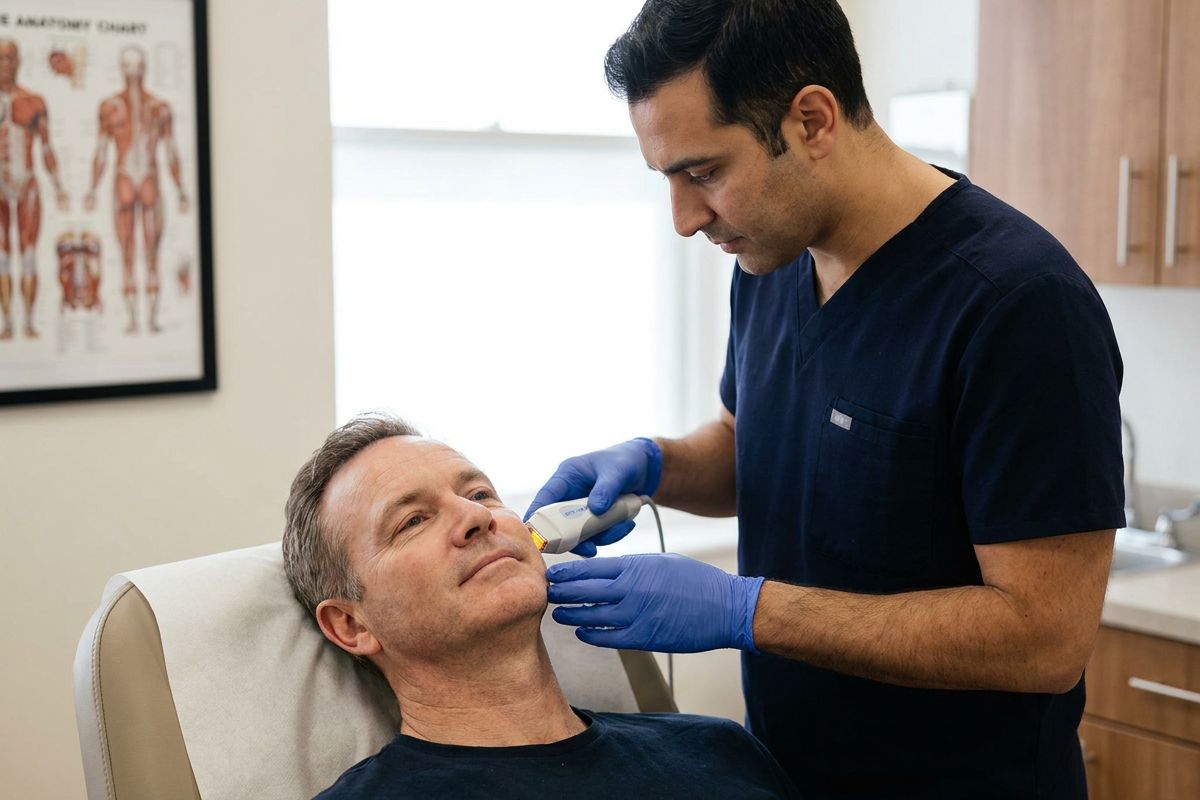
Our Endolift laser is one of the more clinically interesting options in this category. It delivers 1470 nm laser energy via a very fine optical fibre inserted just beneath the skin surface, heating the subdermal fat and the reticular dermis simultaneously. The result is a combination of immediate tissue contraction and progressive collagen remodelling over three to six months. It works particularly well in the lower face, jowl, and neck, areas where skin laxity is the primary concern and where surface treatments have limited penetration. We use it as a standalone treatment and as an adjunct to filler or thread work.
For surface skin quality, texture, pigmentation, fine lines, and overall radiance, CO2 laser resurfacing remains one of the most evidence-supported options available. It does not lift in the mechanical sense, but it substantially improves the quality of the skin envelope, which changes how the face reads at rest and in photographs. A patient with good structural support but poor skin quality will benefit far more from a CO2 resurfacing course than from additional filler. Sequencing matters: we generally treat structure first, then surface.
Microneedling with radiofrequency and PRP combinations are increasingly popular, and the evidence for skin quality improvement is reasonable. For patients who want to understand how collagen induction fits into a broader rejuvenation plan, our post on brow lift vs Botox for forehead lines covers some of the same decision-making framework applied to the upper face. The principle is the same: match the tool to the layer of ageing you are addressing.
One device category we are deliberately cautious about is high-intensity focused ultrasound (HIFU). The technology is sound in principle, but the clinical results in our experience are inconsistent, and the treatment is uncomfortable. We do not currently offer it, and we will say so if a patient asks. There are better options for the same indication in our current device portfolio.
Combining treatments: how we build a non-surgical plan at KCC
The most effective non-surgical facial rejuvenation is almost always a combination approach, sequenced correctly. A single modality rarely addresses the full picture of facial ageing, and stacking treatments without a coherent plan produces results that look busy rather than natural. Our approach at Kensington Cosmetic Clinic is to build a staged plan, typically over six to twelve months, that addresses volume, lift, and skin quality in the right order.
A typical plan for a patient in their mid-forties with early jowling, mild midface deflation, and moderate skin laxity might look like this:
- Initial consultation and full facial assessment, including photography and skin quality grading.
- Botox to relax dynamic lines in the upper face and reduce downward pull from the depressor muscles at the lower face, this alone can improve the apparent position of the brow and soften the oral commissures.
- Structural filler to the temples, lateral cheek, and pre-jowl sulcus, placed in the correct anatomical planes.
- PDO thread lift to the midface and jowl at a separate appointment, once the filler has settled (usually four to six weeks later).
- A course of microneedling or CO2 laser to improve skin quality and consolidate the collagen response from the threads.
- Review at six months to assess longevity and plan maintenance.
This is not a rigid protocol, it is a framework that we adapt to each patient's anatomy, budget, and tolerance for downtime. Some patients want a single treatment with minimal recovery; others are willing to commit to a longer programme. Both are valid, and we will not push a patient towards more treatment than their anatomy requires.
We also integrate PRP treatment into plans where skin quality and collagen density are the primary concern, particularly in patients with sun-damaged or post-menopausal skin where the dermis has thinned significantly. PRP is not a standalone lifting treatment, but as an adjunct to energy-based or needling protocols it has a genuine role.
Who this is not right for
Non-surgical facial rejuvenation has real limits, and we think it is important to name them directly rather than let patients discover them after spending money on treatments that were never going to deliver what they hoped for.
If you have significant skin excess, visible jowls that hang below the jawline, a neck with redundant skin rather than just laxity, or deep nasolabial folds caused by descended SMAS tissue rather than volume loss, non-surgical options will give you a modest improvement at best. They will not give you the result that a surgical facelift would. We have written at length about surgical options on our facelift treatments page, and we encourage patients who are genuinely surgical candidates to read it before committing to a non-surgical programme.
Similarly, if your primary concern is skin excess on the neck with platysmal banding, threads and fillers will not address the underlying muscle anatomy. That requires a surgical approach. If you have had multiple previous filler treatments and your face already carries significant product, adding more is rarely the answer, and in some cases, dissolving existing filler before starting a fresh plan is the most important first step.
Patients who are pregnant or breastfeeding, those on anticoagulants, and those with active skin infections or autoimmune conditions affecting the skin are not candidates for most of these treatments. We screen for all of these at consultation.
We also want to be honest about longevity. HA fillers typically last nine to eighteen months depending on the product and the area. Threads last twelve to twenty-four months. Energy-based treatments produce collagen that is real but that continues to age. Non-surgical rejuvenation is a maintenance programme, not a one-time fix. If that does not suit your expectations or your budget over time, surgery, which offers a longer-lasting structural correction, may be the more cost-effective choice across a five-year horizon.
Booking your consultation
If you are based in Kensington, High Street Kensington, Earl's Court, or anywhere across West London and you want an honest assessment of what non-surgical facial rejuvenation can realistically achieve for your face, we would encourage you to book a consultation rather than a treatment. The consultation is where the clinical work happens, the treatment is the outcome of that work, not the starting point.
Our clinic at 49 Marloes Road, W8 6LA is a short walk from High Street Kensington tube station. Consultations for non-surgical facial treatments are available with Dr Hassan Soueid and with our non-surgical team. We will give you a frank assessment of your anatomy, a clear explanation of which options are appropriate for you, and an honest view of what surgery would offer if non-surgical options are not the right answer for your goals.
You can read more about the full range of facial rejuvenation approaches, surgical and non-surgical, on our Botox and fillers treatments page. When you are ready to take the next step, book your consultation here and we will take it from there.
Frequently asked
Questions we get asked about EnerPeel®
- How long does a non-surgical facelift last?
- It depends on which treatments are used. Hyaluronic acid fillers typically last nine to eighteen months; PDO or PLLA threads last twelve to twenty-four months; energy-based treatments like Endolift or CO2 laser produce collagen that is real but continues to age naturally. Most patients maintain results with annual or biannual top-up treatments rather than a single course.
- Is a thread lift better than fillers for jowls?
- They address different problems. Fillers replace volume and support the overlying skin; threads create mechanical lift and stimulate collagen in the treated zone. For early jowling with volume loss, a combination of both often produces the best result. For significant skin excess or descended SMAS tissue, neither is a substitute for surgical correction, and we will say so clearly at consultation.
- What is the downtime for non-surgical facial treatments?
- Filler injections typically cause mild swelling and occasional bruising for three to seven days. Thread lifts may cause more noticeable swelling and some surface irregularity for one to two weeks. Ablative CO2 laser resurfacing carries a recovery period of seven to fourteen days depending on the depth of treatment. Endolift has a shorter recovery than ablative laser, usually three to five days of swelling and redness.
- At what age is a non-surgical facelift appropriate?
- There is no fixed age, the indication is the anatomy, not the number. We see patients in their mid-thirties with early volume loss who benefit from structural filler, and patients in their early fifties whose skin laxity means surgery is the more honest recommendation. The consultation assessment determines which category you fall into, and we will not recommend treatment that is unlikely to meet your goals.
- Can I have a non-surgical facelift if I have had fillers elsewhere?
- Possibly, but we need to assess what product is already present, in which planes, and in what volume before adding anything further. In some cases the most important first step is dissolving existing filler with hyaluronidase before starting a fresh, anatomically correct plan. We will not simply add more product on top of a previous treatment without understanding what is already there.