

Surgical · 11 min read
SMAS vs Deep-Plane Facelift: Which Is Right for Your Face?
By Dr Hassan Soueid · MD, FRCS · Lead Surgeon, Kensington Cosmetic Clinic
Published 25 May 2026
TL;DR - A facelift London patients enquire about is rarely one single operation; it is a family of techniques, and the two most discussed are the SMAS facelift and the deep-plane facelift. Both lift the face at a structural level rather than simply pulling skin, but they differ in how deep the surgeon works, what tissues move, and, critically, how long the result lasts. Choosing between them is not a matter of one being universally superior; it depends on your anatomy, the degree of descent, your skin quality, and your tolerance for a longer recovery. This post explains the clinical reasoning behind each choice so that when you sit down for a consultation, you already understand the conversation.
What a facelift in London actually addresses, and what it does not
The ageing face descends. Gravity, volume loss, and the gradual weakening of retaining ligaments cause the midface to drop, the jowls to form, and the neck to lose its definition. Skin laxity is a consequence of that descent, not the primary cause. This matters because any facelift technique that addresses only the skin, the old-fashioned "wind-tunnel" approach, will relax quickly and look operated-upon while it lasts. Modern surgery addresses the deeper structural layer, the superficial musculoaponeurotic system (SMAS), which is a fibromuscular sheet sitting beneath the skin and subcutaneous fat of the face.
What a facelift cannot do is replace lost volume, improve skin texture, or correct the fine lines caused by repeated muscle movement. That is why, at Kensington Cosmetic Clinic, a surgical plan frequently includes adjuncts: fat transfer to restore volume, or a course of CO₂ laser resurfacing to address surface quality after the structural work has healed. Surgery and non-surgical treatment are not competitors; they address different layers of the same problem.
It is also worth being direct about what a facelift will not do for someone in their late thirties with mild laxity and good skin quality. In that scenario, the risk-to-benefit ratio of a full surgical procedure is rarely favourable, and a combination of injectables and fillers with energy-based treatments will produce a more proportionate result. We will say this plainly in your consultation rather than book an operation you do not yet need.
The patients who benefit most from facelift surgery are typically in their mid-forties to mid-sixties, with visible jowling, a blunted cervicomental angle, and descent of the midface cheek pad. Skin quality matters too, very thin, sun-damaged skin heals less predictably and may need surface treatment before or after surgery.
The SMAS facelift: what the technique involves and who it suits
The SMAS facelift, sometimes called an SMASectomy or SMAS plication depending on the specific variant, works by either folding, suturing, or partially excising the SMAS layer to reposition the deeper facial tissues before the overlying skin is re-draped. The incision typically runs from the temporal hairline, around the ear, and into the posterior hairline. Because the skin and the SMAS are mobilised as separate layers, the skin closure is tension-free, which is what prevents the operated appearance.
There are several variants within the SMAS category. In a plication, the SMAS is folded on itself and sutured without being lifted off the underlying structures. In an imbrication or SMASectomy, a strip of SMAS is excised. In a SMAS flap, the layer is elevated and repositioned. Each has a slightly different risk profile and a slightly different degree of correction achievable. For patients with moderate jowling and early neck laxity, a well-executed SMAS facelift delivers reliable, natural-looking results with a recovery that most people manage in three to four weeks before returning to social activities.
The limitation of SMAS techniques is in the midface. The SMAS layer in the cheek is not directly continuous with the periorbital and nasolabial structures in the same way it is in the lower face and neck. Significant midface descent, the flattening of the cheek, the deepening of the nasolabial fold, is not fully corrected by a standard SMAS approach. For those patients, a deep-plane technique may produce a more complete result.
Dr Hassan Soueid performs both SMAS and deep-plane facelifts at our Kensington clinic and will advise which is appropriate based on a detailed assessment of your facial anatomy, not on which technique happens to be in fashion at the time of your enquiry.
The deep-plane facelift: anatomy, advantages, and honest limitations
The deep-plane facelift was described by Sam Hamra in 1992 and has been refined considerably since. Rather than lifting the SMAS as a separate layer from above, the deep-plane technique releases the SMAS together with the overlying skin and subcutaneous fat as a composite flap, working beneath the SMAS to release the key retaining ligaments, the zygomatic and masseteric cutaneous ligaments, that tether the descended tissues in their aged position. Once those ligaments are released, the entire composite can be repositioned in a more vertical direction, restoring the cheek to where it sat a decade earlier.
The clinical advantage is meaningful for the right patient. Because the tissues move as a unit, there is less tension on any single layer, and the result tends to look more natural and last longer than a standard SMAS technique. The midface correction is genuinely superior: the nasolabial fold softens, the cheek volume appears restored (even without fat transfer, though we often combine the two), and the transition between the lower eyelid and cheek improves. For patients with significant midface descent, this is not a marginal difference.
The honest limitations are these. The deep-plane dissection is more technically demanding and carries a marginally higher risk of injury to the facial nerve branches, though in experienced hands this risk remains very low. Operating time is longer. Oedema and bruising are typically more pronounced in the first two weeks, and full resolution of swelling, particularly in the midface, can take three to six months. Patients who need a predictable, rapid return to public life may find the recovery arc difficult to plan around.
There is also a subset of patients, those with very heavy faces, significant subcutaneous fat, or a short neck, in whom even a deep-plane facelift has limits. In those cases, combining the facelift with neck liposuction or a platysmaplasty is part of the surgical plan rather than an optional add-on. Our colleague Mr Ali Ghanem contributes to complex combined facial and neck cases at the clinic, and his input is available where the anatomy warrants a multi-surgeon discussion.
Facelift recovery time: a realistic week-by-week picture
Facelift recovery time is one of the most searched phrases associated with this procedure, and it is frequently underestimated in the promotional material patients encounter online. We would rather give you an honest picture so you can plan properly.
For both SMAS and deep-plane techniques, the first 48 to 72 hours involve the most significant discomfort, tightness, and swelling. Drains, where used, are typically removed within 24 to 48 hours. Most patients are mobile and comfortable at home by day three or four, though they should not be driving or managing stairs alone. By the end of week one, sutures are removed in stages and the majority of bruising has peaked and is beginning to resolve.
- Week 1–2: Significant oedema and bruising, particularly under the chin and around the ears. Most patients are not comfortable being seen publicly. Pain is manageable with oral analgesia.
- Week 2–3: Bruising largely resolved; swelling persists but is less dramatic. Many patients feel presentable with light coverage make-up by day 14–16. Avoid strenuous activity.
- Week 4–6: The majority of patients return to desk-based work and social activities. Numbness in the cheek and ear is normal and resolves gradually over weeks to months.
- Month 3–6: Residual firmness and mild swelling continue to resolve, particularly after a deep-plane procedure. The final result is not fully visible until this point.
- Month 6–12: Scars mature and soften. Most patients find their scars are well-concealed within the hairline and ear contour by this stage.
Deep-plane recovery tends to involve more pronounced swelling in weeks two through four compared with a standard SMAS facelift. This is not a complication, it is the expected consequence of a more extensive dissection, but it is worth factoring into your plans if you have a fixed social or professional commitment in the first six weeks after surgery.
We also offer post-operative support through our skin team, including LED therapy sessions from around week three onwards to assist with oedema resolution and tissue healing. This is not a gimmick; low-level light therapy has a reasonable evidence base for reducing post-surgical inflammation, and our patients find it useful during the recovery window.
Who this is not right for, and what we recommend instead
A facelift, whether SMAS or deep-plane, is not the right answer for everyone who enquires about facial rejuvenation. We see patients across the High Street Kensington and Earl's Court catchment as well as from across London and internationally, and a meaningful proportion of consultations end with a recommendation for non-surgical treatment rather than surgery.
Patients who are not suitable candidates include those with:
- Significant uncontrolled medical conditions, particularly hypertension or bleeding disorders, which increase surgical risk materially.
- Active smoking that cannot be stopped for a minimum of six weeks before and after surgery. Nicotine compromises wound healing and significantly increases the risk of skin necrosis, particularly at the post-auricular incision.
- Unrealistic expectations, specifically, patients who expect surgery to arrest the ageing process entirely, or who are seeking a result that would require a degree of tissue repositioning incompatible with a natural appearance.
- Patients whose primary concern is skin texture, pigmentation, or fine lines rather than structural descent. Surgery will not improve these, and a programme combining microneedling with chemical peels or laser resurfacing is a more appropriate starting point.
- Patients with very early ageing changes who are in their late thirties or early forties. The risk-benefit balance does not yet favour surgery, and we will say so clearly.
For patients who are borderline, some jowling but good skin quality, moderate descent, we sometimes recommend a trial period of non-surgical treatment to establish what can be achieved without surgery before committing to an operation. This is not a way of deferring a decision indefinitely; it is a way of ensuring that when surgery does happen, it is the right decision made at the right time.
Our surgical team also includes Dr Riaz Agha, who brings additional reconstructive and aesthetic surgical expertise to complex cases at the clinic. For patients with prior surgery, significant asymmetry, or unusual anatomical considerations, a multi-clinician assessment is available and sometimes advisable before a plan is finalised.
Combining a facelift with other procedures: what makes clinical sense
The most common combination we plan alongside a facelift is fat transfer to the face. The rationale is straightforward: a facelift repositions descended tissue but does not replace the volume that has been lost through fat atrophy over the preceding decade. Restoring that volume, particularly in the temples, the lateral cheek, and the periorbital area, at the same operative sitting produces a result that addresses both the structural descent and the deflation that together characterise facial ageing. Fat transfer also introduces stromal vascular fraction and growth factors into the recipient tissue, which has a beneficial effect on skin quality over the following months.
Neck work is frequently included as part of the same procedure. Platysmaplasty, tightening the platysma muscle bands in the midline of the neck, and submental liposuction address the neck component that a facelift alone may not fully correct. Patients who have a significant amount of submental fat may benefit from more extensive neck liposuction; you can read more about how we approach body contouring principles in our post on surgical planning and recovery considerations.
Upper and lower blepharoplasty (eyelid surgery) is another common concurrent procedure. The periorbital area ages independently of the midface, and in patients with significant upper eyelid hooding or lower lid festoons, addressing the eyes at the same time as the face produces a more harmonious overall result. Staging the procedures is sometimes preferable, particularly if the lower lid requires a more complex approach, and this is a decision made on a case-by-case basis.
What we do not do is combine procedures simply to increase operative scope. Every addition to a surgical plan must have a clear clinical rationale and must not materially increase the risk profile beyond what is acceptable for an elective procedure. Longer anaesthetic time, greater blood loss, and extended recovery are real costs that have to be weighed against the incremental benefit of each additional element.
Booking your consultation
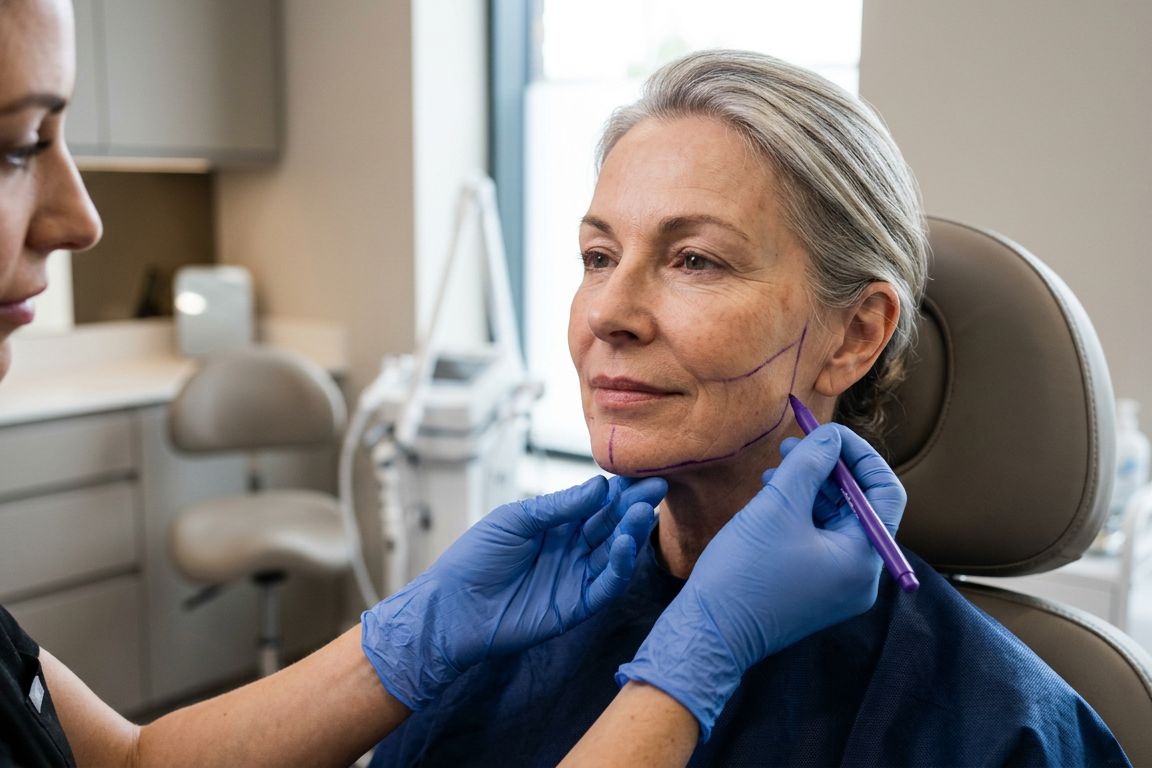
If you are considering a facelift in London and want to understand which technique is appropriate for your anatomy, the starting point is a detailed in-person consultation. At Kensington Cosmetic Clinic, located at 49 Marloes Road, W8, a short walk from High Street Kensington station, we take a full medical history, assess your facial anatomy with you present, and give you an honest opinion about what surgery can and cannot achieve in your specific case. We do not operate on everyone who enquires, and we will tell you plainly if a non-surgical approach is more appropriate at this stage.
You can read more about the full surgical procedure on our dedicated facelift treatment page, which covers technique options, anaesthetic approach, and what to expect at each stage of recovery. For a broader picture of how we approach surgical planning for the face and body, our post on implant selection and surgical decision-making illustrates the same principles of anatomy-led planning we apply across all procedures.
To arrange a consultation with Dr Hassan Soueid or another member of our surgical team, please book online here. We see patients from across London, including Kensington, Chelsea, Notting Hill, and further afield, as well as international patients who combine their consultation and surgery into a single London visit. We will respond to all enquiries within one working day.
Frequently asked
Questions we get asked about EnerPeel®
- What is the difference between an SMAS facelift and a deep-plane facelift?
- An SMAS facelift works by repositioning or tightening the fibromuscular layer beneath the skin as a separate step, while a deep-plane facelift releases and moves the SMAS together with the overlying skin and fat as a single composite unit. The deep-plane approach releases the key retaining ligaments of the face, which allows a more complete correction of midface descent and typically produces a longer-lasting result. The trade-off is a more extensive dissection, longer operating time, and a recovery with more pronounced swelling in the first few weeks.
- How long does facelift recovery take?
- Most patients are presentable with light make-up by around two weeks and return to desk-based work and social activities by four to six weeks. Significant bruising and oedema are expected in the first two weeks regardless of technique. After a deep-plane facelift, midface swelling can persist for three to six months, though it is not visible to most observers after the first month. The final result is not fully apparent until around six months post-operatively.
- Will a facelift look natural?
- In experienced hands, a modern facelift that addresses the deep structural layers rather than simply pulling skin should look natural, the goal is to restore the facial proportions of ten to fifteen years earlier, not to create an operated appearance. The key factors are the surgical technique, the direction of tissue repositioning (vertical rather than horizontal), and tension-free skin closure. Patients sometimes see an operated look when skin-only or high-tension techniques are used, which is why we do not perform those approaches.
- Can I combine a facelift with other procedures?
- Yes, and it is clinically common to do so. Fat transfer to restore volume, platysmaplasty and neck liposuction to address the neck, and upper or lower blepharoplasty for the eyelids are all frequently planned alongside a facelift. Each addition must have a clear clinical rationale and must not increase the risk profile beyond what is acceptable for an elective procedure. We will discuss any combined approach in detail during your consultation and explain the reasoning behind each element of the plan.
- Am I too young, or too old, for a facelift?
- There is no fixed age threshold, but most patients who benefit from facelift surgery are in their mid-forties to mid-sixties with visible jowling, midface descent, and a blunted neck angle. Patients in their late thirties with mild laxity are usually better served by non-surgical approaches at this stage. Older patients are assessed on their overall health and skin quality rather than age alone, many patients in their seventies are excellent surgical candidates. We will give you an honest assessment of where you sit on that spectrum at your consultation.