

Skin · 11 min read
ClearLift Laser in London: The Lunchtime Laser Explained
By Dr Hassan Soueid · GMC 6107783 · Medical Director, Kensington Cosmetic Clinic
Published 25 November 2026
TL;DR. ClearLift is a non-ablative laser that can form part of a measured plan for skin texture, tone and early fine lines with little visible downtime for most people, but it works gradually over a course, the evidence behind it is modest, and it is not a facelift or a substitute for deeper resurfacing.
If you have been searching for ClearLift laser London options, you will have seen it called the 'lunchtime laser'. The nickname is not entirely wrong, because many people return to their day shortly after a session. It is, however, a marketing phrase rather than a clinical description, and it hides the more useful questions. What is the laser actually doing? How strong is the evidence? How many sessions are usually discussed, and who should not have it at all? This guide explains how we approach ClearLift at our Kensington clinic, including the parts brochures tend to leave out.
ClearLift laser in London: what it is and how it works
ClearLift is a brand name for a laser system that uses a Q-switched Nd:YAG laser, most commonly at a wavelength of 1064 nanometres, delivered through a fractional handpiece. Each term matters. 'Q-switched' means the energy arrives in extremely short pulses, measured in billionths of a second. 'Nd:YAG' refers to the crystal that produces the light. 'Fractional' means the beam is split into a grid of tiny points, so only part of the treated area receives energy at any moment, with untouched skin in between.
The key word for patients is non-ablative. An ablative laser, such as a CO2 laser, removes a thin layer of the skin's surface, which is why it involves a genuine wound-healing phase. ClearLift does not deliberately break the surface. Instead, the energy passes through the outer layer and is absorbed deeper in the skin, where the very short pulses create a mechanical and thermal effect. The intended response is a low-grade repair process in the dermis, the supportive layer that contains collagen and elastin.
That repair process is the whole point, and it is also why patience is needed. Skin remodelling is slow. Any change in texture or firmness, where it happens, develops over weeks and months rather than overnight, and it is usually subtle. Whether ClearLift is appropriate for you depends on what is actually causing your concern, which a doctor-led consultation should establish before any laser is switched on.
What it can and cannot do
It is worth being precise here, because this is where most marketing becomes vague. In appropriately selected patients, ClearLift is used with the aim of:
- Softening the appearance of rough or uneven skin texture.
- Improving the look of dullness and mild, uneven tone.
- Supporting the skin's own collagen activity, which may help the appearance of very fine, early lines.
- Offering an option for people who cannot take time away from work for a more intensive procedure.
Notice the language: 'aim', 'appearance', 'may'. That is deliberate. Published evidence for low-energy, fractional Q-switched Nd:YAG treatment exists, but it is modest. Many studies are small, some lack a control group, follow-up periods are often short, and a proportion are linked to device manufacturers. Patient satisfaction is often used as a measure, which is useful but not the same as objective change. Our honest summary is that ClearLift has a reasonable safety profile when used carefully and can produce gentle, gradual change for some people, while others notice little. We cannot tell you in advance which group you will fall into.
Equally important is what it cannot do:
- It does not remove wrinkles. Deeper, established lines, particularly those caused by muscle movement, are not reliably changed by a non-ablative laser.
- It does not lift sagging skin. Loose skin along the jawline, jowls or neck reflects changes in deeper tissues, fat pads and ligaments that a laser does not reposition. That is the territory of surgery such as a facelift.
- It is not a substitute for resurfacing. If marked sun damage, acne scarring or significant textural irregularity is the main concern, a deeper treatment may be more appropriate, with the extra downtime that comes with it.
- It does not restore lost volume, which is a separate issue involving fat and bone changes.
If the honest answer at consultation is that ClearLift is unlikely to meet your goals, we will say so.
A session, step by step
Consultation first. Before any laser treatment you should have a doctor-led consultation covering your skin concerns, medical history, current and recent medications, sun exposure and previous treatments. We will discuss your Fitzpatrick skin type, a scale describing how skin responds to sun, and explain the alternatives, including doing nothing. We are introducing HonestFace, our own iPad app for digital consultation forms, consent signing and secure patient records, so in future some of this paperwork may be completed on a tablet in clinic. Consent remains a conversation rather than a signature, and you should never feel rushed into booking on the day.
Patch test. For many patients, particularly those with darker skin types, a history of pigmentation problems or no previous laser treatment, a test patch is carried out in a discreet area. This allows your skin's response to be checked over the following days before a full session is planned.
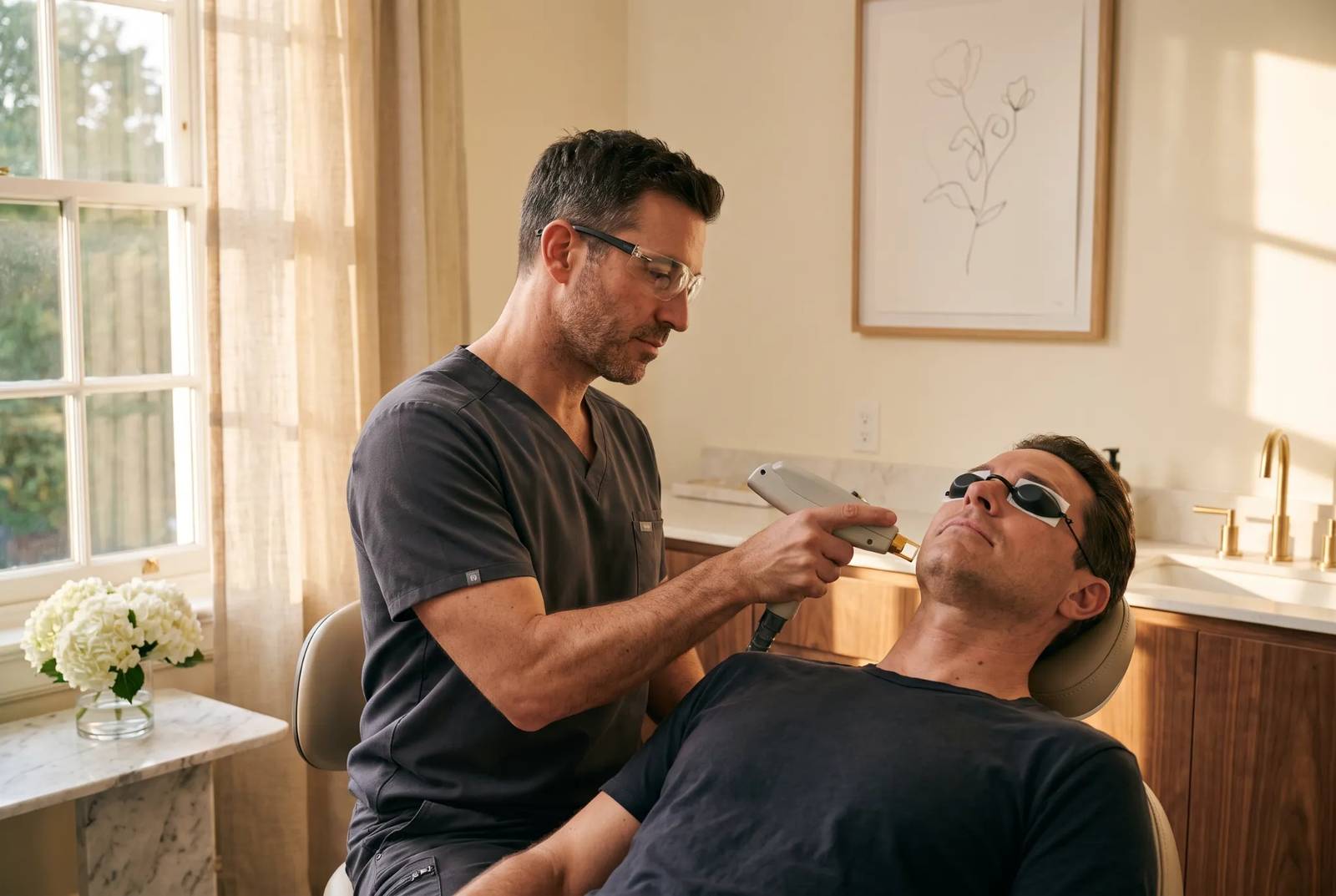
Preparation on the day. Arrive with clean skin, ideally without make-up. Your skin is cleansed, and both you and the clinician wear protective eyewear matched to the laser wavelength. Eye protection is not optional with any laser.
The treatment itself. The handpiece is passed over the area in a series of passes. Most people describe a snapping or flicking sensation, a little like a rubber band, together with warmth. How that feels varies widely between individuals and between areas; skin over bone, such as the forehead and jawline, often feels sharper. Numbing cream is not usually needed, but you can discuss it. We would not describe ClearLift as painless, because for some people it is not.
Duration and afterwards. A full-face session commonly involves around 20 to 30 minutes of treatment time, with the appointment longer once preparation and aftercare advice are included. Mild redness and warmth are common immediately afterwards, and sun protection is applied before you leave.
Courses, spacing and maintenance
One of the most common questions is how many ClearLift sessions are needed. The truthful answer is that a course is usually discussed rather than a single treatment, because the approach relies on repeated, low-intensity stimulation rather than one strong session. Courses of around four to six sessions, spaced roughly two to four weeks apart, are commonly used, but this is a starting framework, not a promise. What makes sense for you depends on your skin type, the concern being treated, how your skin responds and how you tolerate each session.
It is important to separate the number of sessions from the outcome. Completing a course does not guarantee a particular degree of change. Some people notice a gradual difference in texture or brightness partway through; others notice little even after finishing. If, after a reasonable number of sessions, there is no meaningful change, we think the right response is to review the plan honestly rather than keep adding appointments.
Because collagen remodelling continues after treatment, any change is usually assessed a few months after the last session rather than immediately.
Ageing and sun exposure continue regardless of any treatment, so some people choose occasional maintenance sessions. There is no fixed rule. Maintenance is a choice, not a requirement, and should be guided by whether you have genuinely valued the effect so far. The single most important ongoing measure for skin quality is consistent daily broad-spectrum sun protection, which no laser can replace.
Who suits it and who should not have it
ClearLift may be worth discussing if you have early signs of skin ageing such as mild dullness, rougher texture or very fine lines, want a low-downtime option, understand that any change is likely to be gradual and modest, and are prepared to commit to a course and to strict sun protection.
The 1064 nm wavelength is less strongly absorbed by surface melanin than some other lasers, which is one reason it is often considered for a wider range of skin types. That does not make it free of risk. In darker skin there remains a risk of post-inflammatory hyperpigmentation (darkening) or, less commonly, lightening. Conservative settings and a patch test matter.
ClearLift is generally not appropriate, or needs to be postponed, if you:
- Are pregnant or breastfeeding.
- Have taken oral isotretinoin recently. Practice varies, but a waiting period of several months after stopping is commonly advised.
- Are taking photosensitising medicines, such as certain antibiotics including doxycycline, some diuretics, or herbal remedies such as St John's wort. Tell us about everything you take, including supplements.
- Have ever received gold-based treatment, used historically for rheumatoid arthritis, because Q-switched lasers can cause long-lasting skin discolouration in this situation.
- Have an active tan, recent sunbed use or sunburn.
- Have active infection, cold sores, open wounds or inflamed skin in the area. If you are prone to cold sores, antiviral cover may be discussed.
- Have melasma, which can be unpredictable and sometimes worsens with heat or light. Our melasma planning guide explains why it needs careful handling.
- Have light-sensitive epilepsy, a tendency to abnormal scarring or an autoimmune condition affecting the skin, all of which need discussion first.
- Are mainly concerned about loose skin, deep lines or volume loss, where other options are more relevant.
You will usually be asked to pause topical retinoids and exfoliating acids for several days before treatment.
ClearLift compared with microneedling, peels and CO2
The most useful way to compare skin treatments is by how deep they work and how much downtime they involve. Depth broadly tracks both potential change and recovery: going deeper can do more, but asks more of the skin and of you.
ClearLift. Non-ablative, with no deliberate break in the skin surface. Visible downtime for most people is minimal, typically some redness for a few hours. Effects, where they occur, are gradual and modest, and a course is usual.
Microneedling. Microneedling creates many tiny, controlled channels using fine needles, triggering a wound-healing response. Unlike ClearLift, it does break the surface, so redness, tightness and mild flaking for one to three days are common. It is often discussed for texture and some types of acne scarring. On ClearLift versus microneedling, neither is simply better: one is a mechanical injury with a slightly longer recovery, the other a light-based treatment with less surface disruption. Our microneedling evidence guide covers it in more depth.
Chemical peels. Chemical peels use controlled chemical exfoliation, ranging from very superficial peels with minimal flaking to medium-depth peels with several days of visible peeling. They are often used for dullness and uneven tone, and can sit well alongside other treatments.
CO2 laser resurfacing. Fractional CO2 is ablative. It removes microscopic columns of skin, meaning a genuine recovery period, often around a week of redness, crusting or peeling, followed by pinkness that can last longer. It carries a higher risk of pigment change, particularly in darker skin. In return, it is considered for more marked sun damage, textural irregularity and some scarring, where a non-ablative laser is unlikely to be enough. Our guide to CO2 laser resurfacing explains this in detail.
Put simply, ClearLift sits at the gentle, low-downtime end of the spectrum. That is both its appeal and its limitation. If your concern is mild and your priority is minimal disruption, it may be a reasonable starting point. If your concern is more established, a deeper treatment may be the more honest advice.
Aftercare and returning to work
The 'lunchtime' label comes from this part. For most people, visible after-effects are mild and many return to work the same day. For people juggling busy London working weeks, that is the appeal. Even so, it is sensible to plan with a little margin, particularly before your first session, when you do not yet know how your skin responds.
What is common: redness, warmth and a feeling similar to mild sunburn, usually settling within a few hours, and occasionally slight swelling that settles over a day or so.
What is less common, and should be reported: blistering, crusting, persistent or worsening redness, darkening or lightening of the skin, or any sign of infection. Pigment changes are usually temporary but can take weeks or months to settle, and rarely may persist. ClearLift laser side effects are generally mild, but no laser treatment is without risk.
For the first few days:
- Use a gentle cleanser and a simple, fragrance-free moisturiser.
- Apply broad-spectrum SPF 30 or higher daily, reapplying outdoors, and avoid direct sun where possible.
- Avoid saunas, steam rooms, hot yoga and strenuous exercise for 24 to 48 hours, as heat can prolong redness.
- Pause retinoids, exfoliating acids and scrubs for several days, or as advised.
- Mineral make-up can usually be applied once redness has settled.
If you have a significant event, such as a wedding or important presentation, avoid a session in the week beforehand. Even a low-downtime treatment can occasionally behave unexpectedly. You should always know how to contact the clinic if anything concerns you.
Booking your consultation
Every skin plan at Kensington Cosmetic Clinic begins with a doctor-led consultation. The clinic was founded by Dr Hassan Soueid, a GMC-registered doctor and our Medical Director, and is registered with the Care Quality Commission. At your consultation we will assess your skin, go through your medical history and medications, explain whether ClearLift is suitable, and set out the alternatives, including deeper resurfacing, combination approaches or simply improving your skincare and sun protection.
You will not be asked to commit to a course on the day. We would rather you take time to think it through and come back with questions. If ClearLift is unlikely to give you what you are hoping for, we will tell you, and explain why.
Our clinic is in Kensington, within easy reach of central and west London. If you would like to discuss ClearLift or any other skin treatment, you can book a consultation online at a time that suits you.
Frequently asked
Questions we get asked
- Does ClearLift hurt?
- Most people describe a snapping or flicking sensation, similar to a rubber band, along with warmth. How uncomfortable that feels varies between individuals and between areas, with skin over bone such as the forehead and jawline often feeling sharper. Numbing cream is not usually needed but can be discussed. We would not describe ClearLift as painless, and settings and pace can be adjusted during the session if needed.
- How many ClearLift sessions will I need?
- A course is usually discussed rather than a single session. Around four to six sessions spaced roughly two to four weeks apart is a common starting framework, but the right number depends on your skin type, your concern and how your skin responds. Completing a course does not guarantee a particular outcome, and if there is no meaningful change after a reasonable number of sessions, the plan should be reviewed honestly.
- Is there downtime after ClearLift?
- For most people visible downtime is minimal, typically redness and warmth that settle within a few hours, so many return to work the same day. Occasionally redness or slight swelling lasts a day or so, and less commonly pigment changes or blistering can occur. It is sensible not to schedule a session in the week before an important event, and daily SPF is essential afterwards.
- Who should not have ClearLift?
- ClearLift is generally not suitable, or should be postponed, during pregnancy or breastfeeding, after recent oral isotretinoin, while taking photosensitising medicines, with an active tan or sunburn, or with infection or cold sores in the area. A history of gold-based treatment is a reason to avoid Q-switched lasers. Melasma, light-sensitive epilepsy and abnormal scarring need careful discussion, and it is not the right choice if your main concern is loose skin.
- Is ClearLift the same as a facelift?
- No. ClearLift is a non-ablative laser that works within the skin and may gradually improve the appearance of texture and tone in some people. A facelift is a surgical procedure that repositions deeper tissues and removes excess skin to address sagging. ClearLift does not lift loose skin along the jawline, jowls or neck, and it is not a substitute for surgery or for deeper resurfacing.