

Skin · 11 min read
Melasma Treatment London: A Realistic Plan for Your Skin
By Dr Hassan Soueid · MD, FRCS · Lead Surgeon, Kensington Cosmetic Clinic
Published 25 May 2026
TL;DR - Melasma is a chronic, hormonally-driven pigmentation disorder that responds to treatment but rarely disappears permanently. At our Kensington clinic we use a layered approach, prescription-grade topicals, carefully selected peels, and device treatments chosen to match your skin tone, because no single intervention is enough on its own. Patients with darker skin tones require a more conservative protocol to avoid post-inflammatory hyperpigmentation making things worse. If anyone promises you a single session cure for melasma, walk away.
Why melasma treatment in London is more complicated than it looks
Melasma is a form of acquired hypermelanosis, an overproduction of melanin driven primarily by UV exposure, hormonal fluctuations, and genetic predisposition. It presents as symmetrical, irregular brown or grey-brown patches, most commonly across the cheeks, upper lip, forehead, and chin. It is far more prevalent in women, particularly those using combined oral contraceptives, those who are pregnant, or those with a family history of the condition. It is also disproportionately common in skin phototypes III–VI, which means a significant proportion of the London population, with its diverse ethnic mix, is at higher baseline risk.
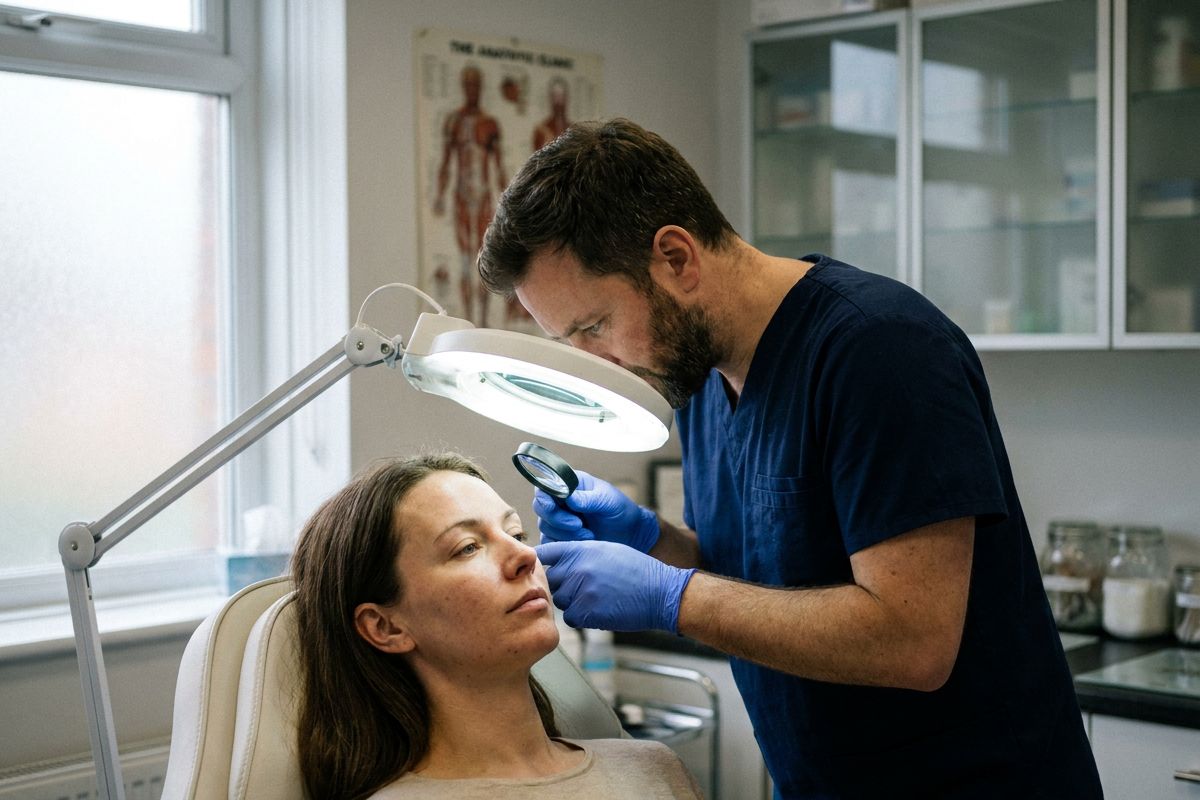
What makes melasma so frustrating is that it sits at multiple levels of the skin simultaneously. Epidermal melasma responds reasonably well to topical agents and superficial peels. Dermal melasma, where melanin has been deposited deeper in the dermis, is far more resistant. Mixed-type melasma, which is the most common presentation we see, requires patience and a multi-modal strategy. A Wood's lamp examination in clinic helps us assess the depth of pigmentation before we recommend anything.
London's climate is a double-edged sword. We have lower baseline UV intensity than Mediterranean or tropical climates, which helps maintenance. But patients who travel for work or holidays, as many of our patients in the High Street Kensington and Earl's Court catchment do, frequently return with significant flares. Sun protection is not optional in a melasma management plan; it is the single most important intervention, and no treatment will hold without it.
There is also a psychological dimension that we take seriously. Melasma is visible, it is on the face, and it disproportionately affects women during already demanding life stages, pregnancy, early parenthood, perimenopause. We have seen patients who have spent thousands on treatments elsewhere in London before coming to us, often having been sold aggressive laser protocols that worsened their pigmentation. Our starting point is always an honest conversation about what is achievable and on what timeline.
Diagnosing pigmentation correctly before any treatment begins
Hyperpigmentation is a broad term that encompasses melasma, post-inflammatory hyperpigmentation (PIH), solar lentigines (sun spots), and drug-induced pigmentation. Getting the diagnosis right matters enormously because the treatment approach differs. PIH, for example, often responds faster than melasma because it is typically epidermal and not hormonally perpetuated. Treating solar lentigines with a Q-switched laser is straightforward; using the same device on melasma can trigger a rebound flare.
At our clinic, every pigmentation consultation begins with a full skin assessment. Dr Anna Peca, who leads much of our medical skin work, takes a detailed history including contraceptive use, pregnancy history, sun exposure habits, previous treatments, and any topical agents the patient is currently using. Photographs under standardised lighting are taken at baseline so that progress is measurable rather than subjective.
We also assess skin phototype carefully using the Fitzpatrick scale. This is not a bureaucratic exercise, it directly determines which devices and which chemical concentrations are safe to use. A Fitzpatrick IV patient who has been told they are suitable for an ablative CO2 laser by another clinic is, in our view, being put at unnecessary risk. Our pigmentation treatment pathway is explicitly designed to be safe across all phototypes, including skin of colour.
If there is any clinical uncertainty, for example, if the pattern is atypical, if there is associated inflammation, or if the patient has a history of melasma that has not responded to standard treatment, we will refer for a dermatology opinion before proceeding. We would rather lose a booking than cause harm.
The topical foundation: why Tebiskin and prescription agents matter
No in-clinic procedure for melasma works well without a strong topical programme running alongside it. This is the part of treatment that most patients underestimate, and it is where the difference between a well-managed case and a recurring one is often made.
Hydroquinone remains the most evidence-based topical depigmenting agent available. Used at 2–4% concentration, often in combination with a retinoid and a mild topical corticosteroid (the classic Kligman formula), it inhibits tyrosinase, the enzyme responsible for melanin synthesis. It is available on prescription in the UK and we prescribe it when clinically appropriate, with clear instructions on cycle length to avoid ochronosis with prolonged use.
For patients who cannot tolerate hydroquinone, or for whom it is contraindicated (including during pregnancy), we use the Tebiskin range, which is a professional-grade cosmeceutical line formulated specifically for pigmentation and sensitive skin. Tebiskin OSK and Tebiskin Gly-C are the two products we most commonly incorporate into home protocols. They contain azelaic acid, kojic acid, and stabilised vitamin C in concentrations that are clinically meaningful rather than cosmetic. These are not available over the counter in standard pharmacies, which is part of why patients travelling from across London to our W8 clinic specifically ask about them.
Vitamin C serums, niacinamide, and alpha-arbutin all have supporting evidence as adjuncts. Retinoids, whether tretinoin on prescription or a well-formulated retinol, accelerate epidermal turnover and enhance the penetration of other actives. We build a home protocol that is layered but not overwhelming, because patients who are given eight products to use twice daily simply do not comply, and non-compliance is the most common reason melasma treatment fails.
Broad-spectrum SPF 50+ sunscreen, applied every morning and reapplied at midday, is non-negotiable. We recommend mineral-based formulations (zinc oxide or titanium dioxide) for melasma patients because there is some evidence that visible light, not just UV, can trigger melanogenesis in darker skin types, and mineral filters provide broader protection against this.
In-clinic treatments: matching the intervention to the skin
Once the topical foundation is established, typically after four to six weeks, we introduce in-clinic treatments in a sequence determined by skin phototype, depth of pigmentation, and the patient's tolerance for downtime.
For Fitzpatrick I–III skin, a course of chemical peels using glycolic acid, mandelic acid, or a modified Jessner's solution is often our first in-clinic step. These are superficial-to-medium depth peels that accelerate epidermal turnover, improve the penetration of topical agents, and produce a meaningful reduction in surface pigmentation over a course of four to six sessions. We space sessions three to four weeks apart and we do not rush the programme. Peeling too aggressively, too frequently, causes inflammation, and inflammation in melasma-prone skin triggers more pigmentation.
For Fitzpatrick IV–VI skin, we are more conservative. Mandelic acid peels are our preference in darker skin types because mandelic acid has a larger molecular size, penetrates more slowly, and carries a lower risk of PIH than glycolic acid at equivalent concentrations. We also use microneedling as part of the protocol for skin of colour, it creates controlled micro-channels that enhance topical penetration without the thermal injury that laser devices carry. Our colleague Dr Deniz Kanliada has particular experience managing pigmentation in patients with South Asian and Middle Eastern skin tones, which represent a significant proportion of our Kensington patient base.
For device-based treatment, we use the Clear Lift platform, a fractional, non-ablative Q-switched Nd:YAG laser, which has a strong safety profile in darker skin types and can target both epidermal and superficial dermal pigmentation. You can read more about how this works on our Clear Lift treatment page. We do not use ablative CO2 lasers for melasma; the risk of PIH and rebound hyperpigmentation is too high, and the evidence for their use in melasma specifically is not strong enough to justify that risk. Our CO2 laser work is reserved for other indications such as resurfacing of acne scarring or photodamage in lighter skin types.
LED therapy is a useful adjunct at the end of a treatment session to reduce post-treatment inflammation and support skin barrier recovery. It is not a standalone treatment for melasma, but it earns its place in the protocol as a recovery tool. Our LED therapy sessions are often scheduled immediately after a peel or microneedling appointment for this reason.
PRP is another tool we consider in selected cases, particularly where there is an element of skin thinning or compromised barrier function alongside the pigmentation. The evidence base for PRP in melasma is still developing, but the rationale, improving dermal architecture and reducing the inflammatory microenvironment that perpetuates melanocyte hyperactivity, is sound. Dr Hassan Soueid reviews all complex cases personally to ensure the treatment plan is coherent rather than a menu of individual procedures bolted together.
Who this approach is not right for
We are direct about this because we think it matters. Melasma treatment is not right for you right now if you are currently pregnant or breastfeeding. Many of the active ingredients we use, including hydroquinone, tretinoin, and certain peel acids, are contraindicated in pregnancy. Melasma that develops during pregnancy (chloasma gravidarum) often partially resolves postpartum, and we recommend waiting at least three months after breastfeeding has finished before starting any active treatment programme.
If you are still using a combined oral contraceptive pill and are unwilling to consider alternatives, we will still treat you, but we will be honest that hormonal perpetuation of the condition significantly limits what we can achieve. We are not in a position to advise on contraceptive choices, that is a conversation for your GP, but we will explain the clinical relationship clearly so you can make an informed decision.
If you have a history of keloid scarring or are prone to severe PIH, certain in-clinic interventions carry higher risk and we will modify the protocol accordingly or decline to perform them. We would rather offer a conservative plan that delivers modest, safe results than an aggressive one that causes harm.
Patients with very active, rapidly spreading melasma, particularly where there is a strong hormonal driver, may find that in-clinic treatments simply cannot keep pace with the underlying process. In these cases, the most useful thing we can do is optimise the topical programme and manage expectations clearly. We have seen patients who have been through multiple clinic courses elsewhere in London with disappointing results, and sometimes the most honest consultation we can offer ends with us saying: the timing is not right yet.
For those wondering how melasma management compares to other skin concerns we treat, our post on microneedling in London gives a useful overview of what that modality can and cannot achieve across different skin conditions. And if you are considering broader skin rejuvenation alongside pigmentation work, our article on non-surgical facelifts in west London covers how we think about combining treatments without overloading the skin.
What realistic results look like and how long they take
We will not give you a percentage improvement figure because the evidence does not support precise predictions, and because melasma varies enormously between individuals. What we can say, based on our clinical experience, is that a well-managed patient who is compliant with their home protocol and attends a full course of in-clinic sessions will typically see a meaningful reduction in the intensity and area of their pigmentation within three to six months. Epidermal melasma responds faster. Dermal and mixed-type melasma takes longer and may plateau before full clearance.
Maintenance is not optional. Patients who complete a course and then abandon sun protection and topical agents almost universally see recurrence within a season, particularly after summer. We build a maintenance plan into every programme, typically a lower-intensity topical regime and one or two clinic sessions per year, because we want results that last rather than results that photograph well at the three-month review and then disappear.
We also want to be clear that some patients will not achieve clearance. Dermal melasma in particular can be significantly improved but not eliminated with current available treatments. If that is your situation, we will tell you at the outset, and we will focus the programme on improvement and stability rather than a cure that does not exist.
Our colleague Rozina Ali, who works with many of our patients on skin health and aesthetic medicine, often frames it this way: the goal is to get your skin to a place where you feel confident without heavy makeup, and then to keep it there with a manageable routine. That is a realistic and achievable goal for most melasma patients. It is not the same as having skin that has never been affected, and we think patients deserve to hear that clearly before they commit to a programme.
If you are researching injectable skin treatments alongside your pigmentation work, our post on Profhilo in London explains how skin boosters complement a pigmentation programme by improving overall skin quality and hydration. Similarly, our article on mesotherapy in London covers the evidence for vitamin microinjections, which some patients ask about as an adjunct to topical treatment.
Booking your consultation
If you are dealing with melasma or persistent hyperpigmentation and you have found that over-the-counter products have not made a meaningful difference, a structured clinical assessment is the right next step. We see patients from across London and beyond at our clinic at 49 Marloes Road, Kensington, W8 6LA, a short walk from High Street Kensington tube station.
Your initial consultation will include a full skin assessment, Wood's lamp examination where indicated, a review of your current skincare and any previous treatments, and a clear written plan with honest expectations. We do not upsell treatments in the consultation room. If the right answer is a home programme and sun protection for six months before any in-clinic work, that is what we will tell you.
To arrange your assessment, please book a consultation online or visit our pigmentation treatment page for more detail on how we approach this condition. We look forward to giving you an honest picture of what is possible for your skin.
Frequently asked
Questions we get asked about EnerPeel®
- Can melasma be permanently cured?
- Not in the majority of cases. Melasma is a chronic condition with a strong hormonal and genetic component, which means it can be well-controlled but tends to recur if the underlying triggers, particularly UV exposure and hormonal fluctuation, are not managed. Most patients achieve significant improvement with a structured treatment programme, but ongoing maintenance is necessary to preserve results.
- Is laser treatment safe for darker skin tones with melasma?
- It depends entirely on the laser and the operator. Ablative lasers and certain IPL devices carry a high risk of post-inflammatory hyperpigmentation in Fitzpatrick IV–VI skin and are generally not appropriate for melasma in darker skin types. Non-ablative, Q-switched platforms such as Clear Lift have a better safety profile in darker skin when used conservatively. We assess every patient individually and will not use a device we consider unsafe for your skin tone.
- How long does a typical melasma treatment course take?
- Most patients complete an initial course over three to six months, combining a home topical programme with four to six in-clinic sessions spaced three to four weeks apart. Epidermal melasma often shows improvement within the first two months. Dermal and mixed-type melasma takes longer. After the initial course, maintenance sessions and an ongoing home routine are needed to sustain results.
- Can I have melasma treatment while on the contraceptive pill?
- Yes, but with reduced expectations. Combined oral contraceptives are a recognised hormonal trigger for melasma, and continuing them during treatment means the underlying driver remains active. We will still treat you and can achieve improvement, but we will be transparent that hormonal perpetuation limits how much we can achieve. We recommend discussing contraceptive alternatives with your GP if melasma is significantly affecting your quality of life.
- What is the difference between melasma and post-inflammatory hyperpigmentation?
- Post-inflammatory hyperpigmentation (PIH) is pigmentation that develops in response to skin injury or inflammation, acne, eczema, a burn, or an overly aggressive cosmetic treatment. It is typically epidermal and often resolves more readily than melasma. Melasma is driven by hormonal and UV factors and tends to be more persistent, often with a mixed epidermal and dermal component. The treatments overlap but are not identical, which is why accurate diagnosis before any intervention matters.