

Skin · 11 min read
Microneedling in London: What the Evidence Actually Supports
By Dr Hassan Soueid · MD, FRCS · Lead Surgeon, Kensington Cosmetic Clinic
Published 25 May 2026
TL;DR - Microneedling has the strongest evidence base for atrophic acne scarring and general skin texture improvement; the data on pigmentation, stretch marks, and hair loss is promising but thinner. Device choice, Dermapen vs SkinPen and similar, matters less than needle depth, protocol design, and the skill of the person holding the handpiece. At Kensington Cosmetic Clinic we use microneedling as part of a broader skin programme, not as a standalone cure-all, and we will tell you plainly when a different treatment is likely to serve you better.
What microneedling London patients are actually asking for
Over the past five years, microneedling has moved from a niche dermatology procedure to one of the most requested non-surgical treatments in London. The reasons are understandable: it is relatively affordable compared with laser resurfacing, the downtime is short, and the mechanism, controlled micro-injury driving collagen and elastin synthesis, is biologically coherent. Patients arrive at our Kensington clinic having read a great deal online, and they tend to ask sharper questions than they did a decade ago.
The most common presentations we see are atrophic acne scars (rolling, boxcar, and ice-pick subtypes), general skin laxity in the mid-face and neck, fine lines around the eyes and mouth, enlarged pores, and uneven skin tone. A smaller group comes specifically for microneedling Kensington searches having already tried treatments elsewhere and wanting a second clinical opinion on why results were disappointing. That last group is instructive: it tells us that microneedling is often sold without enough patient selection, and without honest expectation-setting.
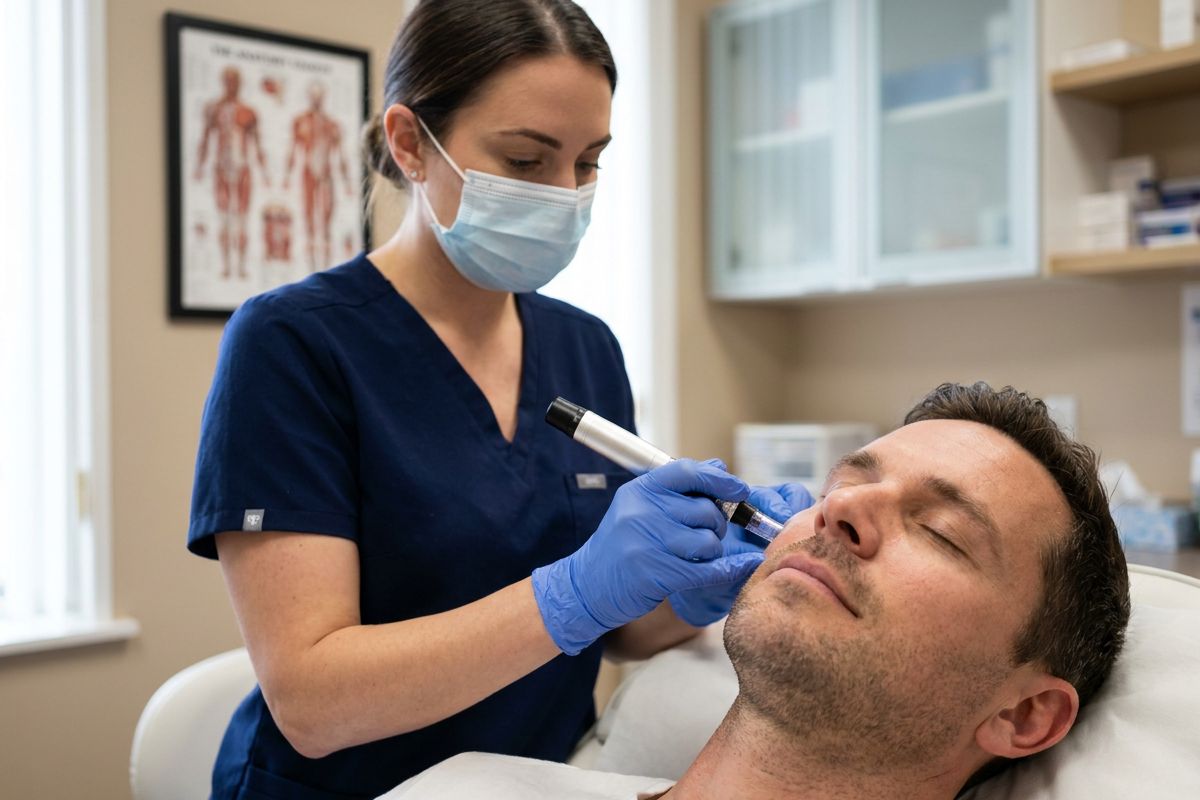
Before we get into the evidence, it is worth being clear about what microneedling physically does. A motorised handpiece drives a cartridge of fine needles into the skin at a controlled depth, typically 0.5 mm to 2.5 mm depending on the target tissue, at high frequency. This creates thousands of micro-channels per square centimetre, triggering the wound-healing cascade: haemostasis, inflammation, proliferation, and remodelling. The remodelling phase, during which new collagen and elastin are laid down, takes weeks to months. That timeline is why a single session rarely produces the results patients want, and why anyone promising dramatic change from one treatment should be questioned.
Our skin team, led by Dr Hassan Soueid, reviews each patient's skin history, Fitzpatrick type, and treatment goals before designing a protocol. There is no single correct number of sessions or needle depth, those variables are set per patient, per area, per treatment cycle.
What the clinical evidence actually shows
The evidence base for microneedling is genuinely solid in some areas and genuinely thin in others. It is worth separating these honestly rather than citing the strongest studies to support every indication.
Atrophic acne scarring is where the evidence is most robust. Multiple randomised controlled trials and systematic reviews, including a 2021 meta-analysis published in the Journal of the American Academy of Dermatology, demonstrate statistically significant improvement in scar depth and surface texture with a course of three to six sessions. The effect size is meaningful: most studies report 50–70% improvement on validated scar scales for rolling and boxcar scars. Ice-pick scars respond less well to needling alone and often need adjunctive treatments such as CO₂ laser resurfacing or subcision.
For skin texture and fine lines, the evidence is positive but more heterogeneous. Study populations, needle depths, device types, and outcome measures vary considerably, making direct comparison difficult. The clinical consensus is that microneedling produces a modest but real improvement in epidermal thickness and superficial rhytides, particularly in patients with mild-to-moderate photodamage. It is not a substitute for ablative laser in patients with deep lines or significant solar elastosis.
Pigmentation disorders, melasma in particular, are a more complicated story. Some studies show improvement; others show post-inflammatory hyperpigmentation as a complication, especially in Fitzpatrick types IV–VI. We are cautious here. For patients with darker skin tones presenting with melasma, we are more likely to recommend our pigmentation programme, which may include topical agents, chemical peels, or low-fluence laser, before considering needling.
The evidence for microneedling in androgenetic alopecia is early but interesting. Several small RCTs show improved hair density when needling is combined with minoxidil or PRP (platelet-rich plasma), likely because micro-channels enhance topical penetration and PRP delivery. We do not position microneedling as a primary hair-loss treatment, but in the right patient it forms a useful part of a combination protocol. For more established hair restoration options, our overview of non-surgical rejuvenation in West London touches on where needling sits within a broader menu of options.
Stretch marks (striae distensae) show modest response in early-stage striae rubrae; mature white striae are significantly harder to treat with any modality, and we say so at consultation.
Dermapen vs SkinPen: does device choice matter?
This is one of the most common questions we receive, and the honest answer is: device quality matters, but the operator matters more. The Dermapen vs SkinPen debate is largely a marketing conversation dressed up as a clinical one.
Both Dermapen 4 and SkinPen Precision are CE-marked, clinically validated devices with peer-reviewed data behind them. SkinPen holds FDA clearance specifically for neck and facial acne scarring, a meaningful regulatory milestone. Dermapen 4 has a large body of published clinical use and a wide needle-depth range. Other devices on the market vary enormously in build quality, needle gauge consistency, and motor precision; some of the cheaper units used in beauty salons produce inconsistent penetration depth, which undermines both efficacy and safety.
What actually determines your outcome is: the depth set for your skin type and indication, the number of passes, the direction of passes, the topical applied during treatment (hyaluronic acid, growth factors, or PRP), the post-treatment protocol, and the interval between sessions. A skilled practitioner using a mid-range validated device will outperform an inexperienced one using the most expensive handpiece available. This is why we spend time at consultation not just selecting a device but designing the full protocol, including what happens in the 72 hours after each session.
At our clinic in Kensington, Dr Anna Peca and Sylwia Bozek lead the majority of our skin treatment programmes, and both have specific training in protocol design for different skin types and scar morphologies. For patients with more complex presentations, significant photodamage, combined surgical and non-surgical plans, we integrate microneedling into a broader programme that may include skin resurfacing or energy-based treatments.
The treatment experience: what a course looks like at KCC
A standard course for acne scarring microneedling at our W8 clinic runs three to six sessions, spaced four to six weeks apart. The spacing is not arbitrary: it reflects the remodelling timeline. Treating too frequently interrupts the proliferative phase; too infrequently loses momentum. We review progress at each session and adjust depth and technique accordingly.
Each appointment begins with a thorough skin cleanse and the application of a topical anaesthetic cream, which is left in place for 30–45 minutes. The actual needling takes 20–40 minutes depending on the area treated. We apply a calming serum immediately post-treatment, typically hyaluronic acid or, where clinically appropriate, PRP drawn from the patient's own blood at the same appointment. The face will be red and feel warm for 12–48 hours; this is expected and is part of the inflammatory phase that drives the result.
We provide written aftercare instructions covering sun avoidance, the products to avoid (retinoids, AHAs, and active vitamin C for the first 72 hours), and what to expect day by day. Patients who have had treatments elsewhere and not received this level of aftercare guidance are often the ones who see suboptimal results, not because the treatment failed, but because the post-treatment skin barrier was compromised by inappropriate product use.
For patients interested in how microneedling compares with injectable skin boosters, our article on Profhilo as a skin booster in London is a useful comparison, the two treatments address overlapping but distinct concerns, and many patients benefit from both within a planned programme.
Pricing at our Kensington clinic reflects the clinical time involved, the device and consumables used, and the complexity of the protocol. A single session for a straightforward skin-texture concern will cost less than a session combined with PRP for complex acne scarring. We give fixed quotes at consultation; we do not operate a variable pricing model based on how much a patient appears willing to spend.
Who this treatment is not right for
This section matters. Microneedling is not appropriate for everyone, and part of our job at consultation is to tell patients when it is not the right choice for them, even when they have come specifically requesting it.
Active acne is a contraindication. Needling over active pustules or cysts will spread bacteria and worsen the breakout. We will not treat active inflammatory acne; we will instead discuss a medical skin programme to bring the acne under control first, then reassess for scar treatment. Similarly, active rosacea with broken capillaries, eczema, psoriasis, or any open skin lesion in the treatment area precludes treatment.
Patients on oral isotretinoin (Roaccutane) should wait at least six months after their last dose before undergoing any needling procedure. The drug impairs wound healing and significantly increases the risk of scarring and post-inflammatory change.
Those with a history of keloid or hypertrophic scarring need careful assessment. Microneedling relies on the wound-healing response, in patients whose healing response is dysregulated, the risk of worsening scarring is real. We do not exclude these patients categorically, but we counsel them thoroughly and may recommend a test patch before committing to a full course.
Patients with significant skin laxity, deep folds, or volume loss will not achieve meaningful improvement from microneedling alone. For these presentations, we are more likely to discuss dermal fillers or botulinum toxin, energy-based tightening, or, where appropriate, a surgical consultation. Our article on brow lift versus botox for forehead lines illustrates the kind of honest comparison we try to offer across our treatment menu.
Pregnancy and breastfeeding are relative contraindications, primarily because of the topical agents used peri-treatment rather than the needling itself. We defer elective cosmetic procedures in this period.
Combining microneedling with other treatments
In clinical practice, the most meaningful results we see come not from microneedling in isolation but from well-designed combination programmes. The sequencing and spacing of treatments is where clinical judgement adds real value.
The most evidence-supported combination is microneedling with PRP. The micro-channels created by needling allow platelet-derived growth factors to penetrate beyond the epidermis, amplifying the regenerative signal. We use autologous PRP, drawn, centrifuged, and applied or injected at the same appointment, for patients with moderate-to-severe acne scarring or those seeking skin quality improvement in the context of early ageing. The evidence for this combination in acne scarring is particularly strong, with several RCTs showing superior outcomes versus needling alone.
For patients with significant photodamage or superficial pigmentation alongside textural concerns, a course of medical-grade chemical peels preceding microneedling can prime the skin and improve the starting point. The peels address the epidermal component; the needling then works at a deeper dermal level. We would not run these treatments simultaneously, the sequencing matters, and we plan it carefully.
LED therapy post-needling is a low-risk addition that some patients find accelerates their recovery and reduces post-treatment redness. The evidence for LED as a standalone rejuvenation treatment is modest, but as an adjunct to reduce inflammation after needling it has a plausible mechanism and a reasonable safety profile.
Where patients have both skin quality concerns and volume loss, we may plan microneedling alongside a fat transfer programme, though these are clearly separate procedures with different recovery profiles, and we would never combine them in a single appointment. For patients considering more comprehensive rejuvenation, Mr Ali Ghanem leads our surgical consultations and works closely with our skin team to ensure non-surgical and surgical components of a plan are properly sequenced. You can read more about combined approaches in our post on combining procedures safely in London.
Booking your consultation
If you are considering microneedling in London and want an honest assessment of whether it is the right treatment for your specific concerns, we would encourage you to book a consultation rather than a treatment. The consultation is where the clinical work happens: we review your skin history, assess your Fitzpatrick type and scar morphology, discuss realistic outcomes, and design a protocol that makes sense for you, or tell you clearly if something else would serve you better.
Our clinic is located at 49 Marloes Road, London W8 6LA, a short walk from High Street Kensington station and easily accessible from the Earl's Court and Kensington area. We see patients from across London and beyond.
To book, visit our consultation booking page or read more about the full treatment on our dedicated microneedling treatment page. If you have questions before booking, our team is happy to speak with you by phone or email, no obligation, no pressure.
Frequently asked
Questions we get asked about EnerPeel®
- How many microneedling sessions will I need for acne scarring?
- Most patients with atrophic acne scarring require three to six sessions, spaced four to six weeks apart, to see meaningful improvement. Rolling and boxcar scars respond better than ice-pick scars. We assess progress at each session and adjust the protocol accordingly, there is no fixed number that applies to everyone.
- Is microneedling safe for darker skin tones?
- Microneedling is generally safer for Fitzpatrick types IV–VI than ablative laser, because it does not generate significant heat in the epidermis. However, there is still a risk of post-inflammatory hyperpigmentation, particularly if the skin is treated aggressively or the post-treatment protocol is not followed carefully. We assess each patient's skin type at consultation and adjust depth and aftercare accordingly.
- What is the difference between microneedling and Dermapen?
- Dermapen is a brand name for one type of motorised microneedling device, the term 'microneedling' refers to the broader technique. Other validated devices include SkinPen, Exceed, and several others. The device brand is less important than the clinical protocol, the practitioner's training, and the aftercare provided.
- How long does it take to see results from microneedling?
- Initial improvement in skin texture and tone can appear within two to four weeks of a first session, but the meaningful collagen remodelling that addresses scarring and deeper texture concerns takes three to six months to fully develop. This is why we assess final outcomes at least three months after the last session in a course, not immediately after treatment.
- Can microneedling be combined with PRP at the same appointment?
- Yes, and this is one of the most evidence-supported combinations we offer. PRP is drawn from your own blood, centrifuged to concentrate the platelets, and applied topically or injected at the same appointment as microneedling. The micro-channels created by the needles allow the growth factors in PRP to penetrate more deeply, amplifying the regenerative effect. The combined appointment takes approximately 90 minutes in total.