

Wellness · 11 min read
Hyperhidrosis Treatment London: Botox for Excessive Sweating
By Dr Hassan Soueid · MD, FRCS · Lead Surgeon, Kensington Cosmetic Clinic
Published 25 May 2026
TL;DR - Hyperhidrosis, clinically excessive sweating beyond what the body needs for thermoregulation, is a recognised medical condition, and botulinum toxin injections are one of the most effective treatments available. At Kensington Cosmetic Clinic we use the same Botox that appears in aesthetic work, but the clinical rationale here is entirely different: we are blocking the cholinergic nerve signals that drive overactive sweat glands, not relaxing a muscle. Results typically last four to seven months in the axillae (underarms), the treatment is well tolerated, and the evidence base is solid. This post explains who is a good candidate, how the procedure works, what alternatives exist, and where Botox sits honestly in the wider picture of hyperhidrosis management.
What hyperhidrosis actually is, and why it matters clinically
Primary focal hyperhidrosis is the most common form: sweating that is localised to specific sites, most often the axillae, palms, soles, and craniofacial area, in the absence of an underlying systemic cause. It is neurologically driven, involving overactivity of the sympathetic cholinergic fibres that innervate eccrine sweat glands. It is not caused by anxiety in any simple causal sense, though emotional triggers can amplify it. Secondary hyperhidrosis, by contrast, is generalised and has an identifiable cause, thyroid disease, menopause, certain medications, or malignancy among them, and that cause must be addressed first.
The condition affects a meaningful proportion of the population, though prevalence figures vary considerably depending on how the threshold is defined. What is consistent in the literature is that it disproportionately affects quality of life: clothing choices, professional confidence, physical contact, and sleep are all commonly impacted. Patients often present having managed the problem privately for years before seeking clinical help, having tried prescription-strength antiperspirants, absorbent undershirts, and dietary modification with limited success.
Before we discuss any treatment at our clinic, we take a brief history to rule out secondary causes. If there are features suggesting a systemic driver, night sweats, weight loss, palpitations, new medication, we will ask you to return to your GP before proceeding. This is not bureaucratic caution; it is the correct clinical sequence. Treating the symptom while the cause is unaddressed helps no one.
The Hyperhidrosis Disease Severity Scale (HDSS) is a simple validated tool we use to quantify impact: a score of three or four (sweating that is barely tolerable or intolerable and frequently interferes with daily activities) is the threshold at which Botox treatment is most clearly justified. If your score is one or two, we may suggest optimising topical treatment first, because Botox is not without cost or inconvenience, and it is not always the right first step.
How botulinum toxin blocks sweat glands, the mechanism explained
Botulinum toxin type A works by inhibiting the release of acetylcholine at the neuromuscular junction, that is the mechanism most people associate with cosmetic use. In hyperhidrosis treatment, the same biochemical action applies, but the target is the neuro-glandular junction rather than a muscle. Eccrine sweat glands are innervated by sympathetic cholinergic fibres, and when acetylcholine release is blocked at those terminals, the gland simply does not receive the signal to secrete.
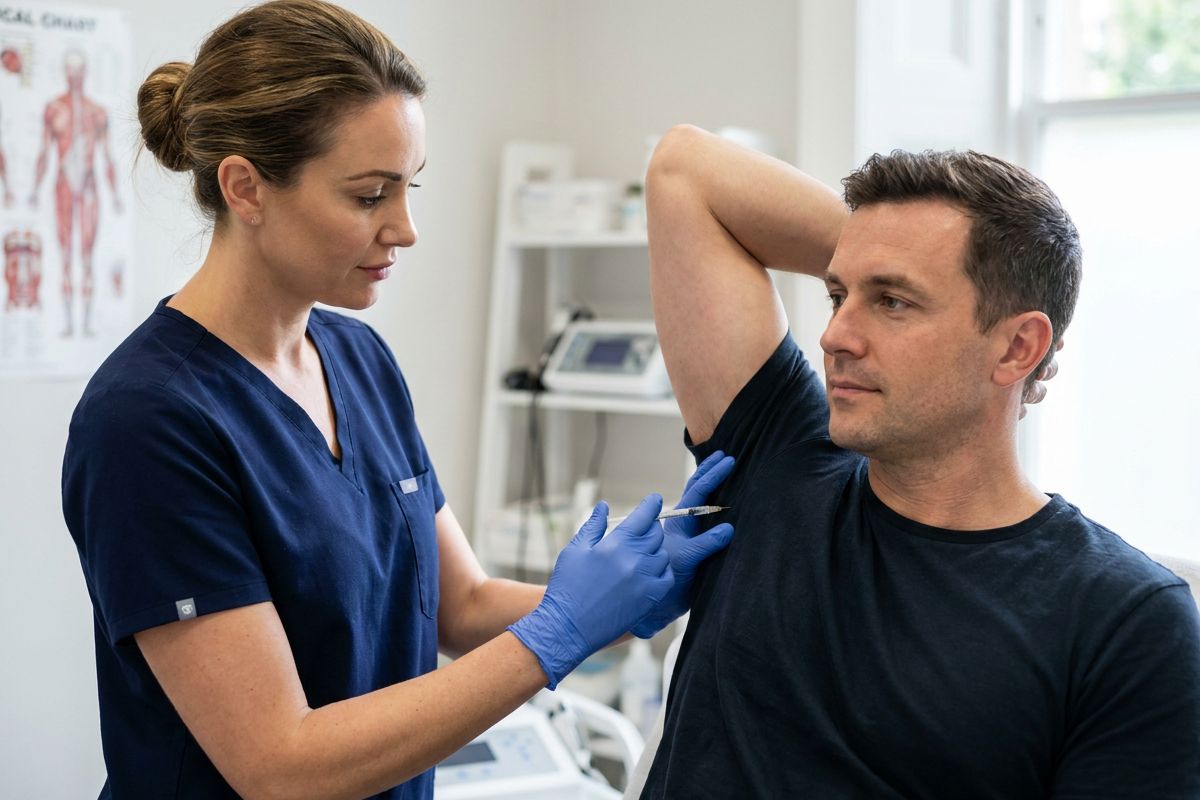
The toxin is injected intradermally in a grid pattern across the treatment zone. In the axilla, this typically means injections spaced roughly one to two centimetres apart across the hair-bearing skin. The depth matters: too superficial and the toxin does not reach the gland; too deep and you lose precision and risk unnecessary spread. This is why the technique should be performed by a clinician with genuine anatomical knowledge, not a practitioner working from a protocol sheet.
Onset is gradual over five to fourteen days. The effect is not permanent, axonal sprouting eventually re-establishes cholinergic transmission, but the duration in the axillae is reliably longer than in facial muscles, typically four to seven months in our clinical experience, and some patients report effect persisting beyond that. Palmar and plantar hyperhidrosis can also be treated, though these sites are more uncomfortable to inject and require careful patient selection and, in some cases, topical anaesthesia.
There is no evidence that blocking sweat glands in a focal area causes compensatory hyperhidrosis elsewhere at a clinically significant level. This concern is raised by patients regularly and is worth addressing directly: the body does not redistribute sweat in a meaningful way following focal Botox treatment. Compensatory sweating is a recognised phenomenon after surgical sympathectomy, which is a far more extensive intervention, it is not a feature of intradermal Botox.
Iontophoresis, topical agents, and where Botox fits in the treatment ladder
A responsible discussion of hyperhidrosis treatment in London, or anywhere, has to acknowledge that Botox is not the first rung on the treatment ladder. The standard sequence for axillary hyperhidrosis begins with aluminium chloride-based antiperspirants at prescription strength (typically 20% aluminium chloride hexahydrate in anhydrous ethanol). These work by physically occluding the sweat duct and, with consistent use, can provide meaningful reduction. The limitation is that they require nightly application to dry skin, can cause irritant dermatitis, and efficacy diminishes over time in moderate-to-severe cases.
Iontophoresis, the use of a low-level direct electrical current passed through water to temporarily block sweat glands, is the established second-line treatment for palmar and plantar hyperhidrosis in particular. It is less practical for the axillae due to the geometry of the treatment area. Iontophoresis requires multiple sessions per week initially, then maintenance sessions, and it demands patient commitment. For motivated patients with palmar sweating, it is a genuinely effective and cost-efficient option that we would discuss before recommending Botox injections to the hands.
Oral anticholinergic medications (such as oxybutynin or glycopyrronium) are used in some cases, particularly where multiple sites are affected simultaneously. The systemic side-effect profile, dry mouth, blurred vision, urinary retention, cognitive effects at higher doses, limits their use, and they are generally more appropriate for patients under specialist dermatological or neurological care. We do not prescribe these at KCC; if a patient's presentation suggests they might benefit, we refer appropriately.
Botox sits clearly as a third-line treatment for axillary hyperhidrosis and is licensed for this indication in the UK. It is appropriate when topical treatments have failed or are not tolerated, and when the severity justifies an injectable approach. Our team, including Dr Anna Peca, who has particular experience with injectable treatments for both aesthetic and functional indications, will always contextualise Botox within this ladder rather than presenting it as the default answer.
For those curious about how botulinum toxin is used in adjacent aesthetic contexts, our post on brow lift versus Botox for forehead lines gives a useful comparative perspective on the drug's range of applications.
The procedure at Kensington Cosmetic Clinic, what actually happens
Your first appointment is a consultation, not a treatment session. We will take a history, examine the affected areas, discuss your previous treatment attempts, and agree whether Botox is appropriate for you at this stage. If you have not tried prescription-strength antiperspirant, we will usually ask you to do so first, not to delay your care, but because it is the right clinical sequence and occasionally sufficient.
When you attend for treatment, the axillary skin is cleaned and, if requested, a topical anaesthetic cream can be applied thirty to forty-five minutes beforehand, though most patients find the axillary injections tolerable without it. A Minor's starch-iodine test, painting iodine solution onto the skin, dusting with starch, and observing the colour change that indicates active sweating, can be used to map the precise treatment zone. We do not always perform this in straightforward cases, but it is a useful tool when the distribution of sweating is asymmetric or atypical.
Injections are placed intradermally using a fine-gauge needle in a systematic grid. The total dose used varies by body surface area and the product used; we will not quote specific units here because the appropriate dose depends on the individual and the product, and quoting numbers out of context can mislead. The procedure takes around twenty to thirty minutes for bilateral axillae. You can return to normal activities immediately, though we ask patients to avoid vigorous exercise, saunas, and hot baths for twenty-four hours.
You can read more about the broader injectable treatments we offer, including the full range of botulinum toxin applications, on our Botox and fillers treatment page. Dr Hassan Soueid oversees the clinical standards for all injectable work at the clinic and is available for consultations where patients want a senior surgical perspective on their options.
Results become apparent over one to two weeks. We recommend a follow-up appointment at four weeks to assess response and, if needed, supplement any areas of incomplete effect. This is standard practice, the grid technique is systematic but individual anatomy means occasional gaps in coverage that are straightforward to address at review.
Who this treatment is not right for
Honesty about patient selection is not a disclaimer, it is part of good clinical practice. Botox for hyperhidrosis is not appropriate for everyone who sweats more than they would like, and we will say so clearly in consultation.
Patients with secondary hyperhidrosis, where an underlying systemic cause has not been identified or addressed, should not proceed to Botox treatment. Masking the symptom while a thyroid disorder or lymphoma goes uninvestigated is not acceptable care. We will refer you back to your GP or to a relevant specialist if the history raises any concern.
Patients who are pregnant or breastfeeding should not receive botulinum toxin, as the safety data in these populations is insufficient to justify elective use. Patients with known neuromuscular junction disorders (myasthenia gravis, Lambert-Eaton syndrome) are contraindicated. Patients on aminoglycoside antibiotics should delay treatment as these potentiate the toxin's effect unpredictably.
Patients with very mild hyperhidrosis, HDSS score of one or two, manageable with standard antiperspirant, are not good candidates at this stage. The cost, the need for repeat treatment every several months, and the small but real risks of the procedure are not justified when a simpler intervention is adequate. We would rather send you away with a prescription recommendation than book you for a treatment you do not need.
Finally, patients who are needle-phobic to a significant degree may find the palmar or plantar injection sites distressing even with topical anaesthesia. Axillary treatment is generally well tolerated, but we will have an honest conversation about this if it is relevant to you.
Costs, longevity, and managing expectations realistically
Hyperhidrosis Botox treatment in London varies considerably in price depending on the clinic, the practitioner's seniority, the product used, and the volume required. We do not publish a single fixed price because the dose, and therefore the cost, varies by individual. What we can say is that axillary treatment at KCC is priced transparently at consultation, with no hidden add-ons. The follow-up review at four weeks is included in the treatment fee.
Longevity in the axillae is generally better than in facial areas. Most patients return for repeat treatment at four to six months, some at seven months or beyond. A small number of patients, perhaps one in ten in our experience, find the duration shorter, particularly in the first treatment cycle; subsequent cycles often last longer as the glandular response appears to diminish with repeated treatment over time, though the evidence for this cumulative effect is observational rather than from controlled trials.
It is worth comparing the annual cost of repeated Botox against the cumulative cost of iontophoresis equipment and consumables if you are treating palmar hyperhidrosis, the economics are not always straightforward. Dr Michail Vourvachis is available for consultations where patients want to think through the longer-term management plan in detail, particularly where multiple sites are affected.
For patients exploring the full range of non-surgical options at our clinic, our post on non-surgical treatments in West London gives a broader sense of how we approach injectable and energy-based treatments. And if you are considering whether skin-quality treatments might complement your care, for instance, addressing post-inflammatory changes in the axillary skin from years of heavy antiperspirant use, our microneedling treatment page is worth reviewing.
We do not offer miraDry (microwave thermolysis) at KCC. It is a permanent treatment for axillary hyperhidrosis with a reasonable evidence base, but it requires specialist equipment and specific training, and we would rather refer patients to an appropriate centre than offer a treatment outside our current provision. Surgical sympathectomy is a last resort for severe, treatment-refractory cases and carries a significant risk of compensatory hyperhidrosis; we do not perform this at KCC and would refer to a thoracic surgeon if it were ever appropriate.
Skin care around the treatment area, what to do between sessions
One aspect of hyperhidrosis management that is often underdiscussed is the condition of the skin itself. Chronic moisture, friction, and years of strong antiperspirant use can leave the axillary skin with post-inflammatory pigmentation, mild folliculitis, or textural changes. These are not cosmetic vanities, they are clinically relevant because compromised skin integrity affects how well topical treatments work and can influence injection technique.
Between Botox sessions, we recommend gentle cleansing with a non-irritant wash, avoiding alcohol-based deodorants on days when the skin is already well controlled by the Botox effect, and using a light non-comedogenic moisturiser if the skin is dry. If pigmentation is a concern, our pigmentation treatment page outlines the options available at the clinic, including topical protocols and light-based treatments that can be sequenced safely with hyperhidrosis management.
Dr Deniz Kanliada has a particular interest in skin health and the intersection of dermatological and aesthetic concerns, and is well placed to advise patients where skin condition and hyperhidrosis management overlap. This is especially relevant for patients who have experienced recurrent folliculitis or skin sensitivity in the treatment area.
Patients sometimes ask whether laser hair removal in the axillae affects hyperhidrosis. The evidence is limited and inconsistent, some patients report modest reduction in sweating following laser treatment, possibly due to thermal damage to superficial glandular structures, but this is not a reliable or predictable effect and we would not recommend laser as a primary hyperhidrosis treatment. If you are considering laser hair removal in the same area, we can sequence treatments appropriately; our post on skin booster injectables in London touches on how we think about treatment sequencing more broadly.
Booking your consultation
If you are based in Kensington, the High Street Kensington area, or anywhere across West London and are living with hyperhidrosis that has not responded adequately to topical treatment, a consultation at Kensington Cosmetic Clinic is a sensible next step. We are at 49 Marloes Road, W8 6LA, a short walk from High Street Kensington and Earl's Court stations, and we see patients from across London and beyond for both initial assessment and ongoing management.
At consultation, we will take a proper history, discuss where you are on the treatment ladder, and give you an honest assessment of whether Botox is the right intervention for you now. If it is not, we will tell you that and point you in the right direction. If it is, we will explain the procedure, the expected results, and the costs clearly before you make any decision.
You can book your consultation online here, or visit our Botox and fillers treatment page for further detail on how we use botulinum toxin across both medical and aesthetic indications. We look forward to helping you find a management plan that actually works.
Frequently asked
Questions we get asked about EnerPeel®
- Is Botox for hyperhidrosis available on the NHS?
- Botulinum toxin for axillary hyperhidrosis is available on the NHS in some areas, but access is inconsistent and often requires documented failure of topical treatments first. Many patients find NHS waiting times prohibitive and choose to access treatment privately. At KCC we see patients from across London who have either been declined NHS treatment or prefer not to wait.
- How many injections are involved and how painful is it?
- In the axillae, injections are placed in a grid pattern roughly one to two centimetres apart across the hair-bearing skin, typically fifteen to twenty injection points per side. Most patients find this tolerable without anaesthesia, describing a mild stinging sensation. Topical anaesthetic cream is available on request if you are concerned. Palmar and plantar treatment is more uncomfortable and we routinely offer topical anaesthesia for those sites.
- Can I have Botox for sweating on my hands and feet, not just my underarms?
- Yes, palmar and plantar hyperhidrosis can be treated with Botox, though these sites are more challenging. The skin is thicker, the injections are more uncomfortable, and the duration of effect can be shorter than in the axillae. We will discuss whether iontophoresis might be a better first option for palmar sweating, as it has a strong evidence base and avoids the discomfort of multiple hand injections.
- Will blocking sweat glands in one area cause more sweating elsewhere?
- This is a common concern and worth addressing directly. Compensatory hyperhidrosis, increased sweating at untreated sites, is a well-documented complication of surgical sympathectomy, which disrupts the sympathetic chain over a wide area. It is not a recognised feature of focal intradermal Botox treatment. The localised block produced by Botox does not cause the body to redistribute sweat in a clinically significant way.
- How soon before an important event should I have the treatment?
- Allow at least two weeks before any significant event, ideally three. The effect begins within five to seven days but reaches its full extent at around ten to fourteen days. Having the treatment too close to a wedding, presentation, or similar occasion risks attending before the full benefit is apparent. We also recommend a four-week review appointment, so booking six weeks before an important date gives us time to address any areas of incomplete coverage.