

Skin · 11 min read
Profhilo London: The Skin-Quality Injectable That Isn't a Filler
By Dr Hassan Soueid · MD, FRCS · Lead Surgeon, Kensington Cosmetic Clinic
Published 25 May 2026
TL;DR - Profhilo is not a dermal filler and should not be marketed as one. It is a high-concentration, thermally stabilised hyaluronic acid product that spreads through the dermis to stimulate collagen and elastin production, improving skin quality, hydration, and laxity rather than adding structural volume. Two sessions, four weeks apart, form the standard protocol; results typically become visible six to eight weeks after the second session and last around six months. It suits patients who notice dullness, fine crepiness, or early laxity but do not yet want, or need, a surgical solution.
What Profhilo actually is, and why it differs from conventional fillers
The confusion between Profhilo and conventional dermal fillers is understandable. Both are injected, both contain hyaluronic acid (HA), and both are administered in a clinic setting. The similarity more or less ends there. A conventional filler is a cross-linked HA gel engineered to stay in place, to fill a nasolabial fold, project a cheekbone, or define a lip border. Profhilo, by contrast, is a hybrid cooperative complex of high- and low-molecular-weight HA that is only lightly stabilised. It is designed to flow and spread through the dermis rather than sit in one spot.
That spreading behaviour is the point. Once injected, Profhilo disperses across a wide tissue plane, releasing HA slowly and stimulating four types of collagen (I, III, IV, and VII) as well as elastin. The mechanism is bioremodelling: you are not replacing lost volume, you are prompting the skin itself to behave more like younger skin. Patients who have had both treatments often describe the result of Profhilo as their skin looking more like itself, clearer, plumper in texture, more even in tone, rather than looking like something has been added.
The product is manufactured by IBSA and is licensed in the UK. It contains 64 mg of HA per 2 ml syringe, which is a notably high concentration compared with most skin-booster products. Because it is not a volumiser, it is injected at specific anatomical points, five on each side of the face in the standard BAP (Bio Aesthetic Points) technique, rather than along the length of a fold or contour. Each injection point acts as a depot from which the product diffuses outward.
We also use Profhilo on the neck, décolletage, and hands, where skin thinning and crepiness are often the primary concern and where adding structural volume would look unnatural. In those areas especially, the distinction from filler matters clinically. You are not trying to make the back of a hand look fuller; you are trying to make the skin sitting over it look more hydrated and resilient.
If you are considering Profhilo alongside other non-surgical skin treatments, it is worth reading our broader overview of non-surgical facelift options in West London to understand where it sits within a wider treatment hierarchy.
How the treatment works in practice: the BAP protocol and what to expect on the day
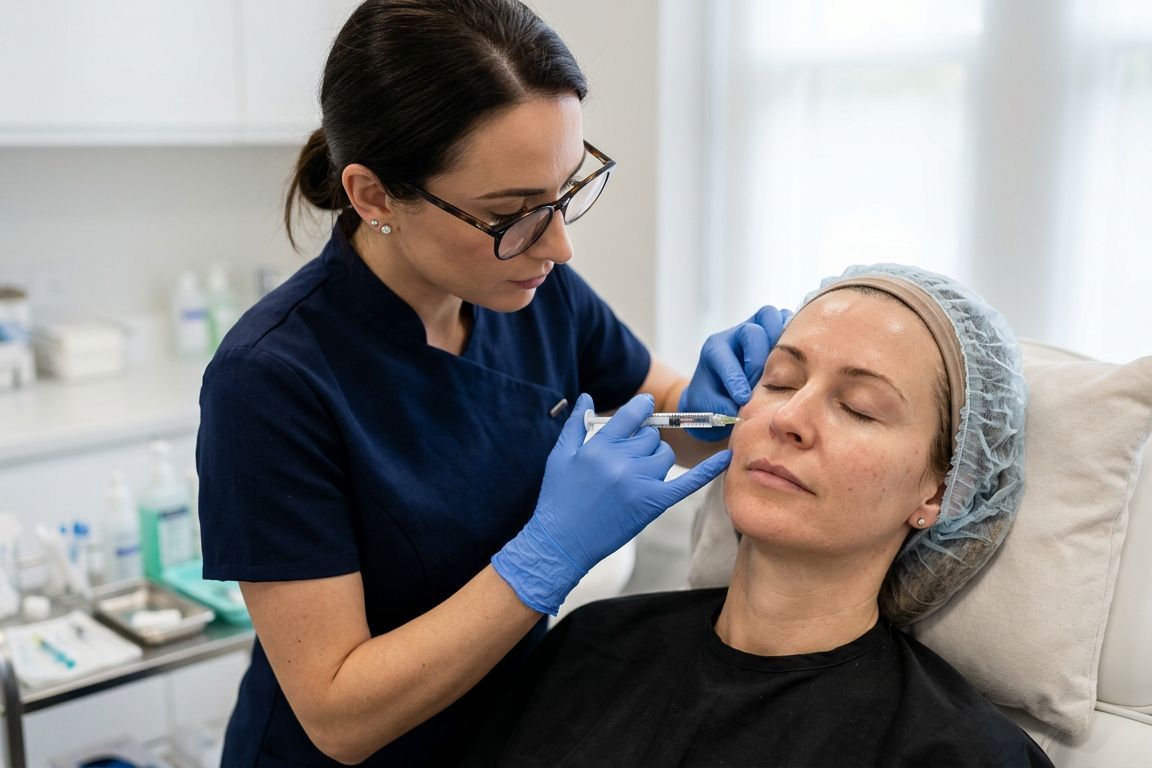
When you come to our clinic on Marloes Road in Kensington for a Profhilo session, the appointment itself is brief, typically 20 to 30 minutes including a pre-treatment skin assessment. We do not routinely apply topical anaesthetic for Profhilo because the injections are shallow, the needle is fine, and most patients find the discomfort minimal. If you are particularly needle-sensitive, a topical cream can be applied 30 minutes beforehand.
The BAP technique places five injection points on each side of the face. The precise locations, lateral cheek, zygoma, pre-auricular area, and two mandibular points, are chosen to correspond with areas of ligamentous attachment where the product can diffuse most effectively across the mid and lower face. The injections are intradermal to superficial subcutaneous; they are not placed deeply. Each point receives a small bolus of product, and you may notice a small raised wheal at each site immediately afterwards, which settles within a few hours.
Post-treatment, we advise avoiding heavy exercise, saunas, and direct sun exposure for 24 hours. There is no requirement to massage the product, unlike some fillers, because the spreading is part of its design. Bruising is possible but less common than with conventional filler injections because we are not injecting into vascular-rich planes. Mild swelling at the injection points for 12 to 24 hours is normal.
The standard course is two sessions, four weeks apart. Some patients with more significant skin laxity or those in their late fifties and beyond benefit from a third session. After the initial course, a single maintenance session every six months is usually sufficient to sustain the bioremodelling effect. We will not recommend more frequent treatment than is clinically justified, the evidence base supports a twice-yearly maintenance model, and exceeding that does not appear to produce proportionally better outcomes.
Our practitioners who administer Profhilo at the clinic include Dr Anna Peca, whose focus on non-surgical skin quality treatments means she is well placed to advise on whether Profhilo alone is appropriate or whether it should be combined with other modalities.
Profhilo vs filler: choosing the right tool for the right problem
The question we hear most often in consultations is some version of: should I have Profhilo or fillers? The honest answer is that they address different problems, and for many patients the answer is both, but sequenced and targeted correctly.
Profhilo vs filler is not a competition. Fillers are the right choice when there is a specific structural deficit: a hollow under the eye, a deflated cheek, a lip that has lost definition, a chin that lacks projection. Profhilo is the right choice when the primary complaint is about skin quality, dullness, fine lines from dehydration, early crepiness, loss of the skin's natural bounce. If a patient has both problems (which is common in the mid-forties and beyond), a combined approach often makes more sense than choosing one over the other.
Where patients sometimes go wrong is in using filler to compensate for poor skin quality. Adding volume to a face with thin, dehydrated skin can look heavy or unnatural because the skin itself is not able to drape well over the added structure. In those cases, improving the skin first, with Profhilo, or with a combination of Profhilo and our microneedling protocol, often produces a more natural result than going straight to volumisation.
Conversely, Profhilo will not restore cheekbone projection or correct a deep nasolabial fold. Patients who come in hoping it will lift significantly or replace lost volume will be disappointed, and we will tell them that clearly in consultation. The product does have a mild lifting effect in the mid-face, partly from the hydration and partly from the collagen stimulation, but it is not a substitute for a well-placed filler or, in more advanced cases, for surgical intervention.
For patients exploring the surgical end of the spectrum, our post on SMAS vs deep-plane facelift explains the structural options available when non-surgical treatments are no longer sufficient. Profhilo and surgery are not mutually exclusive, many patients use skin-booster treatments to maintain skin quality between surgical procedures or in the years before surgery becomes appropriate.
Dr Michail Vourvachis regularly sees patients at our Kensington clinic who are weighing non-surgical options against longer-term surgical planning, and his approach is to map out a realistic treatment pathway rather than push any single modality.
Who is a good candidate, and who this isn't right for
Profhilo works best in patients who have noticed a change in their skin's texture, hydration, or elasticity but whose underlying facial structure is still broadly intact. The sweet spot tends to be the late thirties to mid-fifties, though we treat patients outside that range when the clinical picture supports it. Younger patients with good skin who are simply looking for a glow or a preventive treatment can benefit, as can older patients who want to improve skin quality ahead of or alongside other treatments.
The treatment is particularly well suited to:
- Patients with fine, crepey skin on the face, neck, or décolletage
- Those who find their skin looks dull or dehydrated despite good skincare
- Patients who want a natural result with no risk of looking overdone
- Those who are not ready for fillers but want to do something evidence-based
- Patients maintaining results between surgical procedures
It is not the right treatment for patients whose primary concern is volume loss, deep folds, or significant facial laxity. If you are looking at jowling, a heavy nasolabial fold, or a deflated mid-face, Profhilo alone will not address those issues meaningfully. We will say so, and we will discuss what would actually help, whether that is filler, a procedure such as Endolift for mild-to-moderate laxity, or a surgical consultation.
Profhilo is also not appropriate during pregnancy or breastfeeding, in patients with active skin infections or inflammatory conditions at the treatment site, or in those with a known hypersensitivity to hyaluronic acid. Patients on anticoagulant medication should discuss their regimen with us before booking, as bruising risk is higher.
We do not treat patients who are seeking Profhilo primarily because they have seen it heavily promoted on social media and want to try it without a clinical rationale. A consultation always comes first. If Profhilo is not the right answer for your skin, we will tell you what is.
Combining Profhilo with other treatments: what works and what to avoid
Profhilo sits well within a broader skin-quality programme, and for many patients it is most effective when combined thoughtfully with other treatments. The key principle is sequencing: some combinations work well simultaneously, others should be staged.
Profhilo and microneedling are a logical pairing. Microneedling creates controlled micro-injury that stimulates collagen independently, and the two treatments have complementary mechanisms. We typically recommend completing the Profhilo course first, allowing the bioremodelling to establish, and then introducing microneedling in the maintenance phase. Running both simultaneously is possible but can make it harder to assess which treatment is driving which result, which matters if we need to adjust your programme.
Profhilo and PRP (platelet-rich plasma) treatment is another combination we use, particularly in patients with more significant skin thinning or those recovering from the effects of sun damage. PRP introduces growth factors from the patient's own blood; combined with the HA matrix that Profhilo creates, the environment for fibroblast activity is notably enhanced. We space these treatments by at least two weeks to allow each to work without competing for the same tissue response.
Profhilo and botulinum toxin can be administered on the same day in most patients, provided the injection sites do not overlap significantly. Botulinum toxin addresses dynamic lines driven by muscle movement; Profhilo addresses the skin quality sitting over those muscles. They are not redundant, they are complementary, and combining them in a single appointment is efficient and clinically sensible for the right patient.
What we avoid is combining Profhilo with ablative laser resurfacing or aggressive chemical peels in the same session. Both create a degree of epidermal disruption, and introducing an injectable into already-compromised skin increases infection risk and makes the inflammatory response harder to manage. We stage these treatments with a minimum gap of two weeks, usually longer.
Dr Hassan Soueid oversees the clinic's approach to combination treatment planning, and his view, shared across the team, is that the most effective programmes are the ones that are built around a clear understanding of what each treatment does rather than stacking procedures for the sake of it. If you are considering Profhilo as part of a wider skin programme, the consultation is where that plan takes shape.
For patients also interested in how skin-quality treatments interact with surgical planning, our article on brow lift versus botox for forehead lines offers a useful parallel discussion about matching the right intervention to the right problem.
Costs, realistic expectations, and what we see at our London clinic
We are based at 49 Marloes Road, W8 6LA, a short walk from High Street Kensington station and convenient for patients coming from Earl's Court, Notting Hill, Chelsea, and across central London. The clinic is not a high-street aesthetic chain, and our pricing reflects the clinical standard we maintain rather than a promotional model.
A single Profhilo session in London at a reputable medical clinic typically falls in the range of £350 to £500 per session; the standard two-session course therefore runs between £700 and £1,000. We will confirm exact pricing at consultation. We do not offer package deals that pressure patients into committing to more sessions than they need, and we do not run promotional discounts that compromise the quality of product or practitioner time.
In terms of what you can realistically expect: most patients notice improved skin hydration and a subtle improvement in texture within two to three weeks of the first session. The more significant collagen and elastin remodelling takes longer, the full result of the initial course is usually visible six to eight weeks after the second injection. The effect is not dramatic in the way that a filler result can be; it is cumulative and natural-looking. Patients often report that colleagues or friends comment that they look well or rested rather than identifying a specific treatment.
Results last approximately six months in most patients, though this varies with age, skin condition, lifestyle factors (sun exposure, smoking, hydration), and how well the skin responded to the initial course. Patients who maintain six-monthly sessions consistently tend to see a progressive improvement in baseline skin quality over time, not just a temporary boost.
We see patients from across London and beyond at our Kensington clinic, and a consistent observation from our practitioners is that patients who combine Profhilo with a good topical skincare routine, particularly SPF use and a retinoid, sustain results significantly better than those who treat injectables as a standalone solution. We will always discuss skincare as part of the consultation, because the injectable and the daily routine should be working in the same direction.
Dr Deniz Kanliada brings particular expertise in skin-quality assessment and injectable treatments, and her consultations routinely include a review of the patient's current skincare alongside the treatment plan itself.
Booking your consultation
If you are considering Profhilo, whether as a standalone treatment or as part of a broader skin programme, the right starting point is a face-to-face consultation. We do not administer Profhilo without one, because the treatment needs to be appropriate for your skin, your concerns, and your overall facial anatomy. A photograph or a phone call is not a substitute for a proper clinical assessment.
You can book your consultation online at any time, or call the clinic directly. We are at 49 Marloes Road, London W8 6LA, a short walk from High Street Kensington. Our team will match you with the practitioner best suited to your concerns. If Profhilo is the right answer, we will explain exactly how we would approach your treatment. If something else would serve you better, we will tell you that too.
For a full overview of the injectable and non-surgical treatments available at the clinic, visit our botox and fillers treatment page or explore the PRP treatment page if you are interested in combining approaches. We look forward to seeing you.
Frequently asked
Questions we get asked about EnerPeel®
- Is Profhilo the same as a skin booster like Restylane Skinboosters or Juvederm Hydrate?
- They are related but not identical. All three are hyaluronic acid injectables designed to improve skin hydration and quality rather than add structural volume. Profhilo is distinguished by its unusually high HA concentration (64 mg per 2 ml) and its hybrid molecular structure, which allows it to spread more widely through the dermis and stimulate a broader collagen and elastin response. Conventional skin boosters tend to stay closer to the injection point. The clinical outcomes overlap, but Profhilo's bioremodelling effect is generally considered more pronounced.
- How many sessions of Profhilo do I need?
- The standard initial course is two sessions, spaced four weeks apart. Some patients with more advanced skin laxity or thinning benefit from a third session in the initial course. After that, a single maintenance session every six months is the evidence-supported model. We will not recommend more frequent treatment than your skin actually needs, and we will reassess at each visit rather than assuming the same programme suits you indefinitely.
- Can Profhilo be used on the neck and hands, not just the face?
- Yes, and it is often particularly effective in those areas. The neck and décolletage are common sites of crepiness and skin thinning where adding structural volume would look unnatural; Profhilo's skin-quality improvement without volumisation makes it well suited here. The hands are another area where patients notice early skin ageing and where Profhilo can restore a more hydrated, resilient appearance. The injection technique is adapted for each area, and the BAP facial protocol is not used verbatim on the neck or hands.
- Is there any downtime after Profhilo?
- Downtime is minimal. You may have small raised wheals at the injection points for a few hours, and mild swelling or occasional bruising is possible for 24 to 48 hours. Most patients return to normal activities the same day. We advise avoiding strenuous exercise, saunas, and prolonged sun exposure for 24 hours post-treatment. There is no requirement to take time off work for a standard Profhilo session.
- Will I look noticeably different immediately after Profhilo?
- Not dramatically. The immediate post-treatment appearance is largely unchanged apart from the temporary injection-point wheals. The hydration improvement becomes noticeable over the first two to three weeks, and the full collagen and elastin remodelling effect develops over six to eight weeks after the second session. The result is gradual and natural-looking, most patients report that others notice they look well rather than identifying a specific treatment. If you are looking for an immediate, visible change, Profhilo is not the right product; a filler or a different modality would be more appropriate.