

Surgical · 11 min read
Otoplasty London: When Ear-Pinning Surgery Makes Sense
By Dr Hassan Soueid · MD, FRCS · Lead Surgeon, Kensington Cosmetic Clinic
Published 25 May 2026
TL;DR - Otoplasty (ear-pinning or pinnaplasty) is a well-established surgical procedure that repositions or reshapes prominent ears, and it can be performed safely in children from around five or six years of age as well as in adults at any stage of life. The surgery is carried out under general anaesthetic in children and usually under local anaesthetic with sedation in adults, with most patients returning to normal activity within two weeks. Results are permanent in the vast majority of cases, though no surgeon can guarantee perfect symmetry. If you are considering otoplasty in London for yourself or your child, this article sets out the clinical reasoning behind timing, technique, and candidacy so you can make an informed decision before booking a consultation.
What otoplasty actually corrects, and what it does not
Ear correction surgery is most commonly sought for ears that protrude more than roughly 2 cm from the side of the head, a condition caused by one or both of two anatomical features: an underdeveloped antihelical fold (the inner ridge of cartilage that normally creates the ear's contoured shape) or an overly deep conchal bowl (the central cup of the ear). Either or both can push the ear forward and outward. Otoplasty addresses these structural issues directly, it does not simply pin the skin back, it reshapes and repositions the cartilage itself.
What the procedure does not correct is worth stating clearly. Otoplasty will not change the size of the ear lobe in any meaningful way unless a specific lobuloplasty is added. It will not move the ear higher or lower on the skull, nor will it correct microtia (a congenital condition in which the ear is severely underdeveloped or absent), that requires a separate and considerably more complex reconstructive programme. If your concern is primarily about ear lobe size or shape, or about asymmetry caused by trauma, those are distinct conversations requiring their own assessment.
Prominent ears are also not a medical problem. They cause no hearing impairment and carry no health risk. The decision to operate is therefore driven entirely by the patient's (or, in children, the family's) assessment of psychological impact. We take that seriously, research consistently shows that children with prominent ears can face social teasing, and adults sometimes report that the feature has affected their confidence for decades. But we also do not overstate the psychological benefit of surgery, because that benefit depends heavily on the individual's expectations going in.
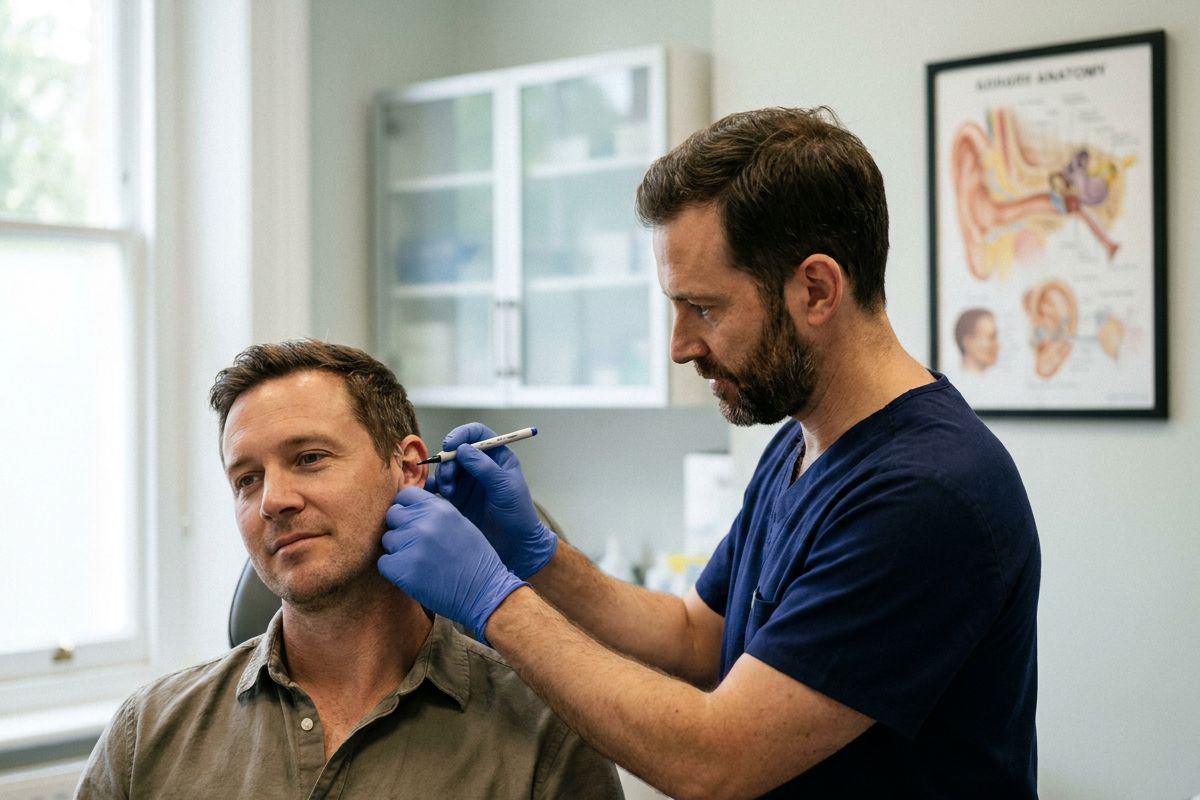
During your consultation with Dr Hassan Soueid at our Kensington clinic, we will examine the cartilage structure carefully, take standardised photographs, and discuss precisely which anatomical features are contributing to the appearance. That assessment shapes the surgical plan, there is no single technique that suits every ear.
The right age for child otoplasty, clinical reasoning, not convention
The question of child otoplasty age is one of the most common things parents ask us. The short answer is that most surgeons, ourselves included, will not operate before the age of five, and many prefer to wait until six. The reason is developmental: the ear reaches approximately 85–90% of its adult size by age five or six, and operating before that point risks interfering with cartilage growth. Waiting until this developmental milestone is reached means the surgical result is stable and long-lasting.
There is a second reason for the lower age limit that is less often discussed: consent and cooperation. A child old enough to understand what is happening, to participate in the decision, and to follow post-operative instructions (particularly keeping the head bandage on and not touching the ears) will have a better experience and outcome than a very young child who cannot. We always speak directly with the child during the consultation, not only with the parents. If the child does not want the surgery, if it is entirely the parents' wish, we will not proceed.
At the upper end, there is no upper age limit. Adults in their fifties, sixties, and beyond can have otoplasty with excellent results. Cartilage does become slightly stiffer with age, which occasionally requires a different suturing technique, but this is a minor technical consideration rather than a contraindication. We have operated on adults who have lived with prominent ears for forty or fifty years and who, for various reasons, felt the time was finally right.
One nuance worth noting: if a teenager is requesting surgery primarily because of peer pressure or a recent social incident rather than a long-standing personal concern, we will usually suggest waiting and returning after a period of reflection. The decision should be stable and self-motivated, not reactive.
How pinnaplasty is performed, technique and anaesthesia
The term pinnaplasty is used interchangeably with otoplasty in UK practice. The procedure typically takes between 60 and 90 minutes for both ears. In children, we use general anaesthesia, there is simply no benefit to asking a child to lie still under local anaesthetic for that duration. In adults, the procedure is usually performed under local anaesthetic with intravenous sedation, which means you are relaxed and comfortable but breathing independently and recoverable quickly.
The incision is made in the natural crease behind the ear, keeping it entirely hidden. Through this access, the cartilage is exposed and reshaped using one of two main approaches, or a combination of both. The Mustardé technique uses permanent mattress sutures to fold the antihelical fold into a more natural position. The Furnas technique reduces the depth of the conchal bowl by suturing it closer to the mastoid fascia (the tissue behind the ear). In practice, most ears require elements of both. Occasionally a small amount of cartilage is scored or excised to allow it to bend more readily, but we are conservative with cartilage removal because overcorrection, ears that are pulled too far back and look pinned or unnatural, is one of the most common complaints following otoplasty performed elsewhere.
Our surgical team, including Mr Ali Ghanem, approaches the cartilage with the goal of creating a result that looks like the ear was always that shape, not operated upon. The antihelical fold should have a smooth, natural curve; the ear should sit at roughly 15–20 degrees from the skull. Achieving that requires intraoperative assessment with the patient sitting up (where possible) to check symmetry before closing.
The wound is closed with absorbable sutures and covered with a soft dressing and a head bandage that holds the ears in their new position while initial healing occurs. This bandage stays on for approximately one week, after which it is replaced with a lighter sports-style headband worn at night for a further four to six weeks.
Recovery, risks, and what to realistically expect
Most adult patients feel well enough to return to desk-based work within seven to ten days. Children are usually back at school within two weeks, though we ask schools to be aware that contact sport and rough play must be avoided for six weeks. The ears will be swollen and bruised for the first two to three weeks, and the final shape is not fully apparent until swelling has resolved, this typically takes six to eight weeks, though subtle changes can continue for up to six months.
The risks specific to otoplasty include haematoma (a collection of blood under the skin, occurring in roughly 2–3% of cases), infection, suture extrusion (where a permanent suture gradually works its way to the surface), and asymmetry. Asymmetry is the most common source of dissatisfaction, human ears are rarely perfectly symmetrical before surgery, and surgery does not guarantee perfect symmetry afterwards. We discuss this explicitly in every consultation and document pre-existing asymmetry in photographs. Recurrence, where the ear gradually returns toward its original position, can occur if sutures loosen, and is more common in patients who remove their night-time headband too early.
Keloid or hypertrophic scarring behind the ear is uncommon but possible, particularly in patients with a personal or family history of raised scarring. If you know you scar badly, tell us at consultation, it does not necessarily preclude surgery, but it changes the post-operative scar management plan. For patients interested in how non-surgical skin treatments can support scar healing, our microneedling programme is sometimes used in the months after surgery to improve scar texture, though this is adjunctive rather than essential.
Serious complications, nerve damage affecting ear sensation, cartilage necrosis, are rare in experienced hands. Temporary numbness around the ear is common and usually resolves within a few months.
Who otoplasty is not right for
Honest candidacy assessment is something we consider a clinical obligation, not a sales obstacle. There are patients for whom we will not recommend ear correction surgery, and it is worth being explicit about who they are.
Children under five should not be operated on for the developmental reasons described above. Children who do not themselves want the surgery should not be operated on regardless of parental wishes. Patients with active skin infection around the ear, or those with a history of keloid scarring in the ear region, require careful individual assessment before a decision is made.
Adults who have unrealistic expectations, who believe that changing their ears will resolve broader issues of self-esteem or social anxiety, are better served by a conversation with a psychologist before any surgical consultation. We are not dismissing the psychological impact of prominent ears; we are acknowledging that surgery addresses the ear, not the underlying emotional architecture. If the two are thoroughly entangled, addressing only the ear is unlikely to be sufficient.
Patients who are medically unfit for anaesthesia, or who are taking anticoagulant medication that cannot be safely paused, will need medical clearance and liaison with their GP or specialist before we can proceed. This is standard pre-operative practice for any surgical procedure, not unique to otoplasty.
If you have had a previous otoplasty elsewhere and are unhappy with the result, revision surgery is possible but technically more demanding, scar tissue changes the tissue planes and the cartilage may have been altered in ways that limit what can be achieved. We are happy to assess revision cases, but we will always give you an honest opinion about what is and is not achievable before committing to a revision plan. For context, the same principle of careful pre-operative assessment applies to other facial procedures we perform, such as our rhinoplasty programme, where revision cases require equally careful planning.
Otoplasty in context, how it fits with other facial surgery
Otoplasty is occasionally performed alongside other facial procedures, though this is more common in adults than children. The most frequent combination we see is otoplasty with rhinoplasty, patients who are conscious of both their ears and their nose sometimes prefer to address both under a single anaesthetic rather than undergo two separate recoveries. This is a reasonable approach provided the surgical plan for each procedure is independent and not compromised by the combination. Our article on rhinoplasty costs and recovery in London covers the nasal surgery side of that equation in detail.
In older adults, prominent ears can become more noticeable as the face changes with age, the ears, unlike most facial structures, do not lose volume or descend significantly, so they can appear proportionally more prominent as the cheeks hollow and the jaw softens. Some patients in their forties and fifties combine otoplasty with a facelift. If you are considering facial rejuvenation alongside ear correction, our team can discuss how these procedures interact. The surgical considerations around facelift technique, including the differences between approaches, are covered in our post on SMAS versus deep-plane facelift.
We also occasionally see patients who want ear correction as part of a broader confidence-related journey that includes body contouring. While otoplasty and body procedures are rarely performed simultaneously, understanding the full picture of what a patient hopes to achieve helps us sequence treatments sensibly. Dr Riaz Agha is available for consultations where patients wish to discuss a broader surgical plan alongside their ear correction.
For patients who are not yet ready for surgery but want to understand the landscape of facial aesthetic options available at our W8 clinic, our botox and fillers page outlines the non-surgical treatments we offer, none of which correct prominent ears, but which may address other facial concerns in the meantime.
What otoplasty costs and how to approach the financial decision
Ear correction surgery UK pricing varies considerably depending on the surgeon's experience, the facility, and whether one or both ears are being treated. At Kensington Cosmetic Clinic, we provide a full written quote following your consultation, we do not publish a single price online because the surgical plan (and therefore the theatre time and anaesthetic requirements) differs between patients. What we can say is that the quote you receive will be all-inclusive: surgeon's fee, anaesthetist, facility, and all follow-up appointments are included. There are no surprise invoices after the fact.
We do not offer finance arrangements that incentivise patients to proceed with surgery they are uncertain about. If cost is a significant consideration, we would rather you take time to save and return when you are financially comfortable than feel pressured into a decision. Surgery should never be a financial stretch that creates stress, that stress affects recovery.
For children, it is worth noting that otoplasty is occasionally available on the NHS where there is documented evidence of significant psychological harm, though waiting times are long and eligibility criteria are strict. We are a private clinic and cannot facilitate NHS referrals, but we can provide a thorough clinical letter for your GP if you wish to explore that route first.
Our clinic is located at 49 Marloes Road, Kensington, London W8 6LA, easily accessible from High Street Kensington and Earl's Court underground stations, which places us within straightforward reach of patients across central and west London as well as those travelling from further afield. We see patients from across the UK and internationally for surgical consultations, and we are experienced in planning care for those who need to travel.
Booking your consultation
If you are considering otoplasty, whether for yourself or your child, the right starting point is a detailed surgical consultation, not a quote call. During that consultation, we examine the ear structure, discuss your goals honestly, and tell you clearly whether surgery is likely to achieve them. We will also tell you if we think it is not the right time, or if you are not the right candidate.
You can book a consultation online at Kensington Cosmetic Clinic, or call us directly. Consultations for otoplasty are carried out by Dr Hassan Soueid, our lead plastic surgeon, at our Kensington clinic. For patients who would like to read more about what our surgical programme involves before booking, our rhinoplasty treatment page gives a sense of the level of clinical detail we bring to all facial surgical consultations, the same rigour applies to ear correction. We look forward to meeting you.
Frequently asked
Questions we get asked about EnerPeel®
- At what age can my child have otoplasty?
- Most surgeons, ourselves included, will not operate before the age of five, when the ear has reached approximately 85–90% of its adult size. We also require that the child themselves wants the surgery, if the wish is entirely the parents', we will not proceed. There is no upper age limit; adults of any age can have the procedure.
- Will the results of otoplasty be permanent?
- In the vast majority of cases, yes. The cartilage is permanently reshaped and sutured in its new position. Recurrence, where the ear gradually moves back, can occur if permanent sutures loosen, which is why we ask patients to wear a protective headband at night for four to six weeks after surgery. Following post-operative instructions significantly reduces this risk.
- How visible is the scar after ear-pinning surgery?
- The incision is placed in the natural crease directly behind the ear, where it is hidden by the ear itself when viewed from the front or side. Most patients find the scar fades to a fine, pale line within six to twelve months. Patients with a known tendency to keloid or hypertrophic scarring should discuss this at consultation, as it may influence post-operative scar management.
- Can otoplasty be performed under local anaesthetic?
- In adults, yes, we routinely perform otoplasty under local anaesthetic with intravenous sedation, which allows for a faster recovery and avoids the risks associated with general anaesthesia. In children, general anaesthesia is used because asking a child to remain still and cooperative for 60–90 minutes under local anaesthetic is neither safe nor appropriate.
- Is otoplasty available on the NHS?
- NHS otoplasty for children is available in some circumstances where there is documented evidence of significant psychological harm, but eligibility criteria are strict and waiting times are long. We are a private clinic and cannot facilitate NHS referrals, but we can provide a detailed clinical letter for your GP if you wish to explore that route. Adults are very rarely eligible for NHS funding for otoplasty.