

Surgical · 11 min read
Abdominoplasty After Pregnancy: What a Tummy Tuck Can and Cannot Fix
By Dr Hassan Soueid · MD, FRCS · Lead Surgeon, Kensington Cosmetic Clinic
Published 25 May 2026
TL;DR - Pregnancy can permanently stretch the abdominal skin, separate the rectus muscles, and deposit fat that resists diet and exercise. A tummy tuck (abdominoplasty) addresses all three of those structural changes, but it cannot replace weight loss, does not improve skin quality above the navel in a mini procedure, and should not be planned until you have finished having children. At Kensington Cosmetic Clinic we assess each patient individually, and we will not recommend surgery until the timing and the anatomy are genuinely right for you.
Why pregnancy changes the abdomen in ways exercise cannot reverse
During pregnancy the abdominal wall undergoes mechanical loading that no post-natal Pilates programme can fully undo. The two rectus abdominis muscles, which run vertically down the centre of the abdomen, are held together by a fibrous midline structure called the linea alba. As the uterus expands, this structure stretches, sometimes irreversibly, producing a gap known as diastasis recti. The result is a characteristic forward bulge at the midline, often described as a "mummy tummy", that persists regardless of how lean or strong the patient becomes.
At the same time, the overlying skin is stretched beyond its elastic limit. Collagen and elastin fibres fracture, leaving striae (stretch marks) and a degree of laxity that no topical treatment or non-surgical device can meaningfully tighten once it is established. Subcutaneous fat redistribution compounds the picture: the lower abdomen and flanks tend to accumulate adipose tissue that is metabolically resistant, partly because of the hormonal environment of pregnancy and the postpartum period.
Understanding this anatomy matters because it explains why the surgical correction has to address three distinct layers, skin, fat, and muscle fascia, and why doing only one of those things rarely produces a satisfying result. A patient who has liposuction alone on a lax abdomen may end up with more visible skin redundancy than before. Equally, a skin excision without fascial repair leaves the underlying bulge untouched.
This is not a criticism of non-surgical options; it is simply an honest account of their limits. We do offer a range of non-invasive body treatments at our clinic, and for patients with mild laxity and good skin quality they can be worthwhile. But for the structural changes that follow multiple pregnancies or a single pregnancy with significant distension, surgery is usually the only reliable answer.
What a tummy tuck in London actually involves, full versus mini abdominoplasty
The term "tummy tuck" covers a spectrum of procedures, and the distinction between a full abdominoplasty and a mini abdominoplasty is clinically meaningful, not just a marketing label. Choosing the wrong variant is one of the most common sources of patient dissatisfaction in post-pregnancy body surgery.
A full abdominoplasty involves a hip-to-hip incision placed low in the bikini line, elevation of the entire abdominal skin flap up to the costal margin, repair of the diastasis recti through the full length of the linea alba, excision of redundant skin and fat from the lower abdomen, and repositioning of the umbilicus through a new opening in the tightened flap. It addresses laxity both above and below the navel and is the appropriate choice for most post-pregnancy patients with significant skin redundancy or diastasis extending into the upper abdomen.
A mini abdominoplasty uses a shorter incision, does not reposition the navel, and corrects laxity only below the umbilicus. It is suitable for a narrower group: patients who have mild lower abdominal skin excess, good upper abdominal tone, and a diastasis confined to the lower segment. If a patient with upper abdominal laxity has a mini procedure, the upper skin will remain loose and may actually appear more prominent once the lower abdomen is tightened. We are candid about this in consultation.
Many patients also benefit from combining abdominoplasty with liposuction of the flanks, hips, or lateral thighs to contour the transition zones that the tummy tuck itself does not address. This is not always appropriate, blood supply to the elevated flap must be respected, but in carefully selected patients it produces a more harmonious result than the tummy tuck alone. Our approach to combined procedures is discussed at length during your surgical consultation with Dr Hassan Soueid.
For patients with more extensive concerns across the trunk and thighs, our full body makeover programme allows multiple procedures to be staged or combined under a single anaesthetic plan, reducing overall recovery time and surgical risk compared with multiple separate operations.
Who is a good candidate, and who should wait
Timing and patient selection matter more in abdominoplasty than in almost any other elective procedure. The single most important question is: have you finished having children? Abdominoplasty repairs the fascial layer and removes skin that cannot be re-stretched without undoing the surgical result. A subsequent pregnancy after a tummy tuck is not dangerous, but it will compromise the outcome significantly and may necessitate revision surgery. We ask every patient this question directly, and we will not proceed if the answer is uncertain.
Beyond family planning, we look for the following before recommending surgery:
- A stable weight for at least six months, ideally twelve. Significant weight fluctuation after surgery will stretch the repaired tissues.
- A BMI that places the patient in a range where surgical risk is acceptable and the result is likely to be durable. We do not apply a rigid BMI cut-off, but we do have an honest conversation about how excess weight affects both safety and outcome.
- Cessation of smoking for at least six weeks before and six weeks after surgery. Nicotine impairs wound healing and dramatically increases the risk of flap necrosis and wound breakdown.
- No active medical conditions that increase anaesthetic or thrombotic risk without adequate management.
- Realistic expectations, specifically, an understanding that the scar will be permanent, that the result is not a substitute for fitness, and that some residual skin irregularity is normal.
Patients who have recently lost a large amount of weight through bariatric surgery or lifestyle change are often excellent candidates, but they need to have reached a stable plateau first. The skin changes after massive weight loss are different in character from post-pregnancy changes, and the surgical planning reflects that. Our colleague Mr Ali Ghanem has particular experience with post-bariatric body contouring and works alongside the surgical team for complex cases.
Who this is not right for: patients who are still breastfeeding (hormonal changes affect tissue quality and healing), patients planning further pregnancies, patients with uncontrolled diabetes or coagulopathy, and patients who are seeking surgery primarily because of pressure from a partner or social media comparison rather than their own informed desire. We take the psychological context of the consultation seriously.
What a tummy tuck cannot fix, being honest about limits
We see patients who arrive having read that abdominoplasty will "completely restore" their pre-pregnancy body. We understand why that language is appealing, but it is not accurate, and setting the right expectations before surgery is part of our duty of care.
A tummy tuck does not remove stretch marks outside the excised skin panel. Striae above the navel will remain after a full abdominoplasty, although they may shift position slightly as the skin is redistributed. Non-surgical treatments such as CO₂ laser resurfacing can improve the texture and colour of residual stretch marks after the surgical wounds have fully healed, and we often discuss this as part of a staged plan.
Abdominoplasty does not address the flanks, back, or thighs. Patients who carry significant volume in these areas will benefit from combined liposuction or, in some cases, a thigh lift as a separate or staged procedure. The tummy tuck scar itself, while placed low, is permanent. It typically fades to a fine pale line over twelve to eighteen months in patients who heal well, but it does not disappear. Scar management, silicone sheeting, sun protection, and in some cases laser treatment, is part of our post-operative protocol.
The procedure also does not produce the same result in every patient. Skin quality, the degree of diastasis, the amount of residual fat, and the patient's healing biology all influence the final outcome. We show patients representative before-and-after images from our own practice, not curated images from manufacturer websites, so that expectations are grounded in what we actually achieve.
Finally, abdominoplasty is not a weight-loss procedure. The skin and fat removed during surgery typically weigh between one and two kilograms. Patients who expect a dramatic change on the scales will be disappointed. The value of the operation is in contour, projection, and the functional improvement that comes from repairing a diastasis, not in the number on the scales.
The surgical process: consultation to recovery at our Kensington clinic
Our clinic is based at 49 Marloes Road in Kensington, W8, a short walk from High Street Kensington station and easily accessible from across west and central London. The process from first contact to surgery typically unfolds as follows:
- Initial consultation, a detailed clinical assessment with the operating surgeon, including examination of the abdominal wall, assessment of skin quality and diastasis, review of medical history, and an honest discussion of realistic outcomes. Photographs are taken for surgical planning.
- Surgical planning, a decision on the appropriate procedure (full, mini, or combined with liposuction), incision placement, and anaesthetic plan. Pre-operative bloods and, where indicated, an ECG are arranged.
- Pre-operative preparation, smoking cessation, optimisation of any medical conditions, and a pre-operative nursing assessment. We provide detailed written instructions on diet, medications, and what to bring on the day.
- Surgery, performed under general anaesthetic, typically lasting two to four hours depending on the extent of the procedure. Most patients stay one night in our facility.
- Early recovery, you will be walking (slightly stooped) within twenty-four hours. Drains are usually removed before discharge. A compression garment is worn for six weeks.
- Return to normal activity, light activity from two weeks; driving typically from three to four weeks; exercise from six to eight weeks. Full softening of the result takes six to twelve months.
Post-operative care is managed by our nursing team, with follow-up appointments at one week, six weeks, three months, and one year. We do not discharge patients after a single post-operative visit. If you have concerns between appointments, you contact us directly, not a call centre.
For patients interested in understanding how surgical planning differs across body procedures, our article on SMAS versus deep-plane facelift technique illustrates how the same principle, choosing the right anatomical layer to address, applies across different areas of the body. The logic of layered surgical correction is consistent whether we are working on the face or the abdomen.
Combining abdominoplasty with other post-pregnancy procedures
Pregnancy affects more than the abdomen. Many patients also notice changes to the breasts, volume loss, ptosis (drooping), or asymmetry, that they would like to address at the same time. Combining abdominoplasty with breast surgery is a well-established approach, sometimes called a "mummy makeover", and it can reduce the total number of anaesthetics and recovery periods a patient undergoes. Whether combination surgery is appropriate depends on the planned operative time, the patient's fitness, and the complexity of each individual procedure.
We are cautious about combining too many procedures in a single session. Operative time beyond five to six hours increases the risk of thromboembolic complications, and adding procedures that individually require significant recovery can make the combined recovery period harder to manage, particularly for patients with young children at home. Our advice is always to prioritise the procedures that matter most to the patient and stage the rest if needed.
Some patients ask about fat transfer to the buttocks or flanks as part of the same operative plan. Fat harvested during abdominal liposuction can be used for transfer, but the positioning requirements of fat transfer (avoiding pressure on the treated area during healing) can conflict with the positioning needs after abdominoplasty. We discuss this candidly rather than simply offering it as an add-on.
For patients considering a broader post-pregnancy restoration, it is worth reading our post on choosing implant size, shape, and profile for breast augmentation, which covers the decision-making process for the breast component of combined surgery in detail. The principles of matching the implant to the patient's existing anatomy, rather than simply choosing a volume, apply equally to the abdominal component of any combined plan.
Our surgical team includes Dr Riaz Agha, whose experience in complex reconstructive and aesthetic body cases contributes to our multidisciplinary approach to post-pregnancy surgery. Patients with particularly complex anatomy or previous abdominal surgery benefit from this breadth of expertise within a single clinic.
Understanding the scar and managing it well
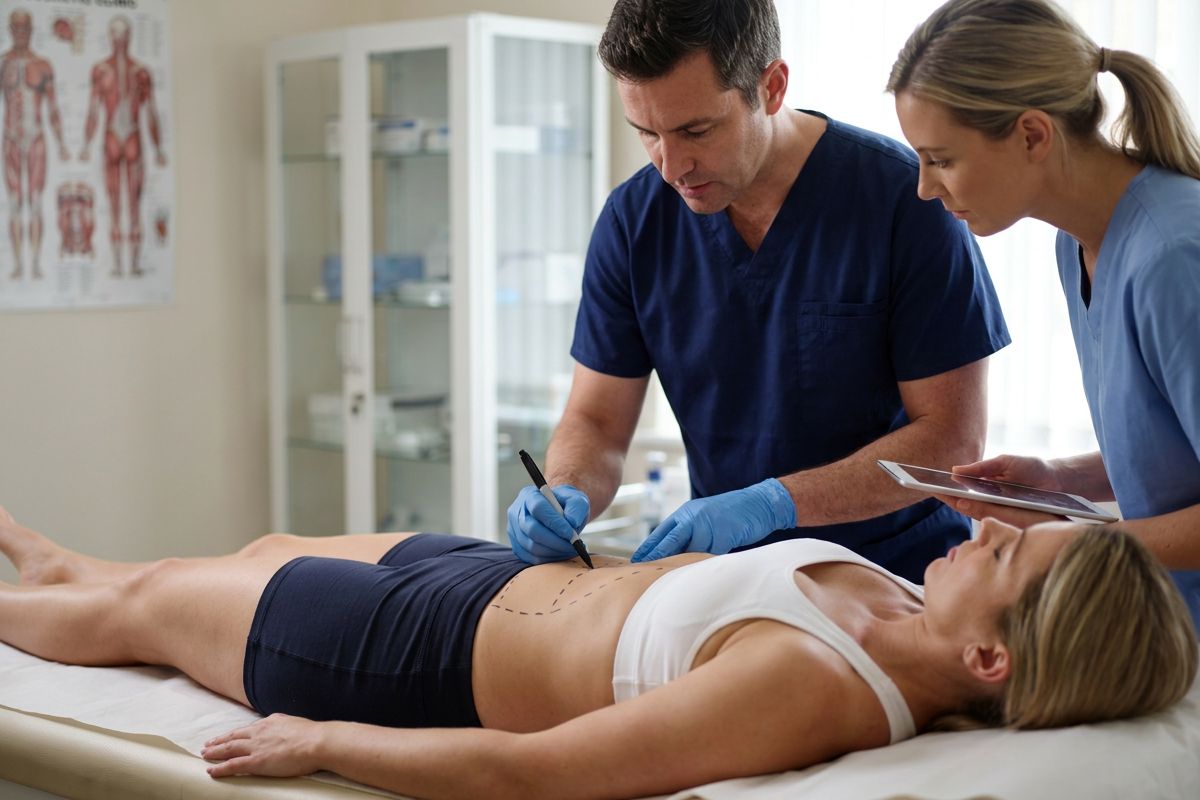
The scar from a full abdominoplasty runs from hip to hip, sitting below the natural bikini line so that it is covered by underwear and swimwear. In a well-planned procedure the scar sits low enough to be hidden by most swimsuit styles. However, the length and final position of the scar depend on the amount of skin to be excised and the patient's individual anatomy, and we show each patient exactly where the incision will be placed during the pre-operative marking session.
Scar maturation takes time. In the first few weeks the scar is typically red, raised, and firm. By three months it begins to soften; by six to twelve months most patients have a pale, flat line that is noticeable only on close inspection. Factors that impair scar quality include smoking, sun exposure, infection, and a genetic tendency to hypertrophic or keloid scarring. We ask about personal and family history of abnormal scarring at consultation.
Our post-operative scar management protocol includes silicone gel or sheeting from approximately three weeks post-operatively, strict sun protection for twelve months, and, where there is evidence of hypertrophic change, early intervention with steroid injections or laser treatment. Microneedling can be used to improve scar texture once the wound is fully healed, typically from three to four months post-operatively. We plan this as part of the overall treatment journey rather than as an afterthought.
Booking your consultation
If you are considering abdominoplasty after pregnancy and want an honest assessment of what surgery can realistically achieve for your specific anatomy, we would encourage you to book a consultation at our Kensington clinic. We are at 49 Marloes Road, W8, within easy reach of High Street Kensington, Earl's Court, and the wider west London area.
You can read more about the procedure, including details of our surgical technique and what to expect at each stage of recovery, on our dedicated tummy tuck treatment page. When you are ready to speak with us, book your consultation online and one of our patient coordinators will be in touch to arrange a time that suits you.
There is no obligation at the initial consultation. Our aim is to give you the information you need to make a decision that is right for you, whether that decision is to proceed with surgery, to wait, or to explore a non-surgical alternative first. We would rather you leave with clarity than with a booking you are not ready for.
Frequently asked
Questions we get asked about EnerPeel®
- How long should I wait after giving birth before having a tummy tuck?
- We recommend waiting a minimum of twelve months after your last delivery, and only proceeding once you have finished breastfeeding and your weight has been stable for at least six months. Hormonal changes during the postpartum period affect tissue quality and healing, and operating too soon increases both surgical risk and the likelihood of a suboptimal result. If you are considering further pregnancies, we strongly advise waiting until your family is complete.
- Will a tummy tuck remove my stretch marks?
- Only the stretch marks within the skin panel that is excised, typically the lower abdomen below the navel, will be removed. Stretch marks above the navel will remain after a full abdominoplasty, although they may shift slightly in position as the skin is redistributed downward. Non-surgical treatments such as CO₂ laser resurfacing can improve the appearance of residual stretch marks once the surgical wounds have fully healed, usually from around three to four months post-operatively.
- What is the difference between a full and a mini tummy tuck, and how do I know which I need?
- A full abdominoplasty addresses laxity both above and below the navel, repairs the full length of the diastasis recti, and repositions the umbilicus. A mini abdominoplasty uses a shorter incision, does not reposition the navel, and corrects only lower abdominal laxity. Most post-pregnancy patients with significant skin redundancy or a diastasis extending into the upper abdomen require the full procedure. The correct choice is determined by clinical examination at consultation, choosing the wrong variant is a common source of dissatisfaction, and we are direct about this.
- Can I combine a tummy tuck with breast surgery or liposuction?
- Yes, in appropriately selected patients. Combining abdominoplasty with breast surgery or flank liposuction is well established and reduces the total number of anaesthetics and recovery periods. However, we are cautious about combining too many procedures in a single session, as prolonged operative time increases thromboembolic risk. Our recommendation is based on the complexity of each individual procedure, the patient's fitness, and the total planned operative time, not on a desire to maximise the scope of surgery.
- What does the tummy tuck scar look like, and where is it positioned?
- The scar runs hip to hip, placed low in the bikini line so that it is covered by underwear and standard swimwear. In the first few months it is typically red and slightly raised; by six to twelve months most patients have a pale, flat line. Scar quality is influenced by genetics, smoking, sun exposure, and wound care. We provide a structured scar management protocol from around three weeks post-operatively, and we intervene early if there are signs of hypertrophic change.