

Surgical · 11 min read
The Mummy Makeover: Combining Procedures Safely in One Operation
By Dr Hassan Soueid · MD, FRCS · Lead Surgeon, Kensington Cosmetic Clinic
Published 25 May 2026
TL;DR - A mummy makeover is not a single named procedure but a surgeon-planned combination of operations, most commonly a tummy tuck, breast lift or augmentation, and targeted liposuction, performed under one anaesthetic to address the physical changes pregnancy and breastfeeding leave behind. Done well, combining procedures reduces total recovery time compared with staging each separately, but it also increases physiological demand, so patient selection and surgical planning are everything. At our Kensington clinic we will only recommend a combined approach when the risk-to-benefit calculation genuinely favours it for you as an individual. This article explains how we make that decision, what the operation typically involves, and who should think twice before proceeding.
What a mommy makeover London patients actually ask for, and what the term really means
The phrase mommy makeover, or mummy makeover, as it is more commonly called in the UK, arrived from the United States and has become one of the most-searched cosmetic surgery terms in London. The search volume is understandable: pregnancy, childbirth, and breastfeeding produce a constellation of physical changes that no single procedure addresses. Skin laxity on the abdomen, separation of the rectus muscles (diastasis recti), deflated or ptotic breasts, and localised fat deposits that resist exercise are all common, and they tend to occur together.
What the term does not mean is a fixed menu of operations. When a patient comes to see Dr Hassan Soueid for a combined body procedure, the first consultation is spent understanding which specific anatomical problems are present and which surgical solutions are proportionate to them. For one woman that might mean a full abdominoplasty with muscle repair and a mastopexy with implants. For another it might mean a mini-tuck and a breast augmentation alone. The word "makeover" implies a package; the clinical reality is a bespoke surgical plan.
It is also worth being honest about what these procedures cannot do. They are not weight-loss operations. They are not a substitute for cardiovascular fitness. And they will not prevent the normal ageing process from continuing. The best candidates are women who have reached a stable weight, ideally within roughly ten to fifteen kilograms of their personal goal weight, have completed their family, and are in good general health. If weight loss is still ongoing, we will ask you to wait, because operating on a body that is still changing produces results that will not hold.
The popularity of combined procedures in London has grown partly because patients are better informed and partly because surgical technique has genuinely improved. Enhanced recovery protocols, better anaesthetic agents, and more precise surgical planning mean that operations which once carried prohibitive combined risk are now routinely performed safely in the right patient. That said, "routinely" does not mean "without risk", and any surgeon who presents a combined procedure as straightforward is doing you a disservice.
The surgical components: tummy tuck, breast lift combined, and the role of liposuction
The most common combination we perform is a tummy tuck paired with breast surgery, with or without liposuction. Each element addresses a different anatomical zone, which is precisely why combining them is logical, the patient is already under general anaesthetic, already in a sterile surgical environment, and the recovery periods overlap rather than stack. The question is always whether the combined operating time and physiological stress remain within safe limits.
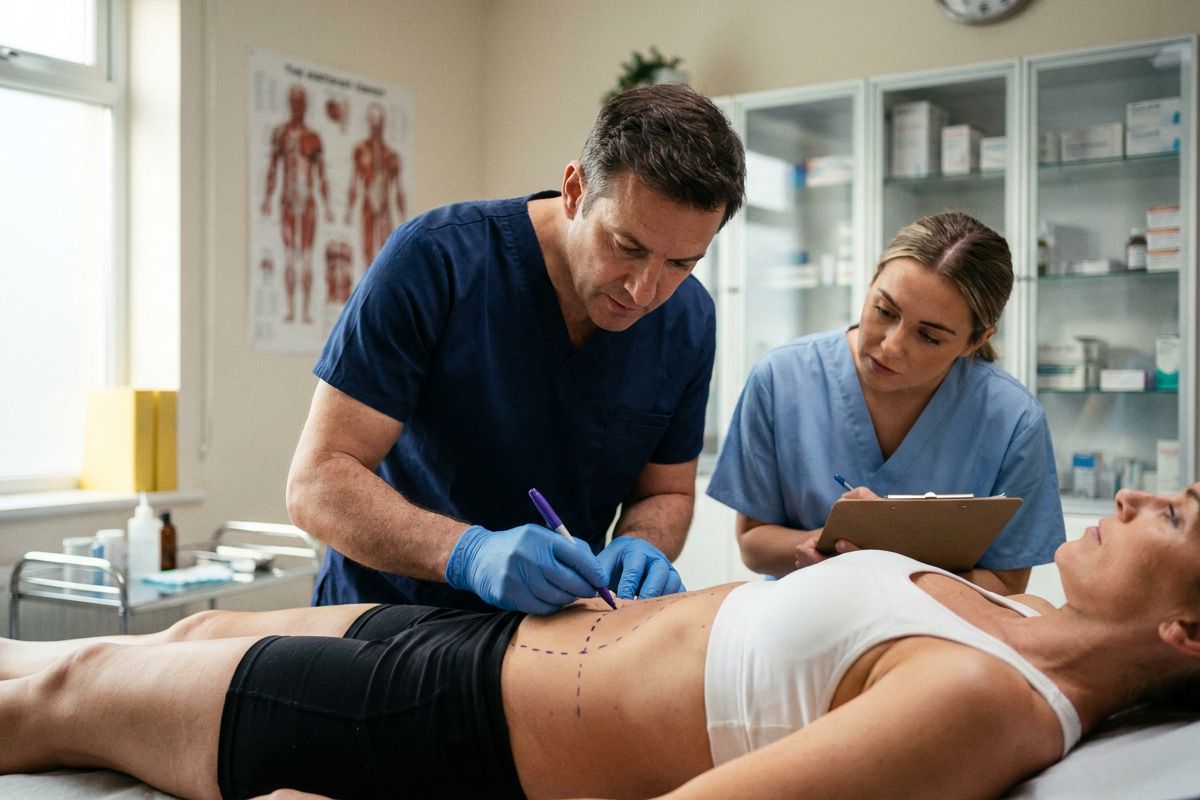
An abdominoplasty, the formal name for a tummy tuck, involves removing excess skin and fat from the lower abdomen, repairing the rectus abdominis muscles if they have separated, and repositioning the umbilicus. It is a substantial operation in its own right, typically taking between two and three hours depending on the extent of the work required. Our detailed guide on tummy tuck surgery after pregnancy covers the procedure in depth, but the key point here is that it creates a large surgical wound with meaningful fluid shifts and a significant inflammatory response. That has to be factored into the combined plan.
Breast surgery in this context most commonly means a mastopexy (breast lift), a breast augmentation, or a combined augmentation-mastopexy. Post-pregnancy breasts frequently lose volume and develop ptosis simultaneously, which is why augmentation and lift are so often performed together. Mr Ali Ghanem works alongside our team on complex breast cases, and the planning conversation between surgeons before a combined procedure is one of the most important parts of the process, sequencing matters, patient positioning matters, and the cumulative tissue handling needs to be coordinated.
Liposuction is frequently added to address flanks, outer thighs, or areas of the abdomen not reached by the tummy tuck incision. Our liposuction approach uses tumescent technique, which reduces blood loss and allows more precise contouring. In a combined procedure, the volume of fat removed via liposuction is deliberately conservative, large-volume liposuction on top of an abdominoplasty increases the risk of seroma, wound healing problems, and haematoma, so we set a ceiling and stick to it.
Occasionally patients ask about adding an arm lift or thigh lift to the same session. In most cases we will advise against this. Adding further procedures extends operating time beyond what we consider safe, and the recovery from multiple simultaneous body-contouring operations becomes genuinely difficult to manage at home. Staging these procedures, with a gap of at least three to four months, is the safer and ultimately more satisfying approach.
How we assess safety: the planning process before any combined procedure
Patient safety in combined surgery depends almost entirely on what happens before the patient enters the operating theatre. At our clinic in Kensington we use a structured pre-operative assessment process that goes considerably further than a standard surgical consultation.
The first step is a thorough medical history and examination. We look at BMI, smoking status, history of clotting disorders, previous abdominal surgery, and cardiovascular fitness. Obesity significantly increases the risk of wound complications, deep vein thrombosis, and pulmonary embolism in body-contouring surgery; we have a BMI threshold above which we will not proceed with a combined procedure, and we apply it consistently. Smoking is a particular concern for abdominoplasty because the flap of abdominal skin relies on preserved blood supply, nicotine causes vasoconstriction and dramatically increases the risk of skin necrosis. We ask patients to stop smoking at least six weeks before surgery and to remain non-smoking throughout recovery.
We also consider operating time carefully. As a general principle, combined procedures should not exceed five to six hours of total anaesthetic time. Beyond that threshold, the risks of hypothermia, pressure injury, deep vein thrombosis, and anaesthetic complications begin to climb steeply. If the planned combination cannot be completed within that window, we will stage the operations. This is not a commercial decision, it is a clinical one.
Our anaesthetic team plays a central role in this planning. Dr Hazim Sadideen brings considerable experience in complex elective surgical cases, and his input on fluid management, temperature regulation, and post-operative pain control is integral to how we approach combined procedures. The anaesthetic plan for a combined body operation is meaningfully different from that for a single procedure, and it deserves the same level of surgical thought.
Blood tests, an ECG if indicated by age or history, and occasionally a chest X-ray are standard pre-operative requirements. We also ask patients to complete a validated psychological wellbeing screen, not to gatekeep, but because the recovery from a combined procedure is demanding, and patients who have realistic expectations and strong social support recover better in every measurable way.
Recovery: what the first six weeks genuinely look like
Honest recovery information is one of the things we feel most strongly about providing. The internet is full of before-and-after photographs and very little about the six weeks between the operating table and the final result. That gap matters enormously, and underestimating it leads to poor decisions, rushing back to work, inadequate rest, or insufficient help at home.
In the first 48 hours after a combined tummy tuck and breast procedure, most patients experience significant discomfort, particularly on movement. The abdominal repair means that standing fully upright is difficult for the first week or so; patients walk in a slightly flexed position to protect the wound closure. Surgical drains are typically in place for the first few days to manage fluid accumulation. Oedema is universal and can be alarming in its extent, the abdomen and flanks will look swollen and bruised before they look improved.
By the end of the second week, most patients are mobile around the house, sleeping more comfortably, and managing with oral analgesia rather than stronger pain relief. The drains are usually removed within the first ten days. Compression garments are worn continuously for the first four to six weeks, they are not optional, and they make a real difference to final contour and to seroma prevention.
Return to desk work is typically possible at two to three weeks for most patients, though this depends on commuting demands and the physical requirements of the role. Driving is not advisable until you can perform an emergency stop without hesitation, usually around three to four weeks post-operatively. Exercise beyond gentle walking is restricted for six weeks, and high-impact activity for twelve weeks after an abdominoplasty.
The final result of a combined procedure is not visible for three to six months. Scars continue to mature for up to eighteen months. We schedule follow-up appointments at one week, six weeks, three months, and twelve months as standard. Patients who want to address residual skin texture or scarring at a later stage may benefit from treatments such as our CO2 laser resurfacing programme, though this is discussed only once healing is complete.
Who this is not right for, and what the alternatives might be
We think this section is as important as anything else on this page. A combined mummy makeover procedure is not appropriate for everyone who enquires about it, and we would rather say so clearly than imply otherwise.
If you are planning further pregnancies, we will strongly advise waiting. A subsequent pregnancy after an abdominoplasty will stretch the repaired muscles and resected skin, partially or fully undoing the surgical result. The same applies to breast surgery, pregnancy and breastfeeding alter breast volume and position in ways that cannot be predicted. This is not a reason to never have the surgery; it is a reason to time it correctly.
If your BMI is significantly elevated, the combined risk profile of a tummy tuck and breast procedure becomes difficult to justify electively. We will have an honest conversation about this at consultation. In some cases, the right answer is to address weight first, whether through lifestyle change or, where clinically appropriate, medical weight management, and to return for surgery once a stable lower weight has been maintained for at least six months.
If your primary concern is skin laxity on the arms or thighs rather than the abdomen and breasts, the combination we have described is not the right starting point. Procedures such as an arm lift address a different anatomical zone and would be planned as a separate surgical episode. Similarly, patients with significant fat distribution concerns across multiple body areas may be better served by a staged approach beginning with 360-degree liposuction before committing to excisional surgery.
Non-surgical options are worth acknowledging, though we will be direct: they do not replicate the results of surgery for significant skin laxity or muscle separation. Treatments like radiofrequency, ultrasound, and injectables have a role in mild cases or as adjuncts to surgery, but a patient with genuine post-pregnancy diastasis and grade III breast ptosis will not achieve a meaningful result without an operation. We would rather tell you that clearly than send you through a series of non-surgical treatments that will not address the underlying anatomy.
Cost, staging, and making a realistic plan for post-pregnancy procedures in the UK
Combined procedures in London vary widely in cost depending on the specific combination, the surgeon's experience, the facility, and the level of post-operative care included. We do not publish fixed package prices for mummy makeovers because the combination is genuinely different for every patient, quoting a flat fee before examining a patient is not something we are willing to do.
What we can say is that combining procedures in one anaesthetic is typically more cost-effective than staging them separately, because theatre time, anaesthetic fees, and facility costs are shared across the session rather than duplicated. That said, cost should never be the primary driver of the decision to combine. If the clinical assessment suggests staging is safer, staging is what we recommend, regardless of the financial difference.
For patients considering a broader body transformation, our full body makeover planning service provides a structured framework for sequencing multiple procedures over time, with a clear roadmap from initial consultation through to final result. This is particularly useful for patients who know they want several things addressed but are uncertain about the right order and timing.
It is also worth reading our article on choosing implant size, shape, and profile if breast augmentation forms part of your plan, the decisions made at that stage have a significant bearing on the long-term outcome of the breast component of a combined procedure. And if you are weighing up the abdominal element in more detail, the considerations around body contouring overlap meaningfully with those discussed in our piece on chest contouring surgery, particularly regarding skin excision planning and scar placement.
Financing options are available through third-party providers and can be discussed at consultation. We do not pressure patients into financial decisions and we do not offer time-limited discounts, both of which we consider incompatible with ethical surgical practice.
Booking your consultation
If you are considering a combined procedure after pregnancy and want an honest, clinically grounded assessment of what is possible and what is appropriate for you, the right starting point is a face-to-face consultation at our clinic at 49 Marloes Road, W8 6LA, a short walk from High Street Kensington station and easily accessible from across west London and the surrounding areas.
At that consultation, Dr Hassan Soueid will examine you, discuss your specific anatomy and concerns, and give you a clear recommendation, including whether a combined approach is advisable or whether a staged plan would serve you better. There is no obligation to proceed, and no pressure to make a decision on the day. Our aim is to give you the information you need to make a choice you will be confident in for years to come.
You can read more about the individual surgical components on our breast surgery and tummy tuck pages before your appointment. When you are ready, book your consultation here and one of our patient coordinators will be in touch to arrange a time that suits you.
Frequently asked
Questions we get asked about EnerPeel®
- How long after having a baby should I wait before considering a mummy makeover?
- We recommend waiting at least twelve months after your last delivery and at least six months after you have finished breastfeeding. This allows your weight to stabilise, your hormones to normalise, and your tissues to recover fully from pregnancy. Operating before these conditions are met increases the risk of complications and reduces the durability of the result.
- Can a tummy tuck and breast lift really be done safely in one operation?
- Yes, in appropriately selected patients and with careful surgical planning, combining these procedures is safe and well-established. The key factors are total operating time (we aim to stay within five to six hours), the patient's general health and BMI, and whether the surgical team has planned the procedure collaboratively. It is not appropriate for every patient, and we will tell you honestly if staging is the better option for you.
- Will I have visible scars after a mummy makeover?
- All excisional surgery leaves scars. An abdominoplasty scar runs horizontally across the lower abdomen, typically positioned so that it sits below the bikini line. Mastopexy scars vary by technique but commonly follow the breast crease and run vertically from the nipple downward. Scars are red and raised for several months before gradually fading and flattening over twelve to eighteen months. We provide detailed scar management advice and can discuss laser or other treatments to improve scar appearance once healing is complete.
- What happens if I lose more weight after the surgery?
- Moderate further weight loss after a mummy makeover is unlikely to significantly affect the result. Substantial weight loss, particularly if it happens rapidly, can cause new skin laxity and may partially undo the surgical improvement, particularly on the abdomen. This is one of the reasons we ask patients to be at or close to a stable goal weight before operating. If weight loss is still ongoing at the time of consultation, we will ask you to wait.
- Is a mummy makeover available on the NHS?
- In the vast majority of cases, no. NHS funding for post-pregnancy body-contouring surgery is extremely limited and is generally restricted to cases where there is a significant functional problem, for example, a severe skin overhang causing recurrent skin infections, that has not responded to other treatment. Cosmetic improvement alone does not meet NHS criteria. All procedures of this type at our Kensington clinic are performed privately.