

Skin · 11 min read
HydraFacial London: What It Does Well, and Where We Wouldn't Use It
By Dr Hassan Soueid · MD, FRCS · Lead Surgeon, Kensington Cosmetic Clinic
Published 25 May 2026
TL;DR - HydraFacial is a well-designed, low-risk skin treatment that combines cleansing, exfoliation, extraction, and hydration in a single session. It produces a reliable, immediate glow and suits a wide range of skin types, making it a sensible starting point for many patients. It is not, however, a resurfacing treatment, and it will not address deep pigmentation, significant laxity, or acne scarring, for those concerns, we would direct you towards more targeted options. If you are in or around Kensington and want a refreshed, even complexion with no downtime, HydraFacial is worth understanding properly.
What HydraFacial London actually involves, the clinical mechanism
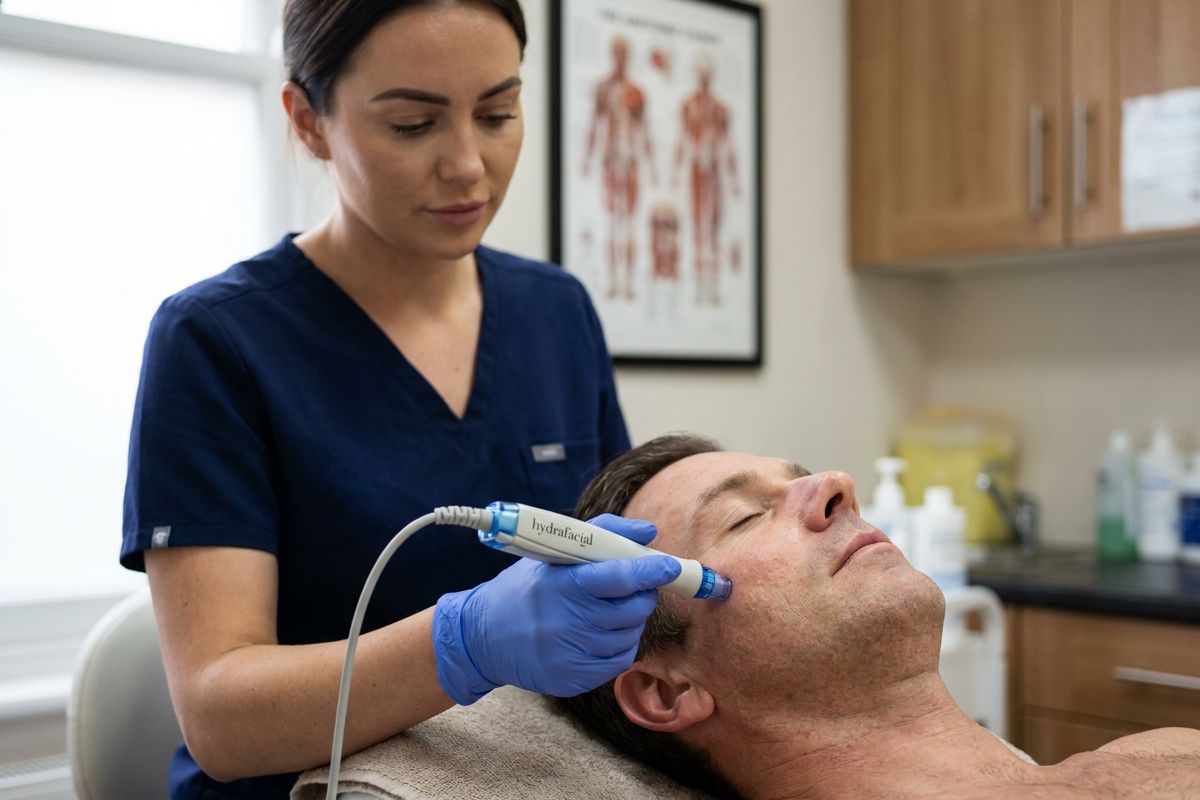
HydraFacial is a multi-step, device-based facial treatment delivered through a single handpiece that simultaneously exfoliates and infuses the skin with serums. The device uses a vortex suction mechanism, a spiral-tipped nozzle that creates a centrifugal flow, to loosen and remove debris from pores while simultaneously delivering hydrating and antioxidant solutions into the superficial dermis. It is not a laser, not a chemical peel in the traditional sense, and not a needling procedure. It works entirely on the surface and the upper follicular layer.
The treatment is typically divided into three stages: cleanse and peel, extract and hydrate, and fuse and protect. The peel component uses a mild blend of glycolic and salicylic acid at concentrations low enough to avoid the post-procedure redness associated with a formal chemical peel. The extraction phase uses negative pressure to clear congested pores without the trauma of manual extraction. The infusion phase delivers hyaluronic acid, peptides, and antioxidants depending on the serum chosen for your skin concern.
What this means practically is that the treatment is genuinely comfortable, most patients describe it as a pleasant pressure sensation rather than anything stinging, and the results are visible immediately. Skin looks cleaner, more even, and better hydrated within an hour of the session ending. That immediacy is one reason it has become a popular choice before events, and why the term "lunchtime facial" has attached itself to it in the UK press.
At Kensington Cosmetic Clinic, we use the HydraFacial as part of a broader skin health programme rather than as a standalone fix. Our aesthetic practitioners, including Analissa, assess your skin texture, sebum levels, and hydration before selecting the appropriate serum combination for your session. That personalisation matters more than the device itself.
Who genuinely benefits from HydraFacial in Kensington
The honest answer is: a broad group of patients, which is part of the treatment's clinical appeal. Because the exfoliation is superficial and the serums are non-irritating, HydraFacial suits most Fitzpatrick skin types, including darker skin tones that cannot safely undergo aggressive laser resurfacing without risk of post-inflammatory hyperpigmentation. That is a meaningful clinical advantage, not a marketing point.
Patients who tend to see the most satisfying results are those with mild-to-moderate congestion, uneven texture, early fine lines driven by dehydration rather than volume loss, and dull or tired-looking skin. If your skin looks flat and lacks radiance, often the case in London's urban environment, where pollution, stress, and disrupted sleep accumulate, a single HydraFacial session produces a noticeable improvement. A course of four to six sessions, spaced two to four weeks apart, produces more sustained improvement in texture and pore appearance.
It also works well as a preparatory treatment before more intensive procedures. We sometimes recommend a session or two before a CO2 laser resurfacing course to ensure the skin is well-hydrated and free of surface debris, which helps the laser energy distribute more evenly. Similarly, patients in the maintenance phase after a chemical peel programme often find HydraFacial a useful interval treatment to sustain the results between peel sessions.
Patients with mild acne, open comedones, occasional pustules, oily skin, often benefit from the salicylic acid component and the mechanical extraction. The caveat here is active, inflammatory acne: we do not recommend the treatment over active breakouts, as the suction can spread bacteria and worsen inflammation. That is a clinical boundary worth stating clearly.
Where HydraFacial falls short, and what we'd use instead
This is the section most clinics omit from their HydraFacial pages, and it is the most useful one to read. HydraFacial does not resurface the skin. The glycolic and salicylic concentrations used are well below the threshold required to produce a controlled wound-healing response. If you are looking to address acne scarring, deep pigmentation, significant sun damage, or textural irregularities that go beyond the superficial layer, HydraFacial will not deliver meaningful improvement, and promising otherwise would be misleading.
For those concerns, our clinical team would typically consider a chemical peel programme at a medium depth, microneedling with or without PRP, or CO2 laser resurfacing depending on the severity of the concern and the patient's skin type and downtime tolerance. Our post on microneedling: the evidence guide covers the distinction between surface hydration treatments and collagen-induction therapies in more detail, and is worth reading alongside this post if you are trying to choose between options.
HydraFacial also does not address skin laxity. If your primary concern is sagging along the jawline, jowling, or loss of cheek volume, no facial treatment, HydraFacial or otherwise, will produce a structural change. Those concerns require either injectable treatment such as botox and fillers for early volume loss, or surgical intervention for more established laxity. Dr Hassan Soueid regularly sees patients who have spent considerable sums on facial treatments before accepting that their concern is structural rather than textural, and that is a conversation worth having early rather than late.
Similarly, persistent melasma or deep dermal pigmentation will not respond adequately to HydraFacial alone. The brightening serums used in the treatment can support a broader pigmentation management plan, but they are not a substitute for a properly supervised pigmentation treatment programme that may include topical agents, sun protection protocols, and targeted energy-based devices.
HydraFacial vs other lunchtime facials, a clinical comparison
The term lunchtime facial covers a wide range of treatments in the UK market, and patients are often unsure how HydraFacial compares to alternatives such as microdermabrasion, oxygen facials, LED therapy, or enzyme peels. The comparison is worth making honestly.
Microdermabrasion uses physical abrasion, either crystals or a diamond tip, to remove the stratum corneum. It produces a similar immediate smoothing effect but lacks the simultaneous infusion component, meaning the skin is exfoliated but not replenished in the same session. HydraFacial's vortex-infusion mechanism gives it a hydration advantage over microdermabrasion, particularly for patients with dry or dehydrated skin.
LED therapy works through an entirely different mechanism, photobiomodulation rather than mechanical exfoliation, and the two treatments are genuinely complementary rather than competing. We often combine an LED session immediately after HydraFacial to support the skin's post-treatment repair response and reduce any residual redness. The combination is well-tolerated and adds clinical value without adding recovery time.
Enzyme peels and oxygen facials are gentler still and suit very sensitive or rosacea-prone skin where even the mild acids in HydraFacial may cause irritation. For patients with reactive skin, our practitioners, including Sylwia Bozek, will assess whether a modified protocol or an alternative approach is more appropriate. There is no single best facial; the right choice depends on your skin's baseline condition and your specific concern.
If you are weighing up non-surgical options more broadly, including injectable skin boosters and biostimulators, our post on Profhilo as a skin booster injectable gives a useful comparison of the hydration-from-within approach versus surface-level treatments like HydraFacial. The two are not mutually exclusive and many patients benefit from both.
What a realistic course of treatment looks like at KCC
A single HydraFacial session at our W8 clinic takes approximately 45 minutes. There is no preparation required beyond arriving with clean skin, and you can return to work, apply make-up, and exercise the same day. The immediate result, cleaner pores, improved hydration, a more even tone, lasts roughly a week before the skin returns to its baseline. That is not a failure of the treatment; it reflects the fact that a single superficial treatment cannot permanently alter skin biology.
For sustained improvement, we recommend a course of four to six sessions, typically spaced three to four weeks apart. By the third or fourth session, most patients notice a meaningful improvement in overall skin quality that persists between appointments. After completing a course, a monthly maintenance session is usually sufficient to preserve the results.
Before your first session, one of our skin practitioners will carry out a brief skin assessment, reviewing your current skincare routine, any active skin conditions, medication use (particularly retinoids or prescription topicals that may affect skin sensitivity), and your specific goals. This is not a lengthy consultation, but it ensures the serum selection and suction settings are appropriate for your skin rather than generic.
We also consider HydraFacial as part of combination programmes. Patients undergoing a broader skin rejuvenation plan, for example, combining PRP treatment with surface treatments, may have HydraFacial scheduled on alternating months to maintain surface quality between the deeper biological stimulation sessions. Our post on polynucleotides for the under-eye area touches on how layered skin treatments work together, which is relevant if you are considering a multi-modal approach.
Who this treatment is not right for
We are direct about this at every consultation. HydraFacial is not appropriate if you have active inflammatory acne, open skin lesions, sunburn, or a recent chemical peel or laser treatment, the skin needs to be intact and not already sensitised. Patients with rosacea should be assessed individually; the suction and mild acids can trigger a flare in some cases, and we may recommend a modified protocol or an alternative treatment.
If you are pregnant, we advise caution with the salicylic acid component and would discuss the serum options with you before proceeding. If you are taking isotretinoin (Roaccutane) or have taken it within the last six months, we would not perform any exfoliating facial treatment until the skin's barrier function has fully recovered.
Patients with a primary concern of skin laxity, volume loss, or deep structural change should understand clearly that HydraFacial addresses none of these. If you have come to us primarily concerned about jowling or significant facial ageing, the appropriate conversation is with Dr Hassan Soueid about surgical or energy-based options, our post on the non-surgical facelift options in West London outlines the realistic ceiling of non-invasive treatments and when surgery becomes the more honest recommendation.
Finally, patients who expect a single session to produce the results of a resurfacing procedure will be disappointed. We would rather set that expectation clearly before your appointment than have you leave feeling the treatment underdelivered. HydraFacial does what it does very well, it is not trying to be something else, and neither should the clinic presenting it.
HydraFacial and skin of colour, a note worth making
London is one of the most ethnically diverse cities in the world, and our patient base in Kensington and the surrounding High Street Kensington and Earl's Court catchment reflects that. Skin of colour, Fitzpatrick types IV through VI, requires particular care when selecting aesthetic treatments, because many energy-based and chemical resurfacing options carry a meaningful risk of post-inflammatory hyperpigmentation in darker skin tones.
HydraFacial's profile here is genuinely favourable. The exfoliation is superficial, the acids are at low concentrations, and there is no thermal energy involved. The risk of triggering hyperpigmentation is low compared with ablative lasers or aggressive peels. For patients with darker skin who want a regular, safe maintenance facial, HydraFacial is one of the more clinically appropriate options available.
That said, the brightening serums used in the treatment, which often contain kojic acid or vitamin C derivatives, do have a mild effect on surface pigmentation. For patients with melasma or significant post-inflammatory hyperpigmentation, this is supportive at best. A properly structured pigmentation treatment programme, supervised by a clinician with specific expertise in skin of colour, is the appropriate route for those concerns. Dr Anna Peca has particular experience in managing pigmentation across a range of skin types and is available for consultation at our Kensington clinic.
We are also mindful that the aesthetic industry has historically been poor at representing and serving patients with darker skin tones. We take that seriously, and it shapes how we present treatment options, including being clear about what HydraFacial can and cannot do for specific pigmentation concerns rather than overpromising.
Booking your consultation
If you would like to discuss whether HydraFacial is the right starting point for your skin, or whether a different approach would serve you better, we would encourage you to book a skin assessment at our clinic at 49 Marloes Road, London W8 6LA. Our practitioners will give you an honest appraisal of your skin's current condition and the options most likely to address your specific concerns, without steering you towards a treatment that is not appropriate for you.
You can book your consultation here, or visit our dedicated skin resurfacing treatments page to understand the broader range of options we offer alongside HydraFacial. If you are already clear that HydraFacial is what you want, you are welcome to book directly for a treatment session, a brief skin assessment is included at the start of every appointment.
Frequently asked
Questions we get asked about EnerPeel®
- How many HydraFacial sessions will I need before I see a lasting difference?
- A single session produces an immediate improvement in radiance and hydration that typically lasts around a week. For a more sustained change in skin texture and pore appearance, most patients need a course of four to six sessions spaced three to four weeks apart. After completing a course, monthly maintenance sessions are usually sufficient to preserve the improvement.
- Can HydraFacial help with acne?
- It can help with mild, non-inflammatory acne, particularly congested pores and oily skin, because the salicylic acid component and mechanical extraction address surface-level blockages. We do not recommend HydraFacial over active, inflamed breakouts, as the suction can spread bacteria and worsen the condition. If acne is your primary concern, a consultation to assess the severity and appropriate treatment plan is the better starting point.
- Is HydraFacial safe for darker skin tones?
- Yes, HydraFacial is one of the more suitable facial treatments for darker skin types (Fitzpatrick IV–VI) because it involves no thermal energy and uses acids at low concentrations that are unlikely to trigger post-inflammatory hyperpigmentation. It is not, however, a substitute for a supervised pigmentation treatment programme if you have melasma or significant uneven tone, those concerns require a more targeted clinical approach.
- How does HydraFacial compare to a chemical peel?
- They work through different mechanisms and address different concerns. HydraFacial uses very low concentrations of glycolic and salicylic acid alongside mechanical suction and hydrating serums, it is a surface-level treatment with no downtime. A chemical peel uses higher acid concentrations to produce a controlled wound-healing response that stimulates collagen and addresses deeper pigmentation and textural irregularities. For significant skin concerns, a peel programme will typically produce more meaningful results; HydraFacial is better suited to maintenance and hydration.
- Can I have HydraFacial if I'm on Roaccutane or have recently finished a course?
- No. We do not perform any exfoliating facial treatment, including HydraFacial, on patients currently taking isotretinoin (Roaccutane) or who have completed a course within the last six months. Isotretinoin significantly thins the skin and impairs barrier function, making exfoliation unsafe during and shortly after treatment. Please let us know at booking if this applies to you.