

Skin · 11 min read
PDO Thread Lifts: What Threads Can and Can't Achieve
By Dr Hassan Soueid · MD, FRCS · Lead Surgeon, Kensington Cosmetic Clinic
Published 25 May 2026
TL;DR - A thread lift London patients ask about most often is the PDO (polydioxanone) thread procedure: a minimally invasive treatment that repositions soft tissue and stimulates collagen without a surgical incision. Results are real but modest, typically one to three years of improved definition along the jawline, midface, or brow, and the treatment works best on mild-to-moderate laxity rather than significant skin excess. It is not a facelift substitute, and we will tell you plainly when surgery would serve you better. What follows is a clinician's account of how threads work, what the evidence supports, and how to decide whether this is the right path for you.
What a PDO thread lift actually does to your tissue
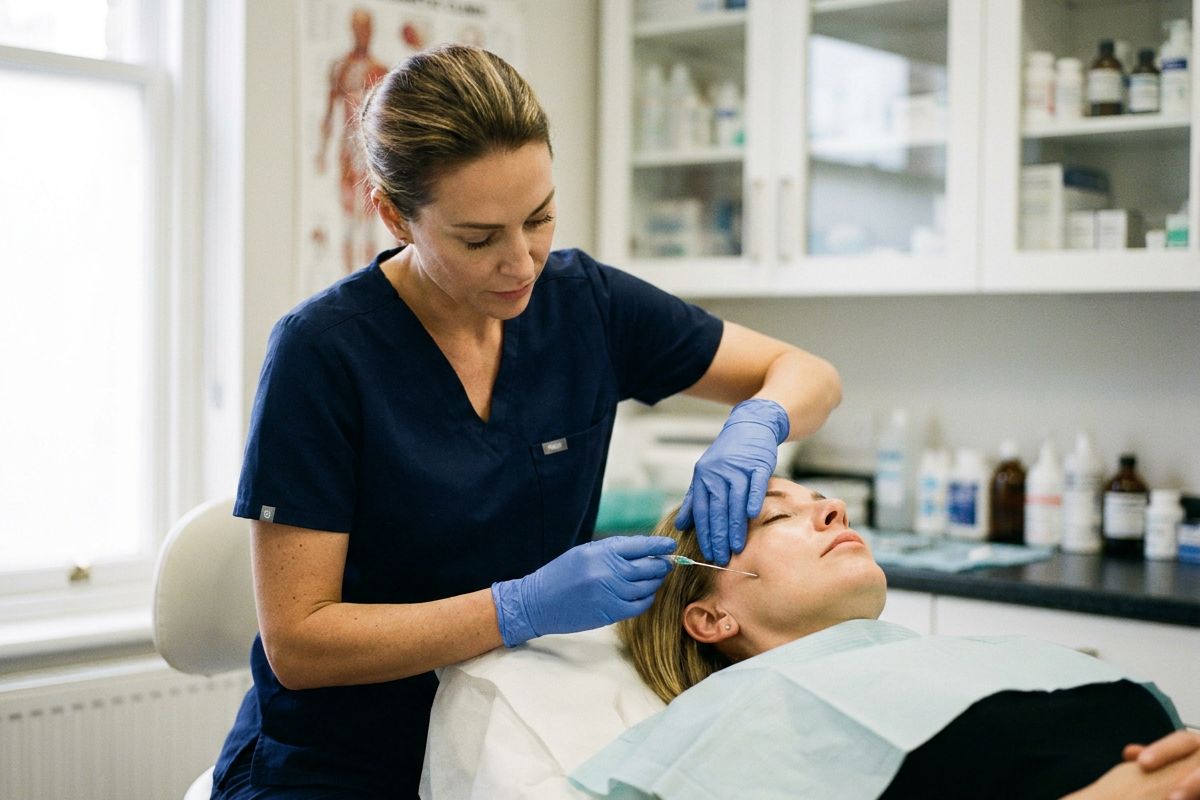
Polydioxanone is a synthetic absorbable suture material that has been used in cardiac and general surgery for decades. In aesthetic medicine, fine PDO threads, either smooth mono threads or barbed cog threads, are introduced beneath the skin via a cannula or needle, then anchored or tensioned to reposition the tissue above. The mechanical lift is immediate but modest; the more durable benefit comes from the biological response that follows.
When PDO is placed in the dermis or subcutaneous plane, the body treats it as a controlled foreign body and mounts a fibroblast response. Over the following weeks, new collagen is deposited along the thread tract. By the time the PDO has fully absorbed, typically around six months, a matrix of fresh collagen remains. This is why patients often notice their result looking better at three months than at three weeks, and why the effect can persist beyond the thread itself.
Barbed cog threads create the mechanical repositioning effect: the tiny barbs grip the fibrous septa of the SMAS and subcutaneous fat, allowing the clinician to vector the tissue superiorly or laterally. Smooth mono threads, placed in a mesh pattern, are used primarily for collagen stimulation rather than lift, they are better thought of as a biostimulator than a repositioning tool. Understanding which type is being proposed, and why, is one of the first questions to ask at any consultation.
The procedure is performed under local anaesthetic in a clinical setting. At our clinic near High Street Kensington, the session typically takes 45 to 75 minutes depending on the number of threads and the areas treated. Bruising and swelling are common for the first week; surface dimpling usually resolves within ten to fourteen days as the tissue settles around the threads.
Who is a realistic candidate for a thread lift in London?
The patients who see the most satisfying outcomes from a PDO thread lift Kensington consultation are generally in their late thirties to mid-fifties, with mild-to-moderate jowling, early midface descent, or a brow that has dropped slightly but retains reasonable skin quality. If you can pinch your skin and see it spring back with some elasticity remaining, threads have useful tissue to work with. If the skin is significantly thinned, heavily sun-damaged, or there is substantial excess volume loss, threads alone will not address the underlying problem.
Body habitus matters too. Patients with a fuller face tend to see a more visible lift because there is more soft tissue for the barbs to engage. Very lean patients with minimal subcutaneous fat may find the threads have less purchase, and the risk of surface irregularity is proportionally higher. This is not a reason to avoid the procedure, but it is a reason to calibrate expectations carefully.
Age is less important than tissue quality and degree of laxity. We see patients in their early thirties who have significant genetic laxity and patients in their late fifties with excellent skin tone. A thorough assessment, including palpation of the SMAS and evaluation of skin thickness, is more informative than a date of birth. Dr Anna Peca, who conducts many of our non-surgical facial assessments, approaches each consultation by mapping the vectors of descent before deciding whether threads, injectables, or a combination is most appropriate.
Contraindications include active skin infection at the treatment site, autoimmune connective tissue disorders, anticoagulant therapy that cannot be paused, and unrealistic expectations about the degree of change achievable. We also counsel against threads as a standalone treatment in patients who have had multiple rounds of heavy filler loading, as distorted tissue planes make accurate placement more difficult and increase the risk of palpable irregularity.
Thread lift results: what the evidence supports and what it doesn't
The published literature on PDO threads is growing but remains heterogeneous. Most peer-reviewed studies report clinically meaningful improvement in facial contour at three to six months, with patient satisfaction rates that are generally positive for appropriately selected candidates. Longevity data suggest the visible effect diminishes significantly after twelve to eighteen months for barbed cog threads, though some collagen benefit persists longer. Studies comparing threads to surgical lifting consistently show that surgical outcomes are more durable and more dramatic, this is not a contested point.
What threads do well: jawline definition in patients with early jowling, midface repositioning where volume loss is not the primary driver, brow elevation of five to eight millimetres in suitable anatomy, and neck skin tightening when combined with complementary energy-based treatments. For a deeper discussion of how non-surgical options compare to each other in the facial rejuvenation space, our article on non-surgical facelift options in West London covers the landscape honestly.
What threads do not do well: correcting significant skin excess, addressing deep nasolabial folds driven by volume loss (that requires fat transfer or filler), lifting a truly ptotic brow with thick forehead skin, or replacing the structural correction that a surgical SMAS facelift provides. Patients who come to us having seen heavily filtered social media results should be aware that the before-and-after photography in thread marketing is often taken immediately post-procedure when swelling creates a temporary augmentation effect. The settled result at six weeks is the honest baseline.
We routinely combine threads with other treatments for a more complete outcome. A course of microneedling in the months following thread placement can amplify the collagen response in the superficial dermis, while PRP treatment injected alongside threads at the time of the procedure may accelerate tissue healing and enhance the biostimulatory effect. These combinations are evidence-informed rather than speculative, but we present them as adjuncts, not as a way to inflate a treatment package.
Thread lift cost UK: what you should expect to pay and why
Pricing for thread lift cost UK varies considerably, and the variation is not arbitrary. The number of threads, the thread type (mono versus cog, single barb versus bidirectional), the anatomical areas treated, and the seniority of the practitioner all affect the final figure. At Kensington Cosmetic Clinic, a single-area treatment, jawline only, for example, typically sits in the range of £1,200 to £1,800. A full-face treatment addressing the midface, jawline, and neck with cog threads is more likely to sit between £2,500 and £3,500. These are honest ranges; the precise figure depends on your anatomy and what is clinically indicated.
We are wary of very low-cost thread treatments advertised across London. PDO threads are a procedural skill, not simply a product. Incorrect depth of placement, too superficial and threads are visible or palpable; too deep and the lift vector is lost, is one of the most common causes of poor outcomes. Thread breakage, asymmetry, and infection risk are all elevated when the procedure is performed by practitioners with limited training. The cost of correcting a poorly placed thread treatment frequently exceeds the cost of having it done properly in the first place.
It is also worth understanding that threads are a repeatable treatment rather than a permanent investment. Most patients who are happy with their first course return for a repeat at twelve to twenty-four months. When you factor in the cumulative cost over five years, it is worth having an honest conversation about whether a surgical option, which carries a higher upfront cost but a much longer result, represents better value for your specific situation. Dr Hassan Soueid regularly has this conversation with patients at consultation, and he will not recommend a non-surgical path if surgery would clearly serve you better.
Thread lift vs facelift: the honest comparison
The thread lift vs facelift question comes up in almost every consultation where threads are being considered. The honest answer is that they are not competing treatments, they operate at different levels of intervention and are suited to different degrees of change. A thread lift repositions tissue without removing it and without addressing the deeper SMAS layer in the way that surgical dissection does. A facelift, particularly a deep-plane or SMAS facelift, releases, repositions, and resuspends the structural layer of the face, removes redundant skin, and produces a result that typically lasts seven to twelve years or more.
For patients with significant jowling, neck laxity, or skin excess, threads will produce a visible but temporary improvement that does not address the underlying structural problem. In these cases, we would recommend a surgical consultation. Our detailed post on SMAS vs deep-plane facelift goes into the surgical options in depth. Mr Ali Ghanem, our consultant plastic and reconstructive surgeon, assesses patients for whom the degree of laxity places them at the boundary between non-surgical and surgical candidacy, a nuanced clinical judgement that benefits from a senior surgical opinion.
There is a legitimate role for threads as a bridge treatment: patients who are not yet ready for surgery, either psychologically or practically, can achieve a meaningful improvement with threads while they consider their longer-term options. There is also a role for threads as a maintenance treatment in patients who have had a facelift and wish to extend the result as natural ageing continues. What threads should not be is a substitute for surgery in patients who clearly need surgery, that is a disservice to the patient and, ultimately, to the profession.
The recovery comparison is also relevant. A facelift requires two to three weeks of social downtime and several months for full healing. A thread lift requires a long weekend of visible bruising and swelling, with most patients presentable within seven to ten days. For patients with demanding professional or social schedules, this difference is clinically meaningful and legitimately influences the treatment decision. We do not dismiss it as vanity, it is a practical factor in planning care.
Who this isn't right for
We want to be direct about the patients for whom we would not recommend a thread lift as a primary treatment. If you have significant skin excess, visible hanging skin along the jawline or neck, threads will not remove that tissue and may actually accentuate the problem by bunching the skin at the insertion point. A facelift is the appropriate intervention, and we would rather tell you that at consultation than take your money for a treatment that will disappoint you.
Patients with a history of keloid scarring or hypertrophic healing responses should be cautious; while PDO is absorbable, the inflammatory response to the thread can occasionally produce a palpable cord along the tract in susceptible individuals. Patients on long-term immunosuppression have an elevated infection risk and require careful pre-procedure assessment. Those with unrealistic expectations, specifically, patients who expect a thread lift to produce the same result as surgery, are not good candidates, regardless of their anatomy.
We also counsel against threads in patients who are considering significant weight loss in the near future. Substantial weight change after thread placement alters the tissue planes the threads were designed to work with, and the result may become unpredictable. If you are mid-way through a significant weight loss journey, it is generally better to wait until your weight has been stable for six to twelve months before investing in any soft-tissue repositioning treatment. For those exploring how non-surgical treatments compare to injectables for facial rejuvenation, our post on brow lift versus Botox offers a useful parallel discussion on the limits of each approach.
Finally, patients who have had multiple sessions of high-volume dermal filler, particularly in the midface, may have tissue planes that are difficult to navigate safely with threads. This is not an absolute contraindication, but it requires an experienced practitioner who can adapt the technique. Dr Michail Vourvachis, who has extensive experience in both injectables and thread procedures, is particularly well placed to assess patients with complex prior treatment histories and advise on the safest approach.
In Kensington and across London, the thread lift market has grown rapidly, and with it the number of practitioners offering the procedure with varying levels of training. We encourage patients to ask directly about the practitioner's specific thread training, the number of procedures they perform monthly, and what their protocol is for managing complications. These are not difficult questions, and any reputable clinic should answer them without hesitation. Our team at Kensington Cosmetic Clinic, W8, maintains a transparent record of training and outcomes, and we welcome scrutiny. For patients who want to explore the broader picture of non-surgical facial treatments available to them, our post on Profhilo as a skin booster is a useful companion read on biostimulatory injectables that complement thread work.
Booking your consultation
If you are considering a thread lift in London and want an honest assessment of whether it is right for your anatomy and your goals, we would encourage you to book a consultation at Kensington Cosmetic Clinic. Our clinic is located at 49 Marloes Road, W8 6LA, a short walk from High Street Kensington and easily accessible from Earl's Court and the broader West London area.
At consultation, we will assess your skin quality, degree of laxity, tissue volume, and prior treatment history before making any recommendation. If threads are appropriate, we will explain exactly which thread type, how many, and in which vectors, and give you a clear sense of what the result will look like at six weeks and at twelve months. If surgery would serve you better, we will say so and introduce you to the relevant surgical colleague. You can also read more about the full range of options on our Endolift treatment page, which covers an alternative energy-based tissue tightening approach that is sometimes more appropriate than threads for certain presentations.
There is no obligation to proceed at consultation, and we do not operate on a commission basis. Our goal is to give you the clearest possible picture of your options so that any decision you make is genuinely informed.
Frequently asked
Questions we get asked about EnerPeel®
- How long do PDO thread lift results last?
- For barbed cog threads used for mechanical lifting, most patients see a meaningful result for twelve to eighteen months, with some collagen benefit persisting beyond that as the thread absorbs. Smooth mono threads used for biostimulation may produce collagen improvement that lasts up to two years, though the visible lifting effect is less pronounced. Individual variation in healing response, skin quality, and lifestyle factors such as sun exposure and smoking all influence longevity.
- Is a thread lift painful?
- The procedure is performed under local anaesthetic, so the insertion itself should not be painful. Most patients describe a sensation of pressure or pulling during thread tensioning. Post-procedure, mild aching and tenderness around the insertion points is common for three to five days and is managed with standard over-the-counter analgesia. Significant pain beyond the first week is unusual and should prompt a review with your treating clinician.
- What is the downtime after a PDO thread lift?
- Bruising and swelling are the main post-procedure effects, typically most visible in the first three to five days and largely resolved by day ten to fourteen. Surface dimpling or puckering at insertion points is common in the first two weeks and almost always settles as the tissue redistributes around the threads. Most patients are comfortable returning to social and professional activities within seven to ten days, though strenuous exercise and facial massage should be avoided for three to four weeks.
- Can threads be combined with fillers or Botox?
- Yes, and combination treatment is often clinically sensible. Threads address tissue repositioning, while botulinum toxin manages dynamic muscle activity and dermal fillers restore volume where it has been lost. We generally prefer to stagger treatments, placing threads first and then reviewing at six to eight weeks before adding injectables, to allow the tissue to settle and to assess the thread result accurately before adding further intervention.
- What happens if I am not happy with my thread lift result?
- Minor asymmetry or surface irregularity in the first two weeks is usually a settling issue rather than a complication, and we ask patients to return for a review before drawing conclusions. If a thread is visibly palpable or causing persistent discomfort after four weeks, it can in most cases be removed or released by an experienced practitioner. Threads cannot be 'undone' in the way that hyaluronic acid filler can be dissolved, which is one reason careful patient selection and realistic expectation-setting at consultation are so important.